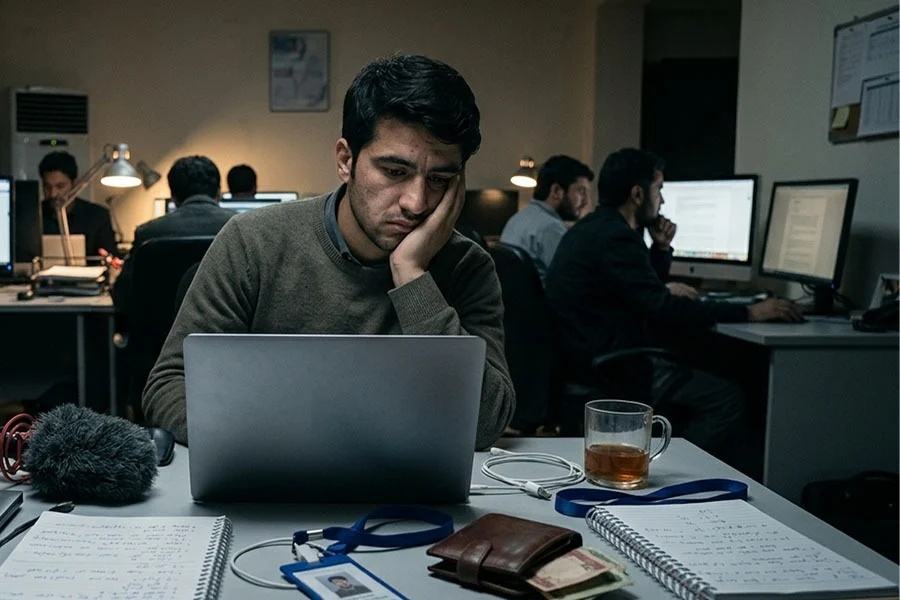
Several young people in Afghanistan complain about prolonged internship periods in the media and the absence of a clear prospect of permanent employment. They say limited job opportunities and rising poverty and unemployment have forced many young people to keep working for long periods on meager pay, or no pay at all, despite having skills and experience. In their view, an internship should provide a foundation for learning and professional growth, not a means of exploiting young people’s labor. They therefore say media outlets should take employees’ skills, expertise, and level of experience into account when setting salaries and benefits.
Samir (pseudonym) says the restrictions and shortage of job opportunities in the current circumstances have forced some people to complete an internship a second or even a third time in order to find a path to employment.
He says: “Because I lacked sufficient work experience, I worked as an intern for six months. People are usually expected to find a path to permanent employment in the media once they complete their internship, but in the current circumstances, because of the restrictions and shortage of job opportunities, some people have no choice but to go through this period a second or even a third time.”
Sahar (pseudonym) says a number of media outlets make use of the opportunities and abilities of interns and employees without offering them suitable financial compensation for their work. According to her, at a time when poverty and unemployment have spread across Afghanistan, and job opportunities have shrunk, it is unfair to use labor without paying a salary or while paying a meager wage, and media outlets should pay employees based on their abilities, skills, and work experience.
She says: “Most media employees, because of the limited job opportunities, especially for women, have no choice but to work for very low pay or to keep working as interns without suitable financial benefits. This situation is getting harder by the day, because the economic conditions of media outlets have also worsened and their ability to pay employees a decent salary has declined.”
Taqwa (pseudonym) says with regret that experienced journalists with professional skills sometimes, because of their need for work and the lack of job opportunities, are forced to take on, once again, as unpaid interns, responsibilities that are in fact the duties of specialized and professional staff.
She says: “Unfortunately, one of the serious problems in the media environment is the exploitation of the passion and enthusiasm of journalists and media employees. Many people, despite having work experience and professional skills, strive to advance the activities of media outlets, but because of economic problems and the lack of job opportunities, they are forced to work as interns without receiving a decent salary. An internship should be a learning opportunity, gaining experience and professional growth, not a means of using the labor of skilled people without paying a salary or providing suitable financial benefits.”
Rokhsar (pseudonym) says that although a number of media outlets operate through donor-supported projects and allocate salaries for interns, in some cases these payments do not reach the interns, who continue working without financial benefits. She says: “Discrimination between permanent employees and interns, and treating them differently, can damage interns’ self-esteem and confidence and reinforce a sense of worthlessness in them.”
Omid (pseudonym) says that compulsory internships for experienced and skilled young people are one of the bitter realities of the labor market. According to him, a large number of young people, despite having skills and work experience, are forced to work as interns because of the shortage of job opportunities or their passion for their field of specialization.
He says: “An internship is not negative in itself, because learning and gaining experience are part of the process of professional growth and advancement. The problem arises when experienced and skilled young people are put to work without a salary or in return for meager financial benefits. Young people need suitable job opportunities so that they can use their knowledge and skills, achieve economic independence, and build a better future for themselves.”
Sharara (pseudonym) says young people’s passion and motivation should not become a tool for exploiting their labor. According to her, an internship should be an opportunity for learning, gaining experience, and professional advancement, not a way of abusing young people who enter the media with the hope of achieving a better future. She says: “Based on my personal experience of working in the media, unfortunately some media outlets exploit young people’s passion, enthusiasm, and need to gain work experience. Despite having skills and abilities, young people are forced to work as interns because of unemployment and the lack of job opportunities, but in many cases they neither receive a salary nor see the promises made to them at the time of recruitment fulfilled.”
Ahmad (pseudonym), who has worked as an intern at a private media outlet for nearly three years, says that during this time he has received only 1,000 Afghanis a month for carrying out his work responsibilities. According to him, every time he asks for permanent employment, the outlet’s officials cite a lack of funds as the reason for not proceeding with hiring.
He says: “Several other girls and boys and I worked at a private media outlet. In the beginning, we did not receive any salary, but after the outlet secured a financial sponsor, we were paid 50 dollars a month. However, after a number of projects were suspended, many employees were dismissed, and we were asked to continue our cooperation for free. Since I was passionate about working in the media, I accepted these conditions and continued my work.”
Meanwhile, Sediqullah Tawhidi, an exiled journalist and former head of the Afghan Journalists Safety Committee (AJSC), says the physical safety and job security of journalists is among the serious challenges in Afghanistan. According to him, a number of media outlets, in order to cut costs, hire professional and experienced journalists who have worked in the field for years as interns on meager pay, and even keep them in that position for months and years, even though these individuals have sufficient professional skills and experience.
Mr. Tawhidi says: “Journalists inside Afghanistan have neither physical security nor job security. Media outlets also lack the necessary freedom of action, and their financial resources have been severely limited. Even some outlets with greater financial capacity refrain from making large investments because of the uncertain future of media activity under Taliban rule. On the other hand, the decline in advertising revenue has also made the financial situation of media outlets more difficult.”
According to Tawhidi, journalists inside Afghanistan have no independent and accountable body to turn to for seeking justice and defending their professional rights. The Taliban also pay no attention to the situation and problems of journalists and are mostly looking to use the media for propaganda purposes.
This comes as, coinciding with the fifth anniversary of the Taliban’s takeover of Afghanistan, several journalists and media employees told the Hasht-e Subh Daily that the restrictions imposed by the group have severely narrowed the space for media activity over the past five years. They added that censorship, limited access to information, a ban on criticism, and fear of arrest have pushed journalists toward self-censorship and reduced the possibility of reporting events freely.
You can read the Persian version of this report here:
کارآموزیهای طولانی و معاش ناچیز؛ چالش جوانان در رسانههای افغانستان