The fall of governments in Afghanistan has usually meant the upending of people’s lives. When news arrives from the Arg, new worries take shape: Will next month’s salary be paid? Will the capital people have invested in their shops remain safe? Will the land deed that has been kept in a family’s chest for generations carry any weight with the new holders of power? A soldier who served for years faces revenge and death when the government changes. Professors and students who have devoted their lives to education not only lose their job prospects and watch the futures they built for themselves collapse, but are also forced to leave the country.
Afghanistan has seen many governments. Yet the more important question is not how many have come and gone, but what has become of the people who each time have had to adapt their shattered lives to a new order. Why have a family’s property, the credibility of a young person’s education and the continuity of an employee’s salary been so exposed to political upheaval? Why has a large part of society, even when the war was far from its region, been unable to feel assured about its economic and legal future?
The answer must be sought in the history of state formation and the relations of power, a history in which access to economic resources and social opportunities has often been tied to the position of individuals and groups within the power structure. Before the expansion of the centralized state, many people’s lives were run within local relations. Khans, clerics, landowners, and kinship networks played a role in resolving disputes, regulating economic relations, and providing security. In many villages, the outcome of land disputes depended on the influence of families and the standing of local elders. It is clear that these relations were not always just; a landless peasant or a family without kinship backing had far more limited means than those with influence. With the expansion of Kabul’s authority, a new apparatus cast its shadow over these same relations. The state collected taxes, conscripted soldiers, and made decisions about ownership and the administration of regions, while the power of many khans and local landowners remained intact. People found themselves at the center of authorities that sometimes cooperated with one another and sometimes competed for resources and influence.
The reign of Abdur Rahman Khan was one of the decisive moments of this transformation. After coming to power in 1880, he expanded the authority of the central state through military campaigns and the creation of an administrative and tax apparatus. In Hazarajat, the wars of the 1890s were accompanied by massacres, enslavement, forced displacement, and the widespread confiscation of land. Part of the Hazaras’ land was handed over to nomadic and migrant Pashtuns, and several people were forced to leave their homeland. The scale of this displacement and its consequences is documented in historical research, although there is disagreement over the exact number of victims.
For people whose lives depended on farmland, water and pastures, land was the economic and social foundation of the family. With the confiscation of land, the relations that had formed around it over several generations also disappeared. Those who migrated to Mashhad, Quetta, Central Asia and India had to build another life in a new environment, often with meager resources. They may have survived the war with their lives, but a return to their former situation was no longer possible for them. The confiscation of land had another consequence as well, one that outlived the decree of those who ordered it. Land handed over to a new owner gradually entered into relations of cultivation, grazing, buying and selling, and inheritance. The later generations of the displaced families, even if they remembered the name of the village, the winter quarters and the boundaries of their ancestral land, faced new difficulties in proving their right. In this way, the political decision of one era could affect the economic and social relations of the people for decades.
This experience was not confined to Hazarajat. Settlement policies and population transfers in northern Afghanistan also changed ownership relations and access to land for a number of local communities. The history of the concentration of power in Afghanistan cannot be understood without attention to these changes in land ownership and in the demographic makeup of regions. In later periods, the central state took a different course. Amanullah Khan tried to transform the state apparatus and social relations through legal, educational, and social reforms. The creation of new institutions, modern education, and changes to the laws could have opened ways to escape dependence on traditional powers. However, the speed of the reforms, social and religious resistance, and political crises made their implementation difficult. The fall of his monarchy in 1929 showed how much the fate of reforms depended on the stability of the government and the capacity of fledgling institutions. With the gradual expansion of the state under Nader Shah and Zahir Shah, schools and government offices claimed more space in people’s lives. A government salary offered new opportunities for some families; the future of all children no longer had to depend on inheriting land or continuing the father’s trade. Teaching, medicine, military service and work in the ministries gradually produced a generation of salaried people who earned their social standing through education and employment.
This transformation was not uniform across the country. In remote areas, access to schools remained difficult, and poverty, discrimination and a lack of facilities deprived many of new opportunities for advancement. Access to education and government employment was influenced not only by individual knowledge and ability, but also by people’s geographic location and social connections. As Kabul grew and the ministries expanded, the gap between those who had access to the state apparatus and the people who remained outside it appeared in a different form. The 1964 Constitution created a new space for political and parliamentary activity, but the administrative structure of the country remained centralized. Under the republic of Daoud Khan as well, broad executive powers were concentrated at the center. Government service, beyond providing a salary, became one of the paths to social standing. Acquaintances in the ministries or access to influential officials often played a role in hiring and career advancement that education alone could not. The Saur Coup of April 1978 and the wars that followed transformed the lives of this same new salaried generation. The political changes were accompanied by purges, arrests, and widespread displacement. In the villages, land reform programs and the government’s attempts to change social relations met with resistance and practical difficulties. The Soviet intervention and the spread of the war displaced millions of people and damaged a large part of the country’s economic and educational capacity. During the war, power shifted from many official institutions to military networks and local commanders. Control of trade routes, the collection of revenues, and dominance over regional resources gave armed groups a new economic standing. In some areas, protecting land or moving goods was not possible without an agreement with the local commander. Families who had migrated sometimes faced new claimants to ownership when they returned. Documents had been lost, witnesses had scattered, and the judicial system lacked the capacity to handle a large number of disputes.
After the fall of Najibullah’s government in 1992, the fighting among the mujahideen groups turned Kabul into a battlefield as well. The city that had been the center for the expansion of administration and modern education in earlier periods was now losing a large part of its capacity. Universities, ministries,s and markets suffered from destruction and insecurity. In many areas, power was divided among commanders and local networks.
During their first period of rule, the Taliban managed to bring a large part of Afghanistan under a single authority, but they governed a society worn down by years of war and migration. Sweeping restrictions on women’s education and employment reduced the economic opportunities of families. Land disputes, debt,s and wartime dependencies also grew more extensive with the change of government.
In 2001, after the fall of the first Taliban government, Afghanistan entered a new phase carrying the legacy of this devastation. The rebuilding of the state, extensive foreign aid, and the expansion of education created opportunities of great importance for the young generation. Universities expanded, media grew, and more women were able to enter higher education and professional jobs. In families where girls’ education had previously been impossible, a daughter going to university changed the outlook of life. Education was gradually becoming one of the important routes to economic independence. The structure of the new state, despite its electoral institutions and the 2004 Constitution, nevertheless remained built on a broad concentration of executive powers. The ministries in Kabul played a decisive role in the distribution of the budget and in appointments. Many commanders and local power brokers also entered the official structure, and wartime relationships found their way into electoral networks, government contracts and administrative posts.
Foreign aid created a considerable boom in parts of the economy; thousands of people found work in institutions, contracting companies and urban services. Despite these opportunities, the domestic economy could not create independent and sustainable opportunities at the same pace. Young people graduating from university often faced a market that lacked the capacity to absorb all the educated workforce. For some, having a connection to a government official or the head of an institution became more important than a university degree.
Ownership disputes continued in another form as well. The return of migrants, the rising value of urban land and the influence of the powerful made old disputes more complicated. The judicial and administrative system, despite its rebuilding, was at times under pressure from corruption and political interference. In the same years that new buildings were rising in Kabul, some families were still wandering in search of a way to reclaim their ancestral home or land.
The fall of the republic in August 2021 exposed the fragility of a large part of these economic relations. The sharp drop in foreign aid, the disruption of the banking system and the halt of many contracts put families’ incomes under pressure. In its review of the 2021 crisis, the World Bank showed that the service sector dependent on foreign aid had been severely hit and that urban income and employment had declined. The Taliban took over an administrative apparatus whose financial and executive powers were largely concentrated in Kabul. Kandahar gained an important position in the Taliban’s leadership and decision-making structure, and religious, military and personal networks, alongside the official administration, influenced the distribution of power.
The change in political relations had different consequences for those who had served in the republic’s apparatus for years, ranging from continuing work under the new conditions to unemployment, death, migration and the loss of professional standing. For women and girls, the change led to the closing of a large part of the paths that had been opened over the past two decades. Restrictions on education and work reduced the possibility of economic independence for a great number of them. According to a United Nations Educational, Scientific and Cultural Organization (UNESCO) report in August 2026, about 2.4 million girls in Afghanistan remain deprived of secondary education. Deprivation on such a scale also affects the future of the country’s human capital and society’s access to specialized services.
In this same period, the expansion of religious schools has become a priority in the Taliban’s educational structure. The significance of this development, beyond the increase in the number of educational centers, also lies in its social relations and potential employment opportunities. For young people with limited access to universities and the labor market, educational and religious networks can become a new path for building social connections, although the actual share of these networks in hiring and in the distribution of government positions requires independent study.
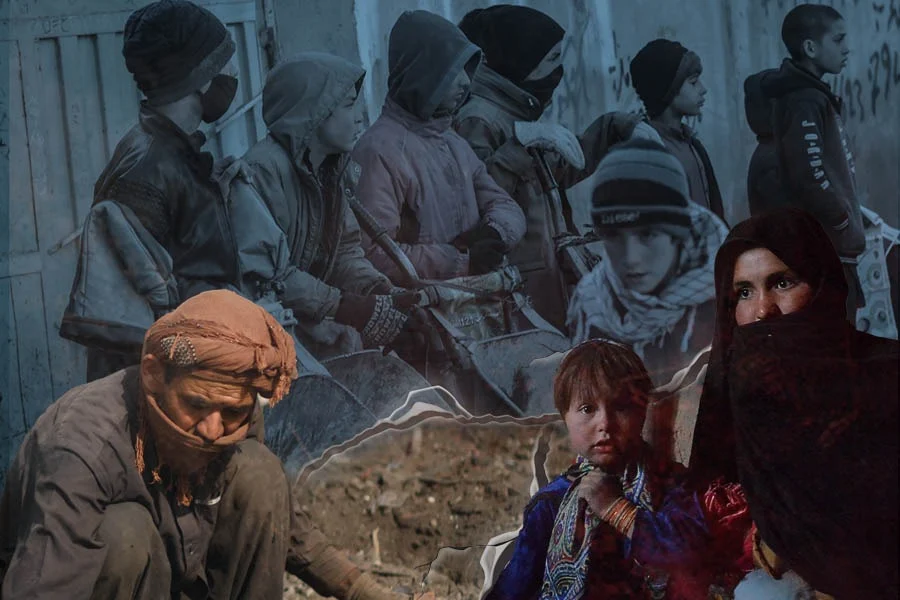
Outside the apparatus of government, people continue to rely on the methods they learned during the years of war and migration. Money exchange, hawala transfers, border trade and kinship ties keep part of the country’s economic life afloat. Remittances from abroad cover the cost of rent, medical care, and food for many families. Women, too, under job restrictions, sometimes help support their families through domestic work and small economic activities. The endurance of these efforts speaks to people’s capacity to adapt to crisis, but it cannot be regarded as a substitute for economic security.
Several decades of recent upheaval have also affected the economic behavior of society. Keeping a land deed, having a relative abroad, saving for uncertain days, and searching for a way to migrate have become part of the strategy of life for many families. These behaviors must be understood in connection with the experience of war, confiscation, unemployment, and instability. Of course, not everyone has the same means of coping with crisis; those who do not have land, capital, or relatives outside the country face more limited choices.
From this perspective, the history of Afghanistan raises a question that goes beyond the concentration or dispersal of power. The experience of the central state and local commanders has shown that without independent legal guarantees, people’s lives remain vulnerable to those in power. The independence of the judiciary, the lasting validity of ownership documents, merit-based hiring, and access to education are of fundamental importance for a society whose political order has been overturned many times.
Over the past century and a half, governments have built administrations, passed new laws, and at times provided great opportunities for education and social advancement; but wars and political upheavals have repeatedly destroyed these same achievements. What has still not been sufficiently established is people’s confidence in the durability of the rights on which they build their lives. For a family that has lost its land once, ownership is not merely holding a deed. For a young person to whom the doors of the university have been closed, education means more than simply going to school. An employee who has lost his job after years of service also knows that a regular salary brings security only when the job and its pay do not vanish at once with a shift among those in power.
Perhaps one day the history of changes of government in Afghanistan can be written without the repetition of these same worries; a time when news arrives from Kabul, and people are not compelled to feel assured about their future, to turn once again to the land deed, the meager savings and the road to migration.
Sources
- Islamic Republic of Afghanistan (2003). Constitution of Afghanistan. Ministry of Justice
- Kakar, M. H. (1979). Government and society in Afghanistan: The reign of Amir ‘Abd al-Rahman Khan. University of Texas Press.
- Encyclopaedia Iranica. (2003). Hazāra II. History.
- United Nations. (2001). Agreement on provisional arrangements in Afghanistan pending the re-establishment of permanent government institutions (Bonn Agreement).
- United Nations, Secretary-General. (2025). The situation in Afghanistan and its implications for international peace and security (A/79/797-S/2025/109).
- Salam Watandar. (2024, September 11). Over 3.6 million Afghans engaged in Islamic education, reports MoE.
- World Bank. (2025, March). Afghanistan economic monitor.
You can read the Persian version of this analysis article here: