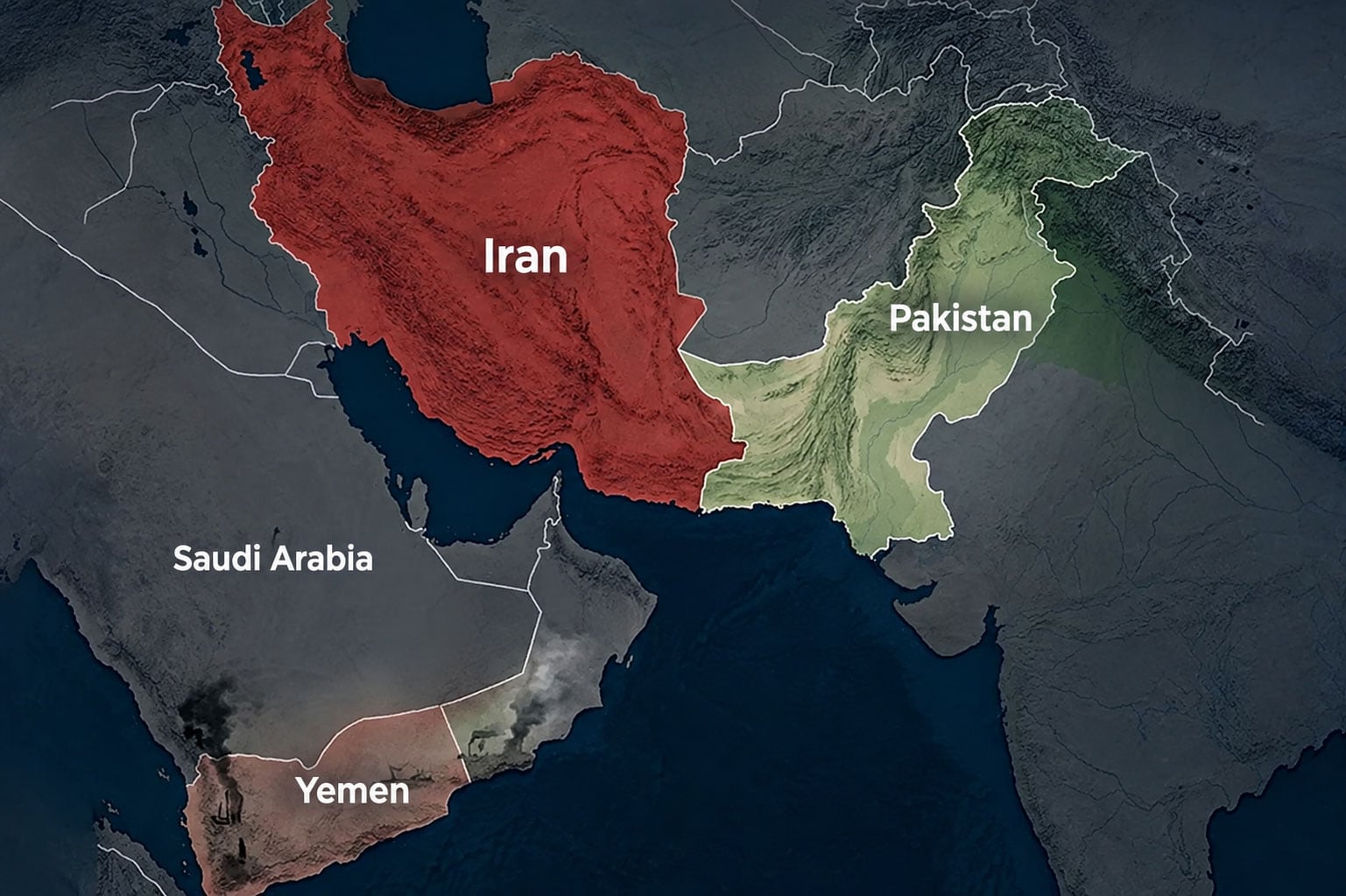
At a glance, one can see what a splendid land Yemen has been throughout history, for this land has even drawn the attention of God and His prophets. For non-Yemeni Arabs, it was a wellspring of hope and aspiration. The word “Yemen” means blessedness, goodness, and abundance.
In the Roman era, the southern part of the Arabian Peninsula was called Arabia Felix, meaning something like “Fortunate Arabia” or “Blessed Arabia.” The reason for this name had mostly to do with wealth and trade, especially the trade in aromatic goods such as frankincense and incense, a strategic and fragrant commodity. These legendary resins were the equivalent of today’s oil at that time.
So why is Yemen’s name tied to war today?
Put simply, if I were to explain the answer to this question, Yemen’s present war and crisis are the result of a combination of economic poverty, deep internal divisions, and rivalry among regional countries over this auspicious land. More specifically, they stem from severe poverty and domestic political deadlock, the rise of the Houthis, the fall of the capital (Sanaa), and the country’s transformation into a stage for proxy wars among regional powers.
What could Pakistan’s initiatives be?
Strategic clarity is very important for securing maximum interests in a chaotic and complicated situation, and this appears to be the approach Islamabad has, to some extent, followed and maintained. A significant part of this balancing approach is the same active diplomatic bridge role that we saw Pakistan play in the Iran-US negotiations.
Although Pakistan is considered a very important security guarantor, one sought by Saudi Arabia, Iran is also an important neighbor for Pakistan’s border security and national security. That is why, in 2015, during the Persian Gulf disputes, Pakistan adopted a passive approach. On 10 April 2015, Pakistan’s parliament also passed a resolution stressing Pakistan’s neutrality in the Yemen conflict.
The noteworthy point was that the resolution did not merely state that Pakistan would not take part in the war, but emphasized: “Pakistan should maintain its neutrality in the Yemen conflict so that it can play an active diplomatic role in ending the crisis.”
Now,w the Yemen crisis, especially the Houthi attacks on Saudi Arabia, has placed Islamabad in another delicate position, despite the “Mecca Pact.” Here I will point out several specific matters:
1- It is obvious that Saudi Arabia is an important strategic, economic, and defense partner for Pakistan. On the other hand, the Houthis are a unique non-state actor for Islamabad. This group may be dependent on and a follower of the Islamic Republic in theoretical or philosophical terms, or in terms of weaponry, but at the same time, the group consists of committed jihadists and skilled fighters.
For example, the bitter experience of foreign and contracted forces backed by the United Arab Emirates in the Yemen war is worth considering. Despite their training and equipment, these forces faced hard battles and heavy casualties in confrontations with the Houthis. Given this, Pakistan has understood better than any other country on the Persian Gulf rim that the Houthis can drag it into a costly, medium-term war of attrition. That is why it is trying to adopt a passive yet diplomatic approach.
2- Mohammad Amir Rana, a columnist on security affairs for the daily Dawn, claims in an article published on 20 September that the prevailing perception in the Balochistan border region is that if Iran can use the Houthis as a proxy force against Saudi Arabia, it should expect a similar reaction from the Saudis. Rana warns that such a perception exists in the Balochistan border region and that the spread of regional conflicts could further complicate Pakistan’s fragile security equations.
3- Given that Pakistan shares more than 900 kilometers of border with Iran, it is in dire need of cooperation with the Islamic Republic of Iran. In fact, the conclusion of the Mecca Pact originates from Islamabad, because fear of the formation of a security and economic belt centered on Israel and India can be seen in Pakistan’s conduct and behavior. Iran is deeply engaged in confrontation with Israel, and Pakistan wants to use this situation and strategy to its own advantage.
4- Reuters reported on 2 October, citing a Pakistani official, that Pakistan has deployed between 30,000 and 40,000 military personnel in Saudi Arabia to defend the country. These forces are not necessarily newly dispatched. According to the Pakistani source cited by Reuters, these forces have entered Saudi Arabia in several phases since last year, and some of them were sent after the recent escalation. However, Pakistan’s Ministry of Defense, Army,y or Foreign Ministry has not yet announced or confirmed the figure of 30,000 to 40,000 troops in an official statement.
5- Under the Mecca Pact, Pakistan and Turkey may increase their level of support for Saudi Arabia against external actors such as the Houthis, and this is entirely natural in Saudi Arabia’s strategy. Pakistan is trying to keep a low profile in the conflict between Riyadh and the Houthis, because the risk to Islamabad’s interests in these conflicts is very high, and on the other hand, it does not want to drift further from Tehran.
6- Islamabad is trying to apply the same balancing scenario in these crises, rather than entering into direct military confrontation with the Houthis. It appears that Pakistan is once again testing the same policy it adopted toward the Yemen war in 2015: neither distancing itself from Saudi Arabia, nor entering directly into war with the Houthis, nor cutting communication channels with Tehran, but maintaining a balance among security commitments, economic interests and geopolitical considerations.
You can read the Persian version of this analysis article here: