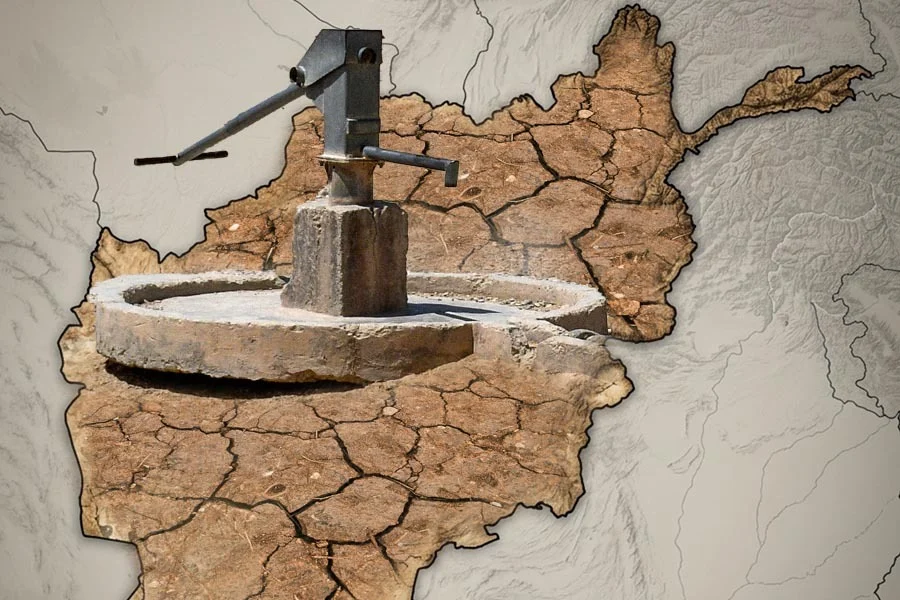
I write this article as an urgent, expert warning. For years, I have spoken in national and international newspapers and in audio and visual media about the danger of Kabul’s water resources running dry. The Mercy Corps report (now Prosper Global) of April 2025 projected 2030 as the endpoint. But new realities, including the return of millions of migrants, rapid high-rise construction, accelerating climate change, inefficient consumption patterns, and heavy losses in the urban water transmission network, have brought this date forward by one year. Calculations based on statistics show that Kabul’s “Day Zero” for water will arrive in 2029, not 2030. This piece is written not to spread fear, but to awaken the collective conscience and spur urgent action. Kabul’s future can still be saved, but the window of opportunity has become very short.
In the past day or two, domestic and international media have once again spoken of the danger of “Day Zero” for Kabul’s water by 2030. Recent reports by organizations such as Prosper Global, and coverage reflected by Afghanistan International and networks such as CNN, warn that if the current trend continues, the capital’s groundwater will run out by 2030.
I take these warnings seriously and welcome their publication. But as someone who, over the years, served as Head of Office at Kabul Municipality, Head of Environment for Kabul, and Head of Planning and Policy at the National Environmental Protection Agency (NEPA) of Afghanistan, and who has witnessed warnings, specialized reports, and field calculations at close range, I must say plainly: more precise calculations show that Day Zero will arrive one year earlier, in 2029.
This claim is not based on guesswork. Based on available data on the decline in groundwater levels (25 to 30 meters over the past decade), an annual overdraft of about 44 million cubic meters, a significant reduction in natural recharge caused by successive droughts, and rapid population growth, Kabul’s usable groundwater reserves are running out faster than public reports suggest.
Imagine Kabul’s water as a bank account. The current account, the surface water of the Kabul, Paghman and Logar rivers, dried up almost entirely years ago. The savings account, the groundwater, is also being drained at a dizzying speed. Each year, about 44 million cubic meters more water is pulled out than nature can replenish. This is like a family that keeps borrowing and assumes it will “make up for it later.” But this is nature’s account, and repaying it is difficult and in many cases impossible.
Since 2010, I have cried out in numerous articles that Kabul is heading toward a water crisis. In those years, many officials and ordinary people told me, “You are a pessimist,” and did not take the warnings seriously. Now the Mercy Corps report (April 2025) confirms that if the current trend continues, Kabul’s water will reach zero by 2030. But given the new realities, this date will be even earlier, probably 2029. Relying on scientific statistics, new causes,s and simple but precise calculations, this article warns that the time left is very short.
In 2001, Kabul’s population was under one million. Natural groundwater recharge was estimated at 28.3 million cubic meters per year, and consumption at about 12.8 million cubic meters. There was a relative balance. The aquifers had not yet been blinded. But the negligence of decision-makers during the Republic era toward uncontrolled population growth, unplanned construction, and the drilling of countless wells changed everything. In articles written years ago, I warned that if no action was taken, disaster was near. When Mercy Corps issued its 2030 warning, I wrote an article, and Ashraf Ghani Ahmadzai reacted after reading it, saying he had had plans, but the government collapsed. I wrote in reply: the reality was that mismanagement and wrong priorities during his tenure deepened the crisis. Now is not the time to shift blame; it is the time for urgent action.
The Mercy Corps report shows that Kabul’s groundwater level has dropped 25 to 30 meters over the past decade, nearly half of the wells have dried up, and the annual overdraft is about 44 million cubic meters. The city’s three main aquifers have a nominal capacity of more than 5 billion cubic meters, but only a fraction of that capacity remains usable, about 400 to 600 million cubic meters. If the baseline trend had continued, reaching zero around 2030 would have seemed reasonable. But accelerating factors have changed this equation.
Four main factors have produced this acceleration. First, the return of millions of migrants: since 2025, more than 2.6 to 2.8 million people have returned to Afghanistan from Iran and Pakistan, and projections indicate the trend will continue. A significant portion of this population has chosen the capital, with estimates suggesting an increase of more than one million people in Kabul. Tens of thousands of internally displaced people have also moved to Kabul because of drought and unemployment. This population growth has increased water consumption by at least 1.5 times and sharply raised pressure on the wells. With this rise in demand, the annual overdraft can easily climb from 44 million to 55 to 60 million cubic meters or more.
Second, rapid construction and high-rise development: the Taliban-run municipality has issued permits for high-rise buildings (up to more than 10 floors) in residential areas with specific aims. In the ordinary houses of the past, one family lived with limited consumption; now, on the same plot of land, dozens of families reside. Extensive concrete pouring has reduced the infiltration of rainwater, increased population density, and multiplied water consumption several times over. This policy, carried out without hydrological planning, brings the disaster closer.
Third, accelerating climate change: the rapid melting of Hindu Kush glaciers, reduced winter precipitation (in some years only 45 to 60 percent of the average), increased evaporation, and sudden flash floods have reduced natural recharge. Warming in Afghanistan’s highlands is twice the global average, and successive droughts have affected millions of people. The rivers that should recharge the aquifers are themselves facing shortages.
Fourth, a culture of inefficient consumption among many returnees who are unaccustomed to water scarcity and use water uneconomically. This factor alone has significantly increased household consumption.
With these factors, the annual deficit has clearly grown beyond 44 million cubic meters. If we conservatively assume usable reserves of 500 million cubic meters and take the baseline overdraft as 44 million, it would take about 11 years. But with the 1.5-fold increase in demand caused by migrants and construction, the overdraft reaches about 60 to 65 million cubic meters. Dividing 500 by 60 to 65 gives roughly 8 years. From 2021 (when the sharp acceleration began) to 2029 is exactly this span. In central areas such as Dasht-e Barchi, Qala-e Fatullah, Taimani, Shirpur and Khwaja Rawash, this time will be even shorter.
Pollution has also made drinking water unusable: up to 80 percent of groundwater is contaminated with sewage, arsenic and nitrates, increasing diseases, including cancer and digestive problems. Land subsidence, about 31 centimeters in some areas in recent years, threatens houses, pipes and even historical sites such as Babur’s Garden and Darul Aman. This subsidence permanently destroys the empty spaces of the aquifers and makes recharge impossible.
In addition, water reaches Kabul through the urban water supply network. Flawed management of water transmission into the city has caused many secondary and aging pipes to deteriorate. This deterioration has sharply increased water losses along the transmission route, and because most of these pipes are old and lead-based, they also contaminate the water. In this way, even the water that reaches the city is partly lost before it reaches consumers or loses its quality.
Many citizens say: “We used to dig 40-meter wells; now it is 150 to 200 meters and sometimes 300 meters. The water is salty and foul-smelling, and tankers are expensive.” Families spend up to 30 percent of their income on water, and children and women suffer the most. Only about 20 percent of households have access to piped water.
A critical warning: people should not take comfort in the idea that transferring water from Panjshir, Logar, Band-e Shah-e Arus or Shahtoot is the final solution. Climate change is so severe that in the coming years even farmers in Panjshir, Kapisa, Logar and Parwan are facing water shortages. Tension between upstream and downstream communities can easily turn into conflict, and residents of those provinces will not allow the transfer. Global experience shows that inter-basin water transfer without demand management at both source and destination is never sustainable.
There is no sustainable solution for Kabul’s water other than circular consumption and careful management of the city’s own resources. To prevent Day Zero in 2029, immediate conservation is needed: each person should consume at least 20 liters less. Installing low-flow taps, door-to-door campaigns, and education in schools are essential. Tehran’s experience with tiered tariffs and penalties for heavy consumers is a good model. Artificial recharge through absorption wells, infiltration basins, dredging of the Kabul River, and recycling of treated water should be given priority. Expanding green space and urban wetlands to capture local rainfall and reduce runoff, strict laws and oversight to completely ban illegal wells (there are more than 120,000 unauthorized wells), control of construction and fair water tariffs, and smart tax policy to encourage low-consumption water appliances and penalize high-consumption ones are other necessary measures. Public awareness and citizen reporting on well depths and ground cracks are also important.
If every citizen, mosque, school, and media outlet cooperates, the annual deficit of 44 to 60 million cubic meters can be made up. Otherwise, the future will turn against the citizens of Kabul, and the city will be left without inhabitants.
Conclusion
Kabul is drowning in a water crisis. My warnings since 2010, the Mercy Corps report, and the new realities (population, construction, climate, consumption, and transmission network losses) show that Day Zero may be 2029, not 2030. This article is scientific; it is based on statistics from Mercy Corps reports, UNICEF, satellite data, and simple calculations of the water deficit. The bank account analogy shows the reality precisely: income (recharge of about 28 million cubic meters) is far lower than expenditure (now more than 70 million cubic meters), and the balance is running out.
If we do not act today, tomorrow will be too late. Kabul must not become the world’s first modern capital without water. People and officials, let us get to work. The future can still be saved, but time is very short.
Sources
- Mercy Corps / Prosper Global report, April 2025 (Kabul water crisis)
- UNICEF reports and projections on population displacement
Satellite data and United States Geological Survey (USGS) studies on groundwater decline and land subsidence - The author’s previous articles on Kabul’s water and environmental crisis
- United Nations (UN) and World Bank reports on the return of migrants (2025-2026)
- The author’s field observations and expert calculations based on available data
You can read the Persian version of this article here:
کابل بهسوی روز صفر ۲۰۲۹: هشدار فوری یک کارشناس که سالها نادیده گرفته شد