A study examining the representation of gender, roles, attributes, and the social identity of women and men in textbooks published under the Islamic Republic of Afghanistan has found deep gender gaps in these books.
The new findings come at a time when women under Taliban rule face widespread challenges. Reports also indicate that the Taliban are planning to remove subjects such as women’s rights, gender equality, and human rights from textbooks, a move that could further deepen gender inequalities across different sectors of society.
The research was conducted at the Georg Eckert Institute for International Textbook Research (GEI), the largest specialized institution for textbook studies, and examined all Persian-language textbooks. In addition to the textbooks, the study reviewed three key educational policy documents of the Ministry of Education (MoE) to determine the extent to which the commitments made in those policies were reflected in the content of the textbooks.
According to the study’s findings, the government had pledged in official documents to combat inequalities in the political, economic, cultural, and social spheres, and to promote equality between men and women by developing textbooks with a gender-inclusive approach. This commitment was strongly emphasized in all educational policy documents.
The study states: “Emphasis on gender-inclusive content, the presence of female characters alongside males, the empowerment of women through education, and the inclusion of women’s rights in textbooks formed one of the main pillars of the education policy aimed at reducing gender gaps in various fields.”
In theory, textbooks with gender-inclusive content are considered an important tool for reducing gender inequalities, while biased content can perpetuate them.
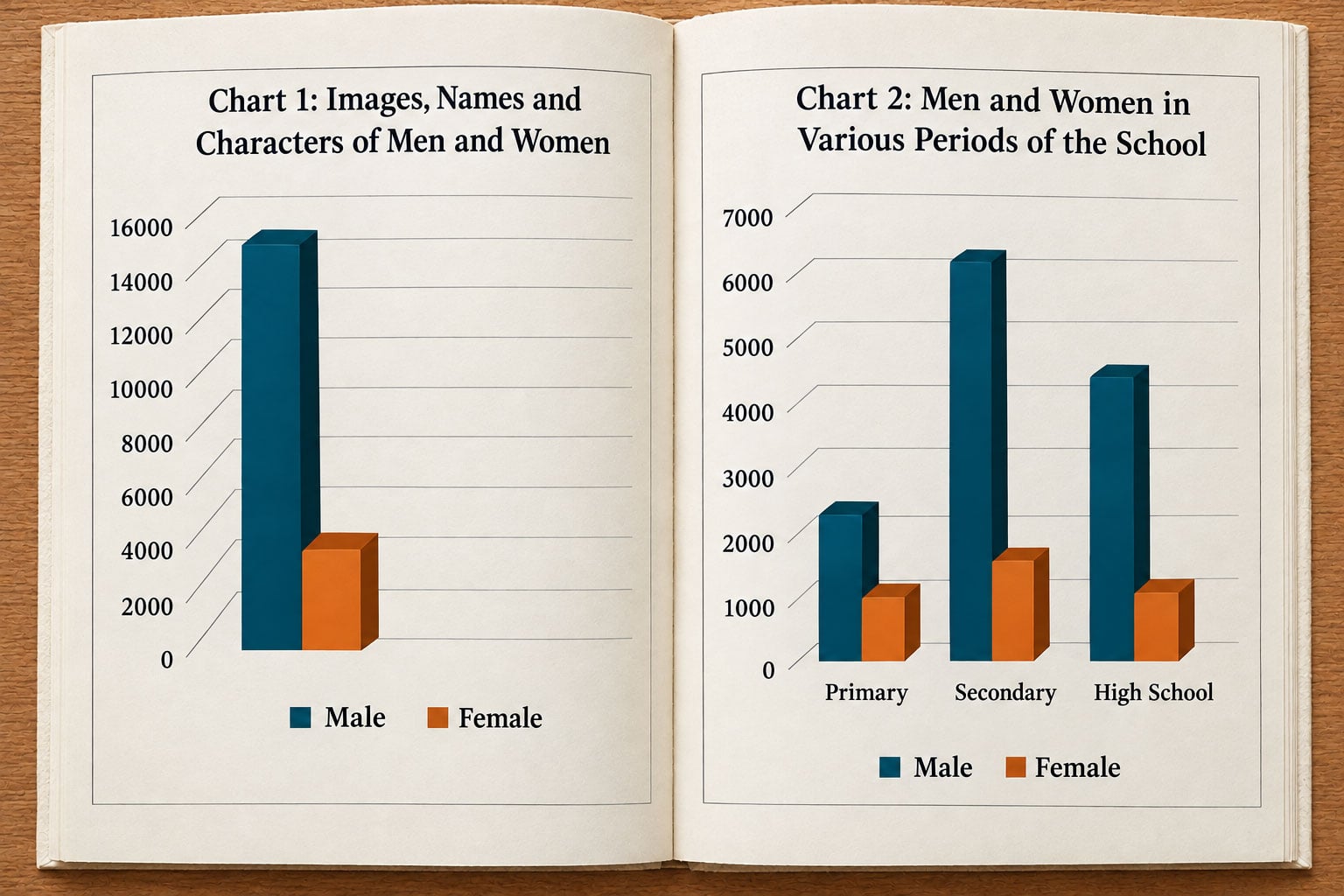
The findings show that the textbooks are heavily biased in their representation of women. According to the findings, 78 percent of all characters and names mentioned in the textbooks are male, while only 22 percent are female (see Chart 1).
The textbooks also contain 1,047 images of men and only 467 images of women. In other words, the number of images of men is more than four times that of women. Regarding the limited presence of women in the textbooks, the study states: “The authors of the textbooks have effectively portrayed a country in which women play only a marginal role.”
The findings also show that the gender gap is smaller in primary school textbooks but increases sharply in middle school and high school. For example, the disparity is only 7 percent at the primary level, but rises to 20 percent at the middle school level and 40 percent at the high school level (see Chart 2).
In terms of images, too, the number of images of men at the primary level is more than three times that of women. This gap grows to five times at the middle school level and to more than nine times at the high school level (see Chart 3).
Alongside the presence of men and women, the study also analyzed the activities, attributes (ascriptions), and interactions (relationships, or actions and reactions) assigned to male and female characters. In total, twelve categories of activities, attributes, and interactions were identified in the textbooks.
The findings show that the activities assigned to men are far more diverse than those assigned to women.
The study states: “For example, among the 12 types of activities identified, women’s participation in politics is almost negligible compared to men. Men account for 97 percent and women for 3 percent.”
The analysis shows that women’s share in all activities, except for those inside the home, is less than 20 percent, and in some areas falls below 10 percent (see Chart 4).
Likewise, male characters dominate all types of interactions. The largest gaps and differences are observed in the areas of governance, leadership, scientific activities, and violent interactions, areas in which women are almost completely absent (see Chart 5).
These findings show that women have been largely excluded from activities outside the home and from participation in social, political, and economic spheres. Women rarely appear in politics, business, and scientific activities, and are less often described with attributes such as leadership, management, financial capability, or technical and professional skills.
They are also mostly portrayed as lacking wealth, financial capability, and decision-making or leadership power. By contrast, women are more often shown in the home, performing tasks such as cooking, cleaning, and child care.
The findings also show that gender gaps in terms of activities, attributes, and interactions are smaller in primary school textbooks, but become significantly deeper and broader in middle school and high school.
According to the study’s results, in middle school and high school, the textbooks increasingly highlight prominent male figures, including politicians, warriors, kings, writers, poets, religious leaders, scientists, merchants, and heroes, while characters attributed to women decrease dramatically (see Graph 1).
The results of the study show a deep gap between promise and practice. In official educational documents, the MoE repeatedly emphasized developing textbooks with a gender-inclusive approach, but the textbooks that were produced are heavily biased.
Link to the full study:
Report 1: https://doi.org/10.1080/00220272.2025.2506429
Report 2: https://doi.org/10.3167/jemms.2024.160204
You can read the Persian version of this article here:
پژوهش از حرف تا عمل؛ کتابهای مکتب دارای شکافهای عمیق جنسیتی هستند