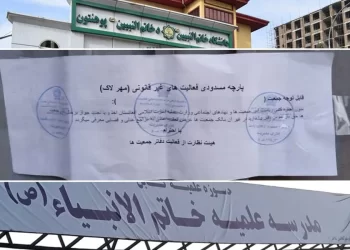
On September 16, the Taliban in Balkh province ordered the complete shutdown of fiber-optic services under the pretext of “preventing immorality,” immediately cutting Afghan Telecom’s services in Kandahar as well. Reports suggest similar restrictions have begun in Helmand, Herat, Uruzgan, and Nimroz. In a country already isolated from the world, the Taliban are now severing its last digital lifeline.
This is not merely a question of censorship; it is an act of self-sabotage against both society and the economy. Every switch turned off reduces productivity, cuts household income, wipes out small businesses, and closes the last remaining avenues of education, employment, and public voice for women and girls.
A Fragile Digital Infrastructure
Afghanistan’s digital backbone was already extremely fragile. By early 2024, internet users accounted for less than 20 percent of the population, with most people forced to rely on slow and costly mobile internet. The economy, valued at roughly $17 billion, remains weak, dependent on foreign aid and remittances from migrants. For women barred from secondary education and most forms of employment, the online space had become their only classroom, workplace, and public forum.
Signs of an Expanding Ban
Taliban officials claim they are only cutting fiber or fixed-line internet, yet local sources in Kandahar reported that Afghan Telecom’s mobile services also went down on Tuesday. These accounts have not been fully verified, and it remains unclear whether private companies’ SIM cards were also disabled. If confirmed, the ban would extend far beyond fiber optics to a full-scale shutdown of mobile networks, an escalation that would multiply economic, educational, and social losses.
Pathways of Economic Damage
The economic fallout from these restrictions is evident on several fronts:
Loss of productive capacity: With fiber and possibly mobile networks shut down, families, clinics, and businesses are forced to rely on prohibitively expensive and unreliable alternatives. This inefficiency delays transactions, disrupts workflows, and leaves tasks unfinished.
Collapse of small businesses: Street vendors, service providers, freelancers, and online teachers lose the ability to operate. The blackout severs their access to markets, clients, and income.
Erosion of financial inclusion: As remittances, mobile money, and digital payments become more unstable, trust in these tools erodes. People are pushed back toward cash-based transactions, slower, riskier, and more costly.
Loss of Human Capital: Girls who depended on online learning once again face a locked door. This deprivation inflicts long-term, irreparable damage on their skills, education, and future earning opportunities.
Decline in Revenue and Investment: With internet access cut, companies such as Afghan Telecom and private providers lose a major portion of their income. As a result, the country’s already fragile tax base erodes further, and incentives for both domestic and foreign investment sharply decline.
Slower Delivery of Aid: Humanitarian agencies rely heavily on the internet to coordinate and implement their programs. Restrictions delay the delivery of assistance and increase the risk that women and other vulnerable groups will be overlooked.
Flight of Capital and Talent: Students, freelancers, and businesses dependent on digital platforms are forced to migrate either to other regions or abroad to preserve their opportunities. This trend severely undermines local growth and development capacity.
Rise of Informal and Illegal Channels: With official digital pathways shut down, people resort to illicit financial routes, eroding transparency and undermining the trust of aid organizations.
Women and girls in the darkness
For Afghan women and girls, the ban is not only an economic blow but also another attempt to erase them. The internet was their last open window, a gateway to education, work, and connection with the outside world. Closing that window means fewer opportunities and deeper censorship of their very existence. For girls confined within their homes, the digital space was the only outlet to breathe; now even that is disappearing.
Empty Promises of a “National Network”
The Taliban insist they will build a national network to serve domestic needs. But closed networks suffocate market freedom, innovation, and competition. Such systems are typically expensive, inefficient, and unreliable. Building one requires capital, technical expertise, and supply chain resources that the Taliban do not possess. Far from offering opportunity, such a network would function as a cage of control.
In Afghanistan, internet access is not a luxury; it is the last active marketplace of ideas, skills, and livelihoods, especially for women. Cutting it off means destroying the country’s economic future, not safeguarding morality.
The Taliban stand before a stark choice: either double down on social isolation to tighten their grip on power, or allow connectivity to grant Afghanistan a measure of prosperity. They must realize that today’s Afghanistan is not the Afghanistan of 1995, and it can never return there.
You can read the Persian version of this analysis here:
افغانستان در مسیر انزوای دهه نود؛ ممنوعیت طالبان بر انترنت، خنجری بر پیکر خود و اقتصاد