Sometimes a regime cannot be understood only through its trenches; its signatures must also be followed.
Resistance is not defined only by mountains and battlefields, just as power is not confined to the gun. Every government that seeks to endure needs money, trade, investment, contracts, banks, transit routes, and ultimately an image of “normalization.” The Taliban is no exception. If its opponents focus only on the group’s military structure while ignoring the network that generates revenue, external connections, and economic credibility for it, they will miss an important part of the reality of power in Afghanistan today.
In my previous article on a “new strategy of resistance,” I argued that today’s conditions are different from those of the Taliban’s first period in power. A large part of the human, political, and professional capacity of the opposition left the country after 2021, and many of the networks that once made political and social organization possible are no longer available with the same strength. Under such conditions, resistance cannot be understood only through its military dimension. The legal, economic, media, and information arenas have also become increasingly important. One of the most significant areas in this broader struggle is the contracts the Taliban signs with foreign companies and investors.
Scrutinizing these contracts does not mean opposing investment. The questions are different: Who signed the contract, and with what authority? Where is the money coming from? What is Afghanistan’s share? Who is the ultimate owner of the company? Which intermediaries were involved in the negotiations? And what obligations are being created for future generations?
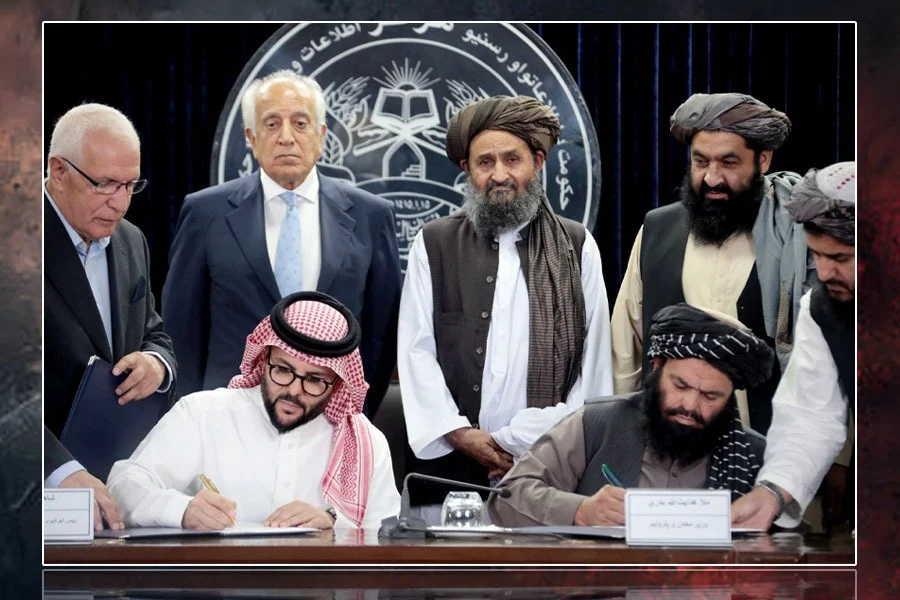
A recent example is the Kashk–Tirpul oil and gas contract in western Afghanistan. On 7 September 2026, the Taliban’s Ministry of Mines and Petroleum signed an agreement with the Saudi company Delta International for the exploration and extraction of oil and gas in Herat and Badghis. The ministry announced an initial investment of approximately $200 million, an eight-year exploration period, and a 25-year contract.
This agreement was not signed with the government of Saudi Arabia, but with a private Saudi company. That distinction should be preserved carefully in both political and legal discussion.
Khalilzad: Between Politics and Business
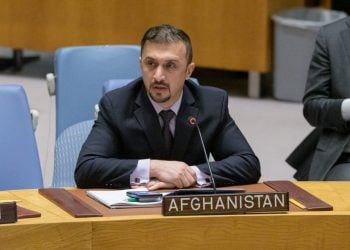
One of the notable aspects of this agreement is the presence of Zalmay Khalilzad. He did not appear only at the final signing ceremony. On 24 October 2025, when the chief executive of Delta International met Mullah Abdul Ghani Baradar to discuss gas exploration, extraction, and the development of transmission pipelines, Khalilzad was also present. He later attended the September 2026 signing ceremony and spoke about the importance of investment and Afghanistan’s readiness for business.
The first issue is the political effect of his presence. Khalilzad is the same diplomat who, as the U.S. Special Representative, led the negotiations that resulted in the Doha agreement with the Taliban. The U.S.–Taliban agreement was signed on 29 February 2020, and the U.S. government subsequently followed its implementation through Khalilzad’s office.
Today, however, his status is entirely different. In response to his recent trip, the U.S. State Department has said that Khalilzad is no longer a U.S. government employee, does not represent Washington, and acts in a personal capacity.
For that reason, the presence of a former senior American diplomat alongside Taliban leaders and foreign investors can have symbolic and economic value for the Taliban. It shows that figures who once operated at the highest levels of U.S. policy are now appearing in Kabul alongside its commercial deals. Some analysts have also examined his recent presence in the context of the Taliban’s efforts to attract investment and advance external normalization.
After his periods of government service, Khalilzad entered the private sector and founded Gryphon Partners, a consultancy that advises clients on commercial opportunities in difficult and emerging markets. This activity was not merely theoretical. In 2011, Khalilzad’s firm represented Tethys Petroleum in a competition for an oil contract in northern Afghanistan, and he himself publicly wrote about his client’s loss in that tender. His son, Alexander Benard, was also involved in the management of Gryphon.
The fact that Khalilzad has both a deep political history in Afghanistan and a record of commercial activity related to investment and natural resources makes questions about his present role legitimate.
The question is this: What exactly is Khalilzad’s role in these negotiations? Who brought him into the process? Is his role purely political and advisory, or is there also a contractual relationship? And if there is a commercial relationship, what are its terms and interests?
In 2014, Khalilzad’s name also appeared in a financial investigation concerning the transfer of approximately $1.5 million and business activities in Iraq and the United Arab Emirates. Austrian authorities temporarily froze accounts belonging to his wife. The Vienna Higher Regional Court later lifted the freeze because of insufficient evidence, and no criminal conviction against Khalilzad resulted from that case. It would therefore be incorrect to present that investigation as “proof of corruption.” Its significance lies only in demonstrating the long history of Khalilzad’s commercial activities and the fact that politics and business have at times operated alongside one another in his career.
The central issue, however, is not Khalilzad. He is only one example of the point at which politics, influence, and capital can intersect.
For every major contract involving oil, gas, mining, electricity, water, railways, or infrastructure in Afghanistan, similar questions should be asked: Where is the full text of the agreement? Was there a competitive tender? How were the resources valued? What royalty or revenue share does Afghanistan receive? Into which accounts will the money be transferred? Who is the ultimate beneficial owner of the company? Who acted as an intermediary? What environmental obligations exist? And in which court or arbitration forum would a future dispute be settled?
These questions are not an argument against investment. Afghanistan needs capital, energy, industry, responsible extraction, and employment. The essential distinction is between transparent investment and the long-term commitment of public resources without effective oversight.
The Taliban has no elected parliament or electoral system, while media freedom and political participation are severely restricted. In such an environment, a 25- or 30-year agreement over natural resources cannot be treated simply as an ordinary commercial transaction. It is an obligation whose consequences may also confront future governments.
Foreign companies should therefore take one fact into account: Afghanistan did not begin with the Taliban, and it will not end with the Taliban.
This does not mean that every contract concluded during Taliban rule is automatically invalid. International law contains no such simple rule. International legal precedent even shows that the lack of recognition of a government does not, by itself, invalidate all of its obligations. At the same time, issues such as corruption, fraud, manifest lack of authority, or violations of fundamental legal rules can affect the validity of a legal commitment.
Some contracts may therefore continue in the future. Others may be renegotiated. Still others, where sufficient legal grounds exist, may become subject to termination, invalidation, or even claims for compensation.
One of Afghanistan’s recurring problems has been that, with every change of government, part of the country’s administrative memory also disappears. The next government is then forced to discover from the beginning who signed which contract, what obligations were undertaken, and which resources were committed.
From the perspective of future governance, the creation of an independent archive of public contracts and obligations concluded during Taliban rule could therefore be highly important: mining, oil, gas, energy, land, water, transmission lines, and major infrastructure agreements, together with the contract text, the parties involved, company ownership, value, duration, intermediaries, and all publicly available documentation.
Within such a framework, the role of individuals such as Khalilzad should also be assessed through evidence rather than slogans or accusations.
The Taliban should not be observed only where it possesses armed force. It should also be observed where it sits at the negotiating table, commits the country’s resources for decades, and uses foreign investment to project an image of normalization for its rule.
And with regard to intermediaries, one principle should remain clear: political influence, diplomatic history, and commercial interest may converge at a single point. But determining whether they actually have converged is a matter for evidence, not speculation.