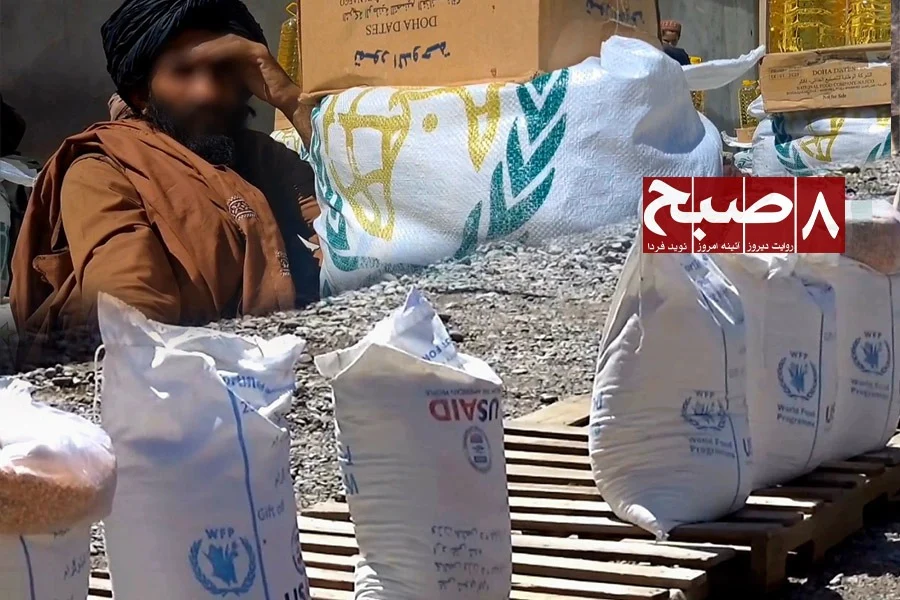
Families in Zabul province say the Taliban are interfering extensively in the distribution of humanitarian aid and channeling it to their own relatives and affiliates. According to residents of Qalat, the capital of Zabul, the people responsible for distributing aid are forced to coordinate with the group out of fear of the Taliban, and they end up delivering aid to ineligible people instead of those in need.
Sher Mohammad Zabuli, a resident of Qalat city, says the aid that arrives in the province in the name of needy people is not distributed properly. He says that from senior Taliban members to lower-level individuals, many are involved in the distribution process and arrange for themselves and their affiliates to receive humanitarian assistance.
Mr. Zabuli says he has personally seen that, during aid distribution, staff of humanitarian organizations and members of the relevant committees register people who have close ties with the Taliban to receive aid.
This Zabul resident adds: “Of all the aid that comes in the name of the needy, only half is distributed to those in need, and the rest is given to those who have connections.”
Aid distribution committee
Meanwhile, a source in the Zabul Department of Economy, who did not want his identity disclosed, told the Hasht-e Subh Daily that all humanitarian aid is distributed through a specific committee made up of Taliban members, and that this committee identifies needy families. According to him, every organization that assists people in Zabul carries out the entire process, from surveying and identifying the needy to delivering the aid, under the supervision of the designated committee.
The source adds that the committee that selects people to receive aid includes one member from the Taliban’s Department of Economy, one from the Taliban’s Department of Intelligence, one representative from the office of the Taliban governor, one representative from the group’s sectoral department, and two representatives from the donor organization.
According to the source, 90 percent of the members of the committee established by the Taliban to oversee and advance the aid distribution process are individuals affiliated with the Taliban, and for this reason, all aid is given to people who support the Taliban.
The source says: “The entire process of every type of aid from organizations is under Taliban control. During distribution, the Taliban take all authority into their own hands and register people according to their own wishes.”
A member of a committee that distributes aid to people in Zabul says all the members of this committee try to make sure that no one who served under the former republic government receives aid. He says there have been repeated uproars and verbal disputes inside the committee over this issue, because the donor organization conducts its survey without discrimination, but the pro-Taliban members of the committee register people to receive aid who are either members of Taliban families or are affiliated with the group.
This member of the aid distribution committee in Zabul says: “The committee that has been established is mostly made up of Taliban. In the field, we have repeatedly argued with one another over the fact that pro-Taliban individuals give this aid to people who are either fully Taliban or who look physically like the Taliban. The people who are members of our committees have all been chosen by the heads of the departments. For this reason, the aid we distribute in the field is also controlled by these same people, and the orders of the department heads are also accepted in it.”
Meanwhile, families currently living in Zabul province who are in very difficult economic conditions also criticize the Taliban’s interference in the humanitarian aid distribution process. They say they have seen the Taliban distribute aid meant for the needy among their own relatives and people who do not deserve assistance.
Bibi Zahra, a resident of Qalat city who is responsible for the care and living expenses of her four children, says she is living in severe poverty and that villagers give her dry bread to feed her children. She says the aid that arrives in the province in the name of the needy is distributed among the relatives and associates of the Taliban rather than among the poor like her.
This woman strongly criticizes international aid organizations in Afghanistan, saying these organizations have no control over the process of delivering aid to people and that the entire process is in the hands of the Taliban.
She adds: “Nothing reaches the poor. For three months, my life has been getting by on my neighbors’ dry bread. The villagers bring me bread every night, but some time ago the Red Cross was distributing aid here, and they did not register the name of any of us. In our village, they registered people, none of whom deserved aid.”
Gul Akhtar, a resident of Shahjoy district in Zabul province, says that in this district too, aid is occasionally distributed by the Taliban and humanitarian organizations, but according to him, the designated committees give this aid to people who are favored by the Taliban. He says corruption is greater in the districts than in provincial capitals, because Taliban district governors interfere directly in the distribution of this aid and take their own share of it.
This resident of Shahjoy says: “Wherever aid is distributed, whether a person is rich or poor, they first consider their own share. In the districts, the Taliban district governors take everything. The people who come to identify and register the poor have no authority, because all responsibility is taken away from them.”
A staff member of an aid organization in Zabul province also confirmed to the Hasht-e Subh Daily that in many cases, aid is given to people who are less in need than the many poor and needy families that exist in society.
This staff member says that the personnel of domestic and foreign organizations currently working in Afghanistan, particularly in Zabul province, are compelled to accept many of the Taliban’s orders to carry out their work, and to place the aid process in the hands of the group. He says the greater the Taliban’s interference in the aid distribution process, the higher the likelihood of corruption.
He adds: “Every organization tries to implement the project it has obtained successfully in the field. To achieve this goal, every organization puts all of its authority in the hands of the local Taliban administration. If it does not do so, the next day the organization’s activities face obstacles and delays. The more organizations affiliated with the Taliban that become our partners in this process, the more corruption there is.”
The United Nations Office for the Coordination of Humanitarian Affairs (OCHA) had previously announced that it had recorded 30 incidents of interference in the delivery of humanitarian aid. The organization said that from July to September of this year, 30 incidents of interference in the provision of humanitarian aid were recorded, of which 16 related to interference in the implementation of programs, 12 related to violence against personnel and facilities, and two related to obstruction of the movement of personnel and the transport of goods.
You can read the Persian version of this report here:
مداخله طالبان در روند توزیع کمکهای بشردوستانه در زابل؛ نیازمندان محروم میمانند