Over recent decades, climate change has moved beyond being a scientific and environmental issue and has become one of the most important questions in global politics, the international economy, human security, and relations among great powers. One of the key international mechanisms for managing this crisis is the annual United Nations (UN) climate change conferences, known by the acronym COP. COP stands for Conference of the Parties.
The UN Climate Change Conference (COP) is the largest international gathering for negotiating and advancing global cooperation on climate change, and it has been held annually since 1995. Representatives of governments, international organizations, scientists, business and commerce figures, civil society institutions, environmental activists and representatives of vulnerable communities attend. By presenting perspectives, experiences and effective methods, they work to strengthen global, collective and inclusive climate action (1).
The thirty-first session of these conferences (COP31) is scheduled to begin on Monday, 9 November 2026, at the Antalya Exhibition Center in the Turkish city of Antalya, and will continue until 20 November (2). Murat Kurum will chair the conference, and Chris Bowen, Australia’s Minister for Climate Change and Energy, will chair the negotiations. Part of the COP31 program is devoted to the World Leaders’ Summit, which is due to take place on the third and fourth days of the conference, namely 11 and 12 November, and will bring together heads of state and government.
This article examines the following topics:
- The themes of COP31;
- A brief review of the factors behind the creation of the COP conferences;
- The effectiveness of the COP conferences;
- The significance of climate change for Afghanistan.
1) What are the subject and main themes of COP31?
COP31 refers to the thirty-first session of the Conference of the Parties under the United Nations Framework Convention on Climate Change (UNFCCC) (4). This convention is an important international treaty that was adopted in Rio de Janeiro in 1992 and is regarded as the parent treaty of the Paris Agreement.
The conference is expected to hold negotiations on issues such as adaptation to the consequences of climate change, reducing greenhouse gas emissions, financing climate action in developing countries, and achieving a just transition for workers and local communities. At this year’s conference, world leaders, negotiators from the member states or parties to the UNFCCC, accredited observers, business and commerce leaders, young people, climate scientists and civil society institutions are expected to take part.
The central theme of COP31 is putting climate solutions into practice and advancing the global energy transition, a transition that could create the conditions for economic growth, more job opportunities, stronger food security, improved health and safety, and access to clean and affordable energy. According to the announced agenda, several key issues will be of particular importance at this conference:
A) Reducing greenhouse gas emissions
One of the core themes of the COP31 negotiations will be strengthening countries’ commitments to reduce carbon dioxide and other greenhouse gas emissions and turning these commitments into practical, measurable action. In this framework, countries are expected to discuss raising the ambition of their climate targets, revising and implementing national emissions reduction plans, and accelerating progress toward the goal of limiting the rise in average global temperature to 1.5 degrees Celsius. However, the main challenge is not merely securing new commitments. Ensuring that earlier commitments are carried out, assessing countries’ progress, and creating effective mechanisms for accountability against the announced targets are also important. From this perspective, the success of COP31 depends largely on whether the world’s countries can narrow the gap between political promises and practical action.
B) The transition from fossil fuels to clean energy
One of the central challenges of the COP31 negotiations will be how to gradually reduce the world’s dependence on oil, natural gas, and coal and speed up the shift to clean and renewable energy sources such as solar and wind power. This transition carries environmental and economic importance, because reducing fossil fuel consumption can help curb greenhouse gas emissions and combat global warming. However, this is not merely an environmental matter; it also has geopolitical and strategic dimensions, because many large economies and energy-exporting countries depend on the production, export, and revenues of fossil fuels. Therefore, the speed and manner of the energy transition could affect global markets, energy security, the balance of power, and economic relations among countries. The main challenge is to carry out this transition in a fair and gradual way so that, while the environment is protected, the economic stability and interests of countries dependent on fossil fuels are also taken into account.
C) Financing developing countries
Poor and vulnerable countries need financial resources, clean technologies and technical capacity to confront the consequences of climate change. Therefore, one of the important themes of the COP31 negotiations will be examining ways to provide climate finance and putting into practice the commitments of developed countries to support developing countries, particularly those that, despite contributing little to greenhouse gas emissions, are the most vulnerable to the consequences of climate change.
D) Adapting to climate change
Another important theme of COP31 will be strengthening countries’ capacity to adapt to the consequences of climate change, including drought, flooding, sea level rise and declining water resources. In this regard, planning for water resource management, protecting food security, strengthening resilient infrastructure, and supporting vulnerable communities are of particular importance.
E) Climate justice
One of the important topics at COP31 is achieving climate justice and the fair distribution of responsibilities and costs in confronting climate change. Industrialized countries, because of their larger share of historical greenhouse gas emissions, bear greater responsibility, while many poor and developing countries, despite their small share in creating this crisis, are the most vulnerable to its consequences. Therefore, financing, technology transfer, and support for vulnerable countries are considered fundamental requirements of climate justice (5).
2) A review of the factors behind the creation of the COP conferences
To understand when and why the first COP was held and what made it necessary, we need to go back to the early 1990s, because by that time scientific evidence about rising global temperatures, greenhouse gas emissions, and the consequences of the world’s industrialization had grown. Scientists warned that widespread emissions of carbon dioxide, methane and other greenhouse gases were disrupting the natural balance of the Earth’s climate. These concerns led the UN to create a legal framework for cooperation among countries.
In this context, the Intergovernmental Panel on Climate Change (IPCC) (6) was established as a scientific body, in cooperation with the World Meteorological Organization (WMO) and the United Nations Environment Programme (UNEP), to examine the scientific state of climate change, its causes and its possible consequences. This intergovernmental body began its assessment work and published its first assessment report in 1990. The report stressed that the increase in greenhouse gases caused by human activity could bring about significant changes in the Earth’s climate.
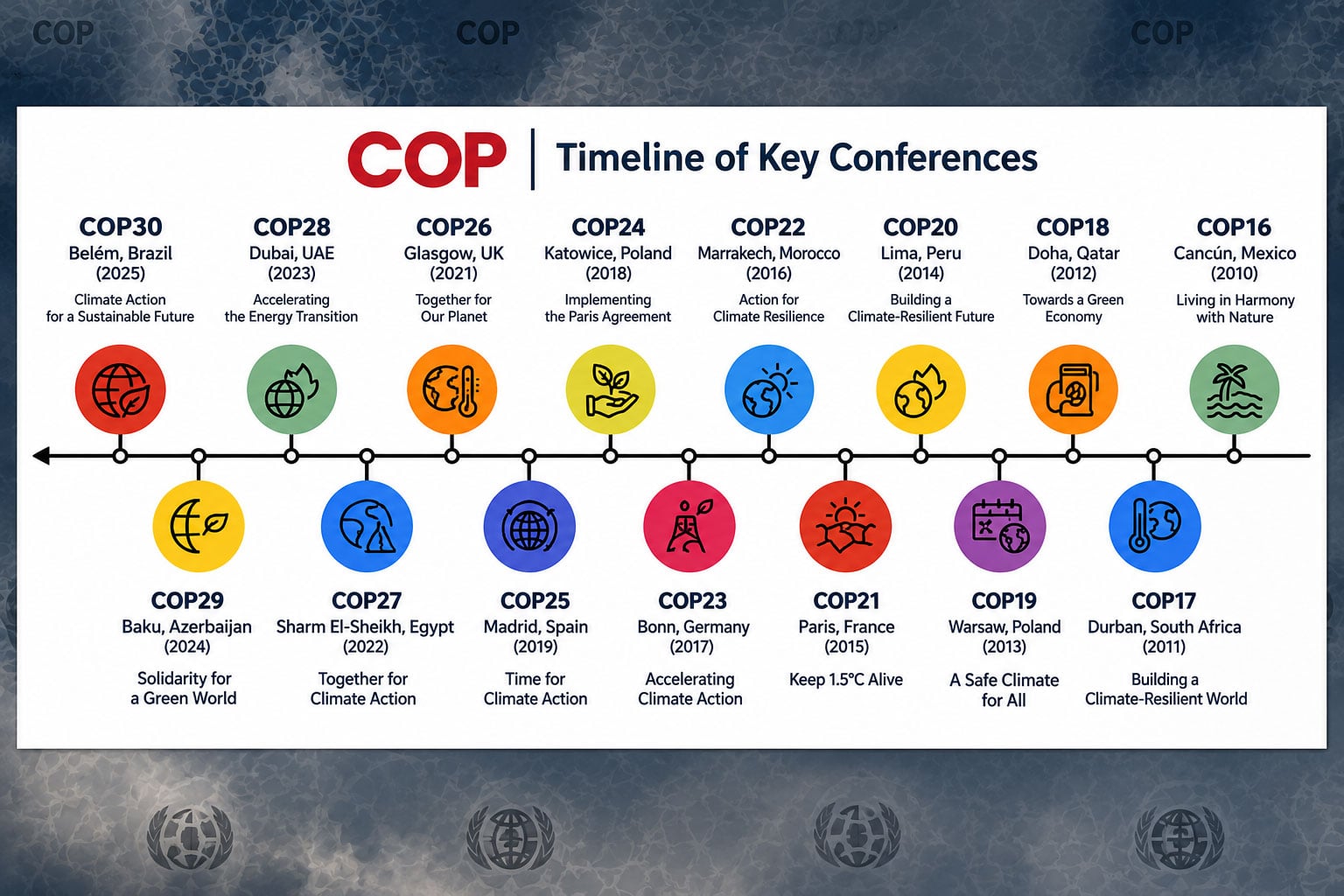
Subsequently, in 1992, during the Earth Summit in Rio de Janeiro, the UNFCCC was adopted. The main goal of the convention was to stabilize greenhouse gas concentrations at a level that would prevent dangerous human interference with the climate system. It is worth noting that the convention entered into force on 21 March 1994, when a sufficient number of countries had ratified it, and a year later, in 1995, the first Conference of the Parties was held. Since then, 30 UN climate change conferences, known as COPs, have been held (7).
The fundamental question, however, is whether the world’s climate situation has improved after 30 international conferences. Have greenhouse gas emissions declined? Have international agreements been able to prevent the rise in the Earth’s temperature?
To answer these questions, we need to distinguish between two categories of issues:
- Diplomatic and legal successes (achievements);
- Real success in reducing climate change (failures and limitations).
1) Positive achievements
In the 30 years from the first conference in 1995 to the present, the climate change conferences have produced several positive achievements:
First: Creating a global legal framework
Before the COP conferences took shape, there was no comprehensive, shared system for the international management of climate change. Today, however, nearly all the world’s countries cooperate within the UN climate convention. This is considered an important achievement in the field of multilateralism.
Second: Adoption of the Kyoto Protocol
The Kyoto Protocol, concluded in 1997, was the first major experience in establishing quantified and binding commitments for industrialized countries to reduce greenhouse gas emissions. Under this protocol, industrialized and developed countries accepted that they would reduce their greenhouse gas emissions according to specific targets. It is worth noting that the first commitment period of the protocol was set for 2008 to 2012 (8). The protocol laid the groundwork for carbon markets and mechanisms of economic cooperation in the environmental field. However, the limited participation of some of the largest producers of greenhouse gases reduced its global effectiveness.
Third: The Paris Agreement
The most important achievement of 30 years of climate diplomacy is the Paris Agreement, concluded in Paris in 2015 at the twenty-first climate change conference. This agreement managed to bring nearly all the world’s countries together within a shared framework. The main goals of the agreement are:
- Limiting the rise in average global temperature to well below 2 degrees Celsius compared with pre-industrial levels;
- Pursuing efforts to limit the temperature rise to 1.5 degrees Celsius;
- Reducing greenhouse gas emissions;
- Providing financial and technical support to developing countries;
- Increasing countries’ ability to adapt to the consequences of climate change;
- Submitting and updating national commitments every five years (9).
Fourth: Creating financial mechanisms
The Green Climate Fund (GCF), which was established at the sixteenth session of the conference in 2010, and the Loss and Damage Fund, which was agreed at the nineteenth session of the conference in 2013, are among the mechanisms created to support vulnerable countries (10). These measures show that climate change has gradually shifted from a purely environmental issue to one linked to economic justice and international responsibility.
2) Failures and limitations of the COP conferences
Despite significant diplomatic and legal achievements, the performance of the COP conferences has faced serious criticism. The most important failures can be examined along four lines:
First: The gap between commitments and practical action
One of the most important failures is the gap between countries’ political promises and their actual performance in reducing greenhouse gas emissions (11). For example, despite numerous commitments under the Paris Agreement, the UNEP report in 2025 showed that even if countries’ national commitments were fully implemented, the world would still be on course for a temperature rise of roughly 2.3 to 2.5 degrees Celsius by the end of the century, while under current policies the increase is projected at about 2.8 degrees. This situation shows that current commitments are still not sufficient to achieve the goals of the Paris Agreement.
Second: Continued dependence on fossil fuels
Despite lengthy negotiations and international agreements, the global economy’s dependence on oil, natural gas, and coal continues. For example, at COP28 in Dubai (2023), countries agreed for the first time in a final text to move away from fossil fuels in the energy system; however, this agreement alone did not mean halting the production and consumption of these fuels, and its implementation faces economic and political obstacles. The dependence of exporting countries on oil and gas revenues and the energy needs of large economies are among the main reasons for the slow pace of this process.
Third: Disagreement between developed and developing countries
One of the long-standing disputes in climate negotiations is how to divide the responsibilities and costs of confronting climate change between rich and poor countries. For example, at COP15 in Copenhagen (2009), developed countries pledged to mobilize 100 billion dollars annually by 2020 to support climate action in developing countries; however, this goal was reached two years late, in 2022. In addition, a considerable share of these resources was provided in the form of loans rather than grants. This issue remains one of the reasons poor countries distrust the financial commitments of industrialized countries (12).
Fourth: Weak enforcement
One of the important limitations of the Paris Agreement is the absence of a strong punitive mechanism to compel countries to achieve their national emissions reduction targets. Under Article 15 of the agreement, a committee has been established to facilitate implementation and monitor countries’ compliance; however, this committee is facilitative and non-punitive in nature and has no authority to impose penalties on governments that fail to honor their commitments (13). For example, if a country cannot achieve the greenhouse gas reduction target announced in its national plan, it may face technical review, requests for explanation, and political and diplomatic pressure; however, merely failing to reach a national target does not automatically result in an international fine or sanction against that country. Therefore, the success of the Paris Agreement depends largely on the political will of governments, transparency in reporting, and pressure from public opinion.
3) The significance of climate change for Afghanistan
Afghanistan is an official party to the UNFCCC and joined it in 1992. The country subsequently ratified the Kyoto Protocol and the Paris Agreement as well (14). In the past, Afghanistan’s representatives, particularly officials of the National Environmental Protection Agency (NEPA), have participated in various UN climate change conferences (14). According to the Associated Press (AP), officials from Afghanistan have again been invited to attend COP31 in Turkey and are due to take part as an observer member.
The fundamental question is why Afghanistan’s participation in COP31 is particularly significant. The answer is that Afghanistan is among the countries with high vulnerability to the consequences of climate change. The country faces structural problems such as a shortage of water infrastructure, the dependence of a large part of its population on agriculture, weak crisis management capacity, and limited financial resources. Several factors increase this vulnerability:
- Recurrent droughts: A large share of Afghanistan’s population depends on agriculture and natural resources, and drought can threaten the livelihoods of millions of people.
- Water crisis: Declining water resources, changing rainfall patterns, and the melting of natural glaciers can affect river flows and access to water and, as a result, challenge the country’s water security.
- Threat to food security: Reduced agricultural production, rising food prices, and the loss of livelihoods can intensify poverty and food insecurity.
- Climate migration: Drought, the degradation of farmland, and the loss of livelihoods can increase internal and external migration.
From this perspective, Afghanistan’s presence and participation in climate negotiations is of particular importance, because the country needs investment, technology, regional cooperation and international financial support to manage the consequences of climate change.
From the standpoint of Afghanistan’s national interests, it appears that the country’s delegation should focus on five fundamental issues:
- Securing climate finance: Winning the support of the GCF and other international financial mechanisms to carry out environmental projects;
- Water resource management: Drawing on regional and international cooperation to manage water resources and confront drought;
- Protecting natural resources: Carrying out programs to restore forests, manage farmland and protect natural resources;
- Food security: Investing in climate-resilient agriculture and developing irrigation systems;
- Climate justice: Stressing that vulnerable countries with a small share of greenhouse gas emissions should not bear the main cost of the world’s climate crisis.
Conclusion
Overall, over the past three decades, the UN climate change conferences have taken important steps in managing the climate crisis by creating legal frameworks, adopting agreements such as Kyoto and Paris, and expanding international cooperation. Yet the continued emission of greenhouse gases, the global economy’s dependence on fossil fuels, and the gap between political commitments and practical action show that current efforts are still not commensurate with the scale of this crisis. Therefore, the significance of COP31 lies in whether it can turn countries’ political will into more effective action, climate finance, and practical cooperation.
For Afghanistan, this conference is not merely an international environmental meeting but an important opportunity to pursue national interests, win financial and technical support, strengthen water resource management, protect food security, and increase resilience against drought and other consequences of climate change. Given the country’s high vulnerability, effective participation in this process and the pursuit of national priorities can play an important role in reducing the consequences of the climate crisis.
Sources and Notes:
- https://unfccc.int/cop31
- https://www.un.org/en/climatechange/cop31
- https://unfccc.int/cop31/about?
- United Nations Framework Convention on Climate Change (UNFCCC)
- https://unfccc.int/cop31/about
- Intergovernmental Panel on Climate Change (IPCC)
- https://unfccc.int/process/the-convention/history-of-the-convention?Essential-background
- Mazini, Amirhossein, Sadeghi, Hossein, and Yazdanpanah, Rezvan. (2019). Examining the Effectiveness of the Kyoto Protocol in Reducing Greenhouse Gas Emissions (from the Perspective of Environmental Economics). Quarterly Journal of Environmental and Natural Resource Economics, 7(3), 115-142. https://doi.org/10.22054/eenr.2020.12491
- https://unfccc.int/most-requested/key-aspects-of-the-paris-agreement?
- https://www.csragency.ir/%D8%B5%D9%86%D8%AF%D9%88%D9%82-%D8%B3%D8%A8%D8%B2-%D8%A7%D9%82%D9%84%DB%8C%D9%85-%D9%88-%D8%AA%D9%88%D8%A7%D9%81%D9%82%D9%86%D8%A7%D9%85%D9%87-%D9%BE%D8%A7%D8%B1%DB%8C%D8%B3/
- https://www.unep.org/en/publications/report/emissions-gap-report-2025?
- https://www.oecd.org/en/about/news/press-releases/2024/05/developed-countries-materially-surpassed-their-usd-100-billion-climate-finance-commitment-in-2022-oecd.html?
- https://unfccc.int/process-and-meetings/bodies/constituted-bodies/paris-agreement-implementation-and-compliance-committee-paicc/more-about-paicc?
- https://unfccc.int/node/28571?
- https://apnews.com/article/climate-cop31-afghanistan-taliban-turkey-antalya-f2ec332953fcbba62ece8592639444eb
- https://www.unep.org/en/publications/report/emissions-gap-report-2025?trk=public_post_comment-text&
- https://www.reuters.com/world/asia-pacific/taliban-administration-officials-attend-un-climate-conference-azerbaijan-2024-11-10/
You can read the Persian version of this analysis here: