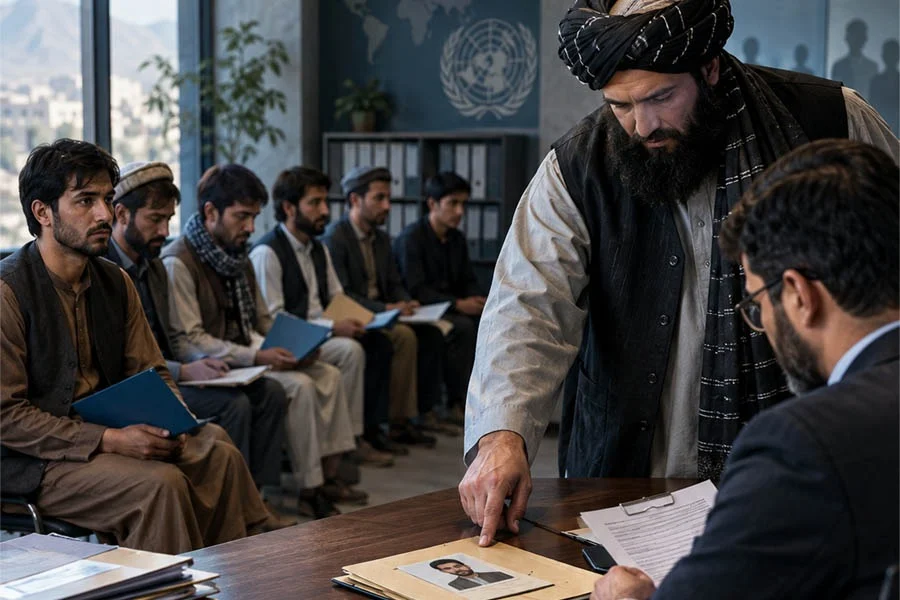
Credible sources at some domestic and foreign organizations operating in Afghanistan have complained, expressing concern over ethnic and linguistic hiring practices in these organizations. They claim that, under the pretext of facilitating understanding and dialogue and speeding up their work with the Taliban, these organizations avoid hiring non-Pashto speakers. According to their claim, officials of these organizations argue that if individuals do not have a command of Pashto, Taliban officials obstruct the organizations’ work and their affairs do not proceed properly. Employees of some organizations say that conveying to foreign officials the idea that the organization will face problems with the Taliban if its employees are not Pashto speakers has paved the way for the institutionalization of discrimination. The findings of this report show that members of the Taliban are present on the hiring committees of some organizations and play a role in the appointment process.
Sources at some of these organizations confirm that one of the hiring requirements is knowledge of Pashto, and that if a Pashto speaker is also competing for a position, priority is given to the person who is Pashtun. These sources add that the continuation of this situation has limited the presence of elites from other language groups and ethnicities in organizations, particularly international ones. They also say that Taliban officials in ministries are likewise involved in, and play a role in, the process of hiring employees at organizations.
A credible source at one foreign organization says that, in hiring people for government institutions under their control, the Taliban give priority to those who, in his words, are “one of their own” and a “Mujahid,” who have connections, or who have full command of Pashto. Otherwise, a person’s chances of being hired are reduced.
According to him, this situation has now spread to international organizations as well, and they have come under pressure to hire Pashto speakers for positions related to government offices under Taliban control. He adds that, in departments that require coordination and communication with government offices under Taliban control, organizations hire non-Pashto speakers only if they have full command of Pashto.
The source adds: “The issue becomes more serious when it is said that if an organization’s employee is not a Pashto speaker, some administrative matters related to the organization’s activities run into problems or are never carried out. These include the approval of project alignment for donors, the determination of project implementation sites, the processing of memorandums of understanding, the processing of visas for foreign employees, and the processing of work permits for both domestic and foreign employees.”
Credible sources at organizations confirm that in most provinces, committees made up of representatives of the Taliban’s governor, the group’s intelligence service, sectoral departments, and the Taliban’s Department of Economy have been established to oversee the hiring process. According to these sources, organizations have lost much of their decision-making authority even in hiring their own employees.
These sources say that obstruction and the imposition of restrictions have also been reported in some cases during the implementation of projects, and that even employees of organizations have been detained or imprisoned while carrying out their duties. According to the sources, following the obstacles created by the Taliban, most international organizations have turned to hiring Pashto speakers, particularly in positions related to government offices, in order to avoid problems in implementing their projects. These sources add that even a number of employees who had previously worked at organizations and were still in their posts have been dismissed for not being Pashto speakers.
An employee of one of these organizations says: “This process contradicts the working principles and regulations of international organizations. Organizations usually emphasize the principle of non-discrimination and avoiding the stoking of linguistic, ethnic, and regional issues. But what is happening now is that the existing pressures have, in practice, left most organizations facing limitations in implementing these very principles.”
One of the employees of these organizations says: “Another issue is how written and oral exams are conducted. In drafting exam questions, one or two questions are always posed in Pashto, so that if an applicant is not a Pashto speaker, they will not be selected for the position even if they achieve a very high score.”
This organization employee adds: “At the moment, this same process is in place at all organizations. In the exam, one question is posed in Pashto. For example, they present an English text and ask the applicant to translate it into Pashto, or to write a letter in Pashto.” He mentions taking an exam at one of the offices of the United Nations (UN) and says that one of the questions was posed in Pashto and the applicant had to answer in Pashto. In the past, alongside the requirement to know English, applicants could speak in their mother tongue.
This organization employee says this situation has led some individuals in organizations and offices of the Taliban regime to abuse their positions and to create the impression among foreigners that if a person does not speak Pashto, the organization’s work in dealing with Taliban officials will run into problems. At the same time, he confirms that people who do not know Pashto face delays of several months in the process of memorandums of understanding at Taliban offices, and that their contracts are also not easily finalized.
A human resources manager at one of the organizations, confirming the issue, says that Persian-speaking employees are being dismissed by the head of the organization on various pretexts. Expressing concern, he says that the spread and normalization of such blatant discrimination contradicts all human values and the working principles of organizations, and that opportunistic individuals within the structures of these institutions engage in such actions by exploiting the current situation.
This human resources manager recounts his experience at the institution where he works: “During the hiring process, I was pressured to hire Pashtuns, and I was warned verbally and in person. The pressure was so intense that, before the hiring process had even begun, they warned me to hire the security staff from among Persian speakers and all other employees from among Pashto speakers. Out of more than 200 people, 99 percent of those hired were Pashto speakers, and only one Persian speaker was appointed for the security section. Two foreign individuals were also present on the hiring committee, but despite this, they pressured me not to object.”
Likewise, according to him, the Taliban’s head of public health in one of the provinces had seized the equipment of an office. When the logistics manager raised the issue in a report to the relevant office, he was dismissed from his job.
He says: “The head of public health [name of province removed due to security concerns] had a beardless boy. The project manager was also Pakistani and had promised the Taliban head that he would hire his beardless boy at the organization so that he would receive his salary from the organization but stay by the side of the head of public health.”
The Hasht-e Subh Daily has reviewed a number of audio recordings in which Taliban officials speak about their role in organizations’ exam processes and how these exams are conducted. In one of these recordings, it is said that a Taliban official takes part in the exam and is present as a committee member and as a representative of the group’s provincial administration.
Previously as well, job applicants have repeatedly complained about discriminatory treatment by some organizations, claiming that they were treated in a discriminatory manner. According to them, Taliban pressure on organizations has caused these institutions to change their approach toward employees and to give priority to individuals who are approved by the Taliban.
You can read the Persian version of this report here:
تبعیض زبانی و قومی؛ در روند استخدام موسسات ملی و بینالمللی در افغانستان چه میگذرد؟