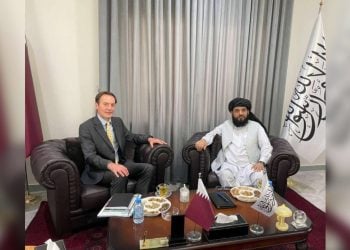
Four Afghan embassies and one consulate in Europe operate under the oversight of the Taliban’s Ministry of Foreign Affairs. These include the embassies in the Netherlands, Spain, the Czech Republic, and Bulgaria, as well as the consulate in Munich, Germany. These political representations maintain close ties with the Taliban and function under the regime’s control.
Diplomatic sources suggest that some of these representatives engage with the Taliban due to ethnic affiliations, fears of exposing past financial and administrative corruption, political connections to former officials, and personal interests, relying on directives from the group. According to these sources, some individuals within these representations are also pursuing their NGO projects in Afghanistan, prompting their engagement with the Taliban. Additionally, one source claims that the Afghan ambassador in the Netherlands has traveled to Kabul several times, making significant efforts to “whitewash” the Taliban’s image and influence the perception of the International Court of Justice (ICJ) regarding the group’s impunity for its crimes. The Afghan ambassador in the Netherlands dismisses these allegations as unfounded and urges other political representations to employ “diplomatic understanding and political insight.”
Sources speaking with the Hasht-e Subh Daily state that certain Afghan embassies and consulates in Europe have forged connections with the Taliban due to ethnic affiliations, concerns about revealing past corruption, incompetence, political ties to previous government officials, and personal interests. These sources emphasize that ethnic solidarity has motivated certain officials within these embassies to connect with the Taliban, highlighting the significant role that ethnic affiliation plays in shaping interactions between some individuals in Afghanistan’s political representations in Europe and the Taliban.
Moreover, diplomatic sources reveal that some individuals who have established ties with the Taliban at Afghan political representations in Europe lack awareness of their diplomatic responsibilities and the ability to analyze political situations or make critical decisions during crises. According to these sources, their inability to understand and manage diplomatic affairs has resulted in inappropriate decisions or even disgraceful actions in complex and sensitive situations. The acting head of the Afghan embassy in Madrid, Spain, is particularly cited as incompetent, primarily focused on preserving his interests, such as receiving a salary and diplomatic privileges, rather than understanding the needs of the Afghan people.
Diplomatic sources accuse the acting head of the Afghan embassy in Spain of managerial incompetence regarding diplomatic matters and the country’s international representation. They assert that such appointments have not only harmed Afghanistan but also weakened the country’s international credibility.
Another reason cited for engaging with the Taliban is to assist the Afghan people. Many embassy officials argue that they must connect with the Taliban to meet the needs of ordinary citizens. They contend that without cooperation with the Taliban administration, the daily necessities of the people will go unmet, leading to disruptions in the country’s administrative affairs. However, diplomatic sources counter that over three years of experience show that representations that have refrained from working with the Taliban continue their operations and, in many instances, effectively support the Afghan people in diplomatic forums and international organizations.
Sources emphasize that the need to support the people cannot justify collaboration with the Taliban, arguing that such reasoning is fundamentally flawed. They claim that these justifications have led some officials to establish ties with the Taliban, despite the group’s illegitimate and primitive nature, simply to maintain their positions in this unstable environment.
Additionally, sources assert that these appointments have been made based on ethnic affiliations rather than merit, drawing criticism from numerous observers. They explain that after the Taliban announced that the activities of 14 Afghan embassies and representations were illegitimate and must come under the control of their regime, individuals lacking diplomatic backing and experience faced increased pressure and found themselves in difficult positions to secure their status with the Taliban.
This report highlights five Afghan political representations operating under Taliban control and examines the profiles of ambassadors and consuls cooperating with the group based on ethnic affiliations, political considerations, and diplomatic privileges.
Ambassador of Afghanistan in the Netherlands and His Engagement with the Taliban
Mohammad Asif Rahimi serves as the ambassador of the previous Afghan government to the Netherlands. He previously led Care Afghanistan and held the position of Minister of Agriculture, Irrigation, and Livestock during Hamid Karzai’s administration. Additionally, Rahimi has a history of membership in Hizbi-Islami Gulbuddin (HIG) led by Gulbuddin Hekmatyar and holds Canadian citizenship.
A source reports that Rahimi traveled to Kabul shortly after the Taliban’s takeover and received assurances from them to continue his mission. However, this guarantee was conditional upon his close cooperation with the Taliban. The source claims that a significant aspect of this collaboration revolves around cases related to crimes against humanity at the Hague court, where the Taliban faces accusations of genocide, war crimes, and crimes against women and girls.
The source further asserts that Rahimi has actively supported the Taliban regime. He not only hopes to continue his mission but also seeks to defend and whitewash the Taliban’s image on the international stage, particularly concerning critical cases at the Hague court. This includes efforts to downplay accusations against the Taliban and obstruct international investigations into war crimes and human rights violations. Such actions suggest that Rahimi aligns himself with the interests of the Taliban regime.
Another source reveals that the embassy facilitated the travel of Abdul Bari Omar, the former head of the Taliban’s judiciary, to Europe. Omar addressed a group of Afghan citizens in Germany, provoking significant reactions.
Currently, the Afghan embassy in the Netherlands operates under the directives and policies of the Taliban’s Ministry of Foreign Affairs, providing consular services that include visa issuance, passport renewals, identity verification, inheritance pledges, travel permits, and marriage certificates. All requests for these services are sent to the Taliban’s Ministry for approval.
However, in an interview with Hasht-e Subh Daily, Rahimi, without naming the Taliban, stated, “Some have claimed that our embassy officials have whitewashed or blackwashed individuals; this is completely baseless and a false accusation. We do not have this capability or responsibility, and we reject this claim as entirely incorrect.”
Rahimi added that the embassy provides consular services to Afghan citizens in the Netherlands under Article 2 of the Vienna Convention on Consular Relations. He explained that the first part of these services involves establishing citizens’ identities for Dutch authorities, while the second part includes sending documents, such as powers of attorney for property management and marriage licenses, to relevant agencies like the courts through the “Ministry of Foreign Affairs of Afghanistan.”
Regarding concerns about sharing information about consular applicants with the Taliban, Rahimi stated: “Based on administrative principles and consular regulations, we take the confidentiality of documents and applicants’ cases very seriously. No document or evidence can be shared without the applicant’s consent. Our compatriots should feel assured.”
The Afghan ambassador noted that the embassy had previously issued a statement emphasizing that it only engages with the Ministry of Foreign Affairs of Afghanistan (the Taliban) concerning consular services, stating, “Without interaction with the Ministry of Foreign Affairs, it is impossible to continue providing services.” He also mentioned that the Afghan embassy is active in facilitating and coordinating international aid for the Afghan people. However, since the Netherlands does not currently recognize the “ruling authorities or caretaker government” (the Taliban regime), the embassy’s political section is “suspended.”
Rahimi urges officials from other Afghan representations to employ what he calls “diplomatic skills and political insight” in their mandates to prevent the closure of political and consular representation avenues in Afghanistan and to ensure citizens continue to receive consular services.
Addressing allegations of attempts to lift Taliban restrictions at the Hague court, he said: “Following the fall of the republic system, our relations with the Hague court have become very limited. Since the court announced it would begin investigating war crimes in Afghanistan, they have not contacted the Afghan embassy at all. I am confident that evidence and reports of war crimes and humanitarian violations are being collected independently and within their jurisdiction. According to the Rome Statute, member countries have no right to intervene in the court’s judicial proceedings, and no individual or entity can obstruct the court’s investigations.”
Rahimi expresses his support for implementing justice in national and international courts in Afghanistan and emphasizes that those who have committed war crimes, crimes against humanity, and devastated the country should one day be held accountable.
Afghan Ambassador in Prague – Czech Republic
Shahzad Gul Aryobee is the ambassador appointed by Ashraf Ghani’s government in Prague, Czech Republic. He currently works under the Taliban and receives directives from them. Mr. Aryobee previously served as Afghanistan’s Minister of Communications and Information Technology.
A source who closely worked with Mr. Aryobee at the Ministry of Communications and Information Technology told Hasht-e Subh Daily that his educational background is unclear. The bachelor’s degree he submitted to parliament comes from a university in Khyber Pakhtunkhwa, Pakistan. However, this source found no evidence of any universities in that city. Aryobee studied in a border area near Afghanistan until the twelfth grade before taking English and computer courses in Peshawar. He moved to Kabul about five years after the Bonn Conference, which established the previous government.
The source also noted that Mr. Aryobee received training in Pakistan from an individual named Ajmal Marjan. Marjan later established the “Electronic Government or e-government” at the Ministry of Finance, where Aryobee was appointed as its head. The source claimed that Marjan introduced Aryobee to Ashraf Ghani. When Ashraf Ghani was dismissed from the Ministry of Finance, Aryobee continued to report to him from that ministry and several other institutions. Allegedly, when Ashraf Ghani became president, he retained Aryobee in a ministerial candidacy position as a reward for his “espionage” activities until Abdul Razaq Wahidi was introduced to the prosecutor’s office for financial corruption and subsequently dismissed.
The source accused Mr. Aryobee of engaging in corruption within the ministry until Ashraf Ghani ultimately dismissed him. Allegedly, he insisted that project reviews be conducted verbally, without documentation or adherence to legal processes. Reports only detailed the progress or delays of specific contracts, after which he would negotiate with the contractors, creating opportunities for his corruption.
Diplomatic sources indicate that Mr. Aryobee established contact with the Taliban’s Ministry of Foreign Affairs early in his tenure and carries out all consular services based on their directives, sharing all information about consular service applicants with this ministry. He did not respond to Hasht-e Subh Daily’s inquiries regarding this matter.
Embassy of Afghanistan in Spain
Mohammad Rahim Peerzada serves as the acting head of the Embassy of Afghanistan in Spain and the permanent representative to the United Nations World Tourism Organization (UN Tourism). He previously worked as a local staff member during Eklil Hakimi’s tenure as the Afghan ambassador to Washington. Peerzada received his official appointment to the Ministry of Foreign Affairs during Ershad Ahmadi’s time as the political deputy of the previous government’s Ministry of Foreign Affairs. Sources suggest that he is influenced by Hikmatullah Karzai and Eklil Hakimi in his decision-making.
Sources also indicate that the acting head of the Afghan embassy in Madrid, a resident of Takhar Province, maintains a close relationship with Atta Muhammad Nur, the former governor of Balkh Province. According to these sources, Peerzada entered the Afghan Ministry of Foreign Affairs with Atta Muhammad Nur’s support and began his diplomatic career as the second secretary at the Afghan Embassy in Paris. He later became an advisor at the Afghan Embassy in Madrid with Nur’s direct assistance and recommendation.
Reports indicate that such appointments, based on personal and political relationships, are common in Afghanistan’s diplomatic system. The close connection between Peerzada and Atta Muhammad Nur illustrates how support from influential figures, such as the former governor of Balkh, can significantly impact the professional trajectories of Afghan diplomatic officials.
The Afghan Embassy in Madrid has previously stated that it is in contact with the Taliban’s Ministry of Foreign Affairs regarding consular matters. The embassy claims to work collaboratively with the Taliban to resolve consular issues and sends confirmation letters of consular documents to the Taliban in Kabul for verification.
Embassy of Afghanistan in Sofia, Bulgaria
Mohammad Fazil Saifi, the ambassador appointed by the previous government in Bulgaria, reportedly studied engineering and is the cousin of Mohammad Yunus Qanuni, the former first vice president. Sources indicate that Qanuni mediated Mr. Saifi’s appointment as Afghanistan’s ambassador in Sofia when Mohammad Hanif Atmar served as the foreign minister. He is also the brother of Atiqullah Baryalai, a senior member of the National Resistance Front of Afghanistan. Mr. Saifi, who has a Bulgarian wife, has lived in Bulgaria for many years and previously served as the chargé d’affaires of the Afghan Embassy during the Islamic (Mujahideen) government.
Another source notes that, despite his family ties to prominent figures in the National Resistance Front, such as Baryalai and Qanuni, Mohammad Fazil Saifi has established communication with the Taliban. This apparent contradiction between his stance and that of his brother, Atiqullah Baryalai, is noteworthy. While Atiqullah Baryalai firmly opposes the Taliban, his brother, as the head of the Afghan embassy in Bulgaria, expresses a desire to establish relations with the group and has made several attempts to contact them. The source suggests that this contradiction may arise from personal interests, political pressures, or other factors.
Sources indicate that such communication with the Taliban, especially from someone whose family has strong ties to the National Resistance Front, reflects the complex political and personal dynamics among Afghan diplomatic officials and the severe challenges they face in the current situation.
In a conversation with Hasht-e Subh Daily, the Afghan ambassador in Bulgaria denied any engagement with the Taliban, stating, “This embassy has never engaged with the Taliban at any point and has conducted all its duties regarding displaced persons, stateless individuals, and Afghan refugees solely on a humanitarian basis and according to the principles and conventions of Vienna in consular matters.”
Mr. Saifi considers the submission and verification of consular documents to the Taliban Ministry of Foreign Affairs a necessary process, stating, “Without coordination and approval from the center, consular documents lack legal validity.” He adds, “Providing consular services to citizens, even in critical and sensitive conditions, is a primary and legal duty of any embassy. This duty should be carried out through effective cooperation between the center and its representatives, particularly the consular department. Issuing any documents, including powers of attorney, marriage certificates, and identity verification, without coordination and approval from the center lacks legal validity. This is a fundamental principle of consular activities that must be upheld.”
The Afghan ambassador in Bulgaria claims that providing consular services is unrelated to political issues and that various countries maintain consular cooperation to support their citizens even during wartime. He criticizes those who comment on this issue for lacking adequate knowledge of international law, stating, “Unfortunately, it seems that some individuals, without sufficient understanding of international laws and the Vienna Conventions, have a misguided perception of the duties and authorities of an embassy. Embassies operate within the framework of international laws and coordinate with the center, and all their actions are subject to precise legal scrutiny.” He emphasizes that, following the collapse of the republic system, the legal status of the ambassador and extraordinary representative has logically changed, reducing the embassy’s status to that of a consular office. Mr. Saifi claims that some diplomatic representations have ignored this reality, leading to the ineffective use of embassies.
Consulate of Afghanistan in Munich
Sifatullah Rahimi serves as the consul of the previous government in Munich, Germany. He previously held the positions of deputy ambassador and chargé d’affaires for the European Union in Brussels, Belgium, and also headed the office for Eklil Hakimi, the former finance minister.
In conversations with Hasht-e Subh Daily, informed sources reveal that Mr. Rahimi was initially appointed to the Afghan consulate in Bonn, Germany. However, he faced opposition from Salahuddin Rabbani, the former foreign minister. Subsequently, by order of Ashraf Ghani, the former president, he was reassigned to Munich. Sources suggest that he engaged with the Taliban due to “ethnic superiority and bias.”
Diplomatic sources indicate that Sifatullah Rahimi is among those who received rapid appointments to key positions without prior diplomatic experience during Ashraf Ghani’s government. Although he lacked a background in diplomatic affairs or experience in the Ministry of Foreign Affairs, Ashraf Ghani appointed him as the Afghan consul in Munich, reportedly based on ethnic considerations despite the presence of notable diplomatic talent in the Afghan Ministry of Foreign Affairs.
The Afghan consulate in Munich currently provides a range of consular services, including the issuance of visas, passports, electronic identity cards, inheritance documentation, travel permits, driver’s license verification, powers of attorney, identity card services, criminal liability exemptions, single status certificates, birth certificates, marriage documentation, postal services, and other consular services for verification by the Taliban Ministry of Foreign Affairs. Khosrow Amiri serves as the consul, Mohammad Muqaid Sakhi as the deputy consul, and Mohammad Mansour Ashraf oversees financial and administrative matters at the consulate. Sifatullah Rahimi has not responded to messages from Hasht-e Subh Daily regarding this matter.
Previously, Amir Khan Muttaqi, the acting foreign minister of the Taliban, stated that this group has effectively controlled and managed Afghanistan’s political representations at the regional level over the past year, with 39 political representations in various countries currently taking orders from them.
You can read the Persian version of this daily report here: