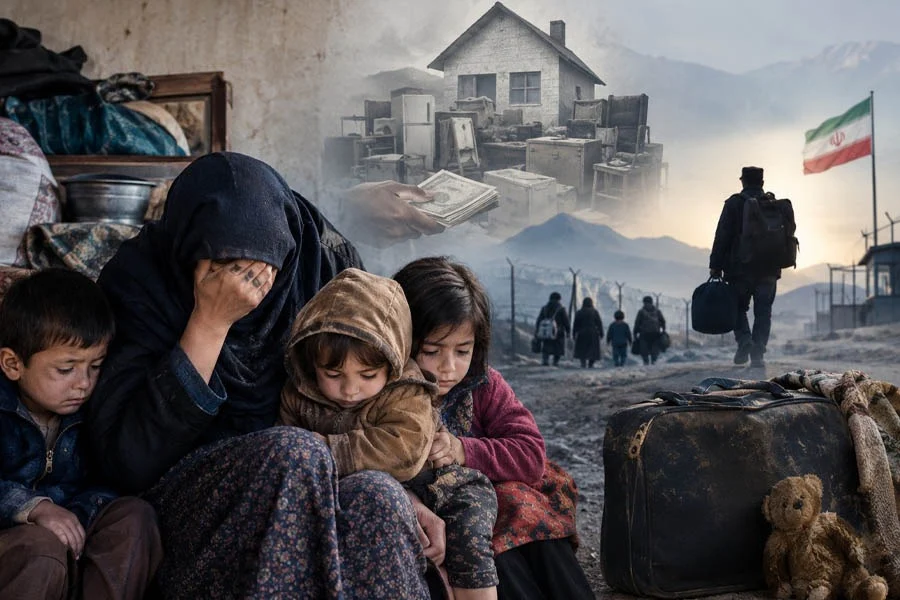
This report reflects the account of a family who sold all their household belongings in an effort to escape economic hardship and twice tried to migrate to Iran. Family members say that both times, after crossing the border, they were returned to Afghanistan. Now, after these attempts failed and the family lost its assets, the woman’s husband, who set out for Iran alone for the third time, has been missing for three weeks. His family, with no news of his fate, is struggling with poverty and an uncertain future.
Zainab (pseudonym) says her husband sold all their household belongings to cover the costs of migrating to Iran. However, her two attempts with her children to cross the border failed, and almost nothing is left of what remained for them. She says she can no longer afford clothes for herself and her children, and since her husband’s disappearance, she has been facing a difficult economic situation.
She adds that after being deported twice, they no longer had the financial means to repeat the journey. For this reason, her husband set out for Iran alone with the remaining money and funds borrowed from his brothers. But it has been three weeks, and there is no news of his fate.
Zainab says: “My husband sold all the household belongings, and we were left with only two sets of clothes each. My husband and I, along with our three children, went to Iran illegally twice. But even though we had crossed the border, Iranian border guards detained us and deported us back to Afghanistan. After that, we had no money left to go. My husband set out for Iran with the remaining 500,000 Afghanis. A few days later, he called from an unknown number and said that he had borrowed 15,000 Afghanis from my brothers and that I should send him the money. Three weeks have passed since I sent the money, and since then I have had no information about whether he is alive or what has happened to him.”
According to Zainab, her husband was previously a shopkeeper. However, after the Taliban took control and the group increased its financial demands, including payments that she says were beyond his means, he ran into economic trouble. She adds that her husband was even unable to pay the rent for his shop and was eventually forced to close it. After that, he turned to pushing a handcart to provide for the family, but the family’s economic situation did not improve, and their lives became harder.
She says: “My husband tried every way, but none of them worked. Finally, he said that we should sell everything and go to Iran with the money to work and build a new life. But now, instead of building a life, I have lost everything. Nothing is left for me, and I have come to my mother’s house with my three children. My mother’s economic situation is not good either, but I have no choice except to live with her. The weather has turned cold, and my children have no warm clothes. I do not even have 100 Afghanis to buy them clothes, let alone meet their other needs.”
Pashtun Gul, Zainab’s mother, says her daughter has been living in her house with her three children for about a month. She says her own family’s economic situation is also difficult. Her husband has lost his eyesight because of old age, and they cannot afford medical expenses or daily living costs.
She says: “I do not have money for my husband’s treatment, or even for my own. Now my daughter has come to my house with her three children as well. My son has his own family and also covers our household expenses by working as a laborer. We have only one room, and everyone lives in it. My daughter’s life has fallen apart, and her husband is missing. If there had been job opportunities and a chance to earn a living in the country, why would my daughter’s husband have been forced to leave the country under any circumstances?”
Zakira, Zainab’s sister, says her sister’s difficult situation has deeply affected her. She says watching her sister’s suffering and helplessness, while being unable to help her, puts great emotional pressure on her.
She says: “My own economic situation is not good either. Still, I have given my children’s used clothes to my sister’s children, because they do not even have enough clothes to wear. Seeing my sister suffer before my eyes, while there is nothing I can do, is very hard for me. My sister’s economic situation was not good before either, but at least she had a shelter to live in, clothes to wear, and bread to eat. Now she has not only lost her household belongings, but her husband has also disappeared, and she is living with her children in very difficult conditions.”
Meanwhile, Asifa Stanikzai, a migration affairs expert, says poverty, unemployment, insecurity, social restrictions, and the lack of a clear outlook for the future are among the most important factors pushing families to migrate.
According to her, under such circumstances, people’s fundamental rights, including the right to human dignity, security, shelter, education, health services, and livelihood opportunities, are severely threatened. She adds: “Every migrant has the right to a fair and proper legal process before being deported. Returning people to areas where they face a real risk of torture, persecution, or serious harm may constitute a violation of the principle of non-refoulement. A state that deports people is obliged to respect their human rights and to seriously assess the potential risks and consequences of return before sending them back.”
This comes as several migrants from Afghanistan recently complained to the Hasht-e Subh Daily about fraud and extortion by human smugglers on the route from Iran to Turkey. They said smugglers lure young people from Afghanistan into migrating via the Iran-Turkey route with various promises and charge between four and five thousand dollars per person. However, according to these migrants, smugglers abandon some of them in the deserts of Iran instead of taking them to their destination, and pretend that they have reached Turkish territory.
You can read the Persian version of this report here:
از فروش داراییهای خانه تا ناپدیدشدن نانآور؛ روایت خانوادهای گرفتار در فقر و بیسرنوشتی