• 8AM.MEDIA
  • ویب‌سایت فارسی
  • پښتو ویب‌پاڼه
  • اۉزبېکچه ویب‌سایت
  • Podcast
Saturday, October 10, 2026
Hasht-e Subh
  • Home
  • News
    • Afghanistan News
    • World News
  • Opinion
    • Editorial
    • Analysis
  • Reports
    • Daily Reports
    • Investigative Reports
  • Society
    • The story of people
  • Women’s Word
  • Columns
    • Three Years After Afghanistan’s Fall: The Taliban’s Resurgence
    • Towards Equality
    • The Resurgence of the Taliban: Two Years Since Afghanistan’s Fall
    • Hebatullah Report Special Edition
    • Resistance for Education Special Edition
    • Special Column on Taliban’s Education Curriculum
    • Nawroz
  • Interviews
  • Contact Us
    • About Us
    • 8AM MEDIA Annual Awards
    • Submit an Article to Hasht-e-Subh
  • 8am.mediaBack
Subscribe
No Result
View All Result
  • Home
  • News
    • Afghanistan News
    • World News
  • Opinion
    • Editorial
    • Analysis
  • Reports
    • Daily Reports
    • Investigative Reports
  • Society
    • The story of people
  • Women’s Word
  • Columns
    • Three Years After Afghanistan’s Fall: The Taliban’s Resurgence
    • Towards Equality
    • The Resurgence of the Taliban: Two Years Since Afghanistan’s Fall
    • Hebatullah Report Special Edition
    • Resistance for Education Special Edition
    • Special Column on Taliban’s Education Curriculum
    • Nawroz
  • Interviews
  • Contact Us
    • About Us
    • 8AM MEDIA Annual Awards
    • Submit an Article to Hasht-e-Subh
  • 8am.mediaBack
No Result
View All Result
Hasht-e Subh
No Result
View All Result

Forced Seizure of Pashai Community Lands: Taliban’s Policy of Ethnic Discrimination in Nijrab, Kapisa

Elina Qalam Elina Qalam
22 September 2025 - Solar Hijri Date: 1404/06/31 [t_time:1758532407]
Aerial view of agricultural fields and valley settlements in Afghanistan's mountainous terrain, showing the type of farmland at the center of disputed ownership claims in Kapisa province. (Photo Credit: Exclusive)

Exclusive

Local sources in the Nijrab district of Kapisa province say that the Taliban intend to seize farmlands belonging to the Pashai people in the Giava valley of this province and redistribute them among Pashtuns aligned with the group. These sources add that the residents of the Giava valley possess valid ownership documents for the lands and have paid taxes on them in the past, but the Taliban refuse to recognize these documents. According to the sources, the people of Nijrab district have cultivated these lands for more than 40 years, and the Taliban’s move threatens over 300 Pashai families with displacement and the loss of their main source of livelihood.

Local sources, who requested anonymity due to security threats, told the Hasht-e Subh Daily that the Taliban plan to allocate these agricultural lands to Pashtuns from Tagab district, the Afghania valley, and Pachaghan. The sources stated that by implementing mono-ethnic policies and relying on coercion, the Taliban seek to marginalize and dispossess the indigenous people of the valley.

One source, who also wished not to be named, said the Taliban are attempting to confiscate the lands of the Pashai people by force solely because some of them worked with the former government. He added that if this problem is not addressed, the Taliban may even forcibly evict residents from their homes.

The source stated, “Our crime is that we lived under the republic for 20 years. The Taliban, out of their deep grudges, treat us this way. Perhaps soon our homes will be next.”

Another local source in the same valley said the Taliban intend to distribute the Giava valley’s farmlands among their affiliated Pashtuns. He added that residents had also petitioned the Taliban governor’s office in Kapisa, but no one listened to their pleas.

The source continued: “Since the time of Sardar Mohammad Daoud Khan, our people have farmed these lands, and even then, we paid taxes. If tax receipts were ever kept in government offices, they were lost during the course of this 40-year upheaval. More than 300 families, all from the Pashai community, will be affected by this Taliban decision.”

He added: “We formed a tribal council and decided to take our problem to the provincial authorities, but it was useless; no one heard our voice.”

Meanwhile, one resident of Nijrab district said that with this new Taliban decision, he would lose nearly 3 hectares of farmland. In his view, the Taliban are enforcing decisions based on the “law of the jungle.” He added, “In recent years, due to drought, we could not farm these lands, and as you can see, they have dried up. But since the time of Daoud Khan, we cultivated these fields and owned them. Nevertheless, the Taliban, under a mono-ethnic law and the law of the jungle, want to isolate the indigenous peoples of this land.”

At the same time, several human rights activists say that, from a legal perspective, this action by the Taliban violates the property rights and the right to live with human dignity. In their view, the continuation of such practices could have serious and long-term consequences, including deepening ethnic divisions, undermining civic trust, fueling violence and ethnic clashes, paving the way for local wars, weakening national identity, eroding social cohesion, and ultimately causing chronic instability in the country.

Nazifa Jalali, a human rights activist, said that allocating the lands of the Pashai people to other groups amounts to ethnic discrimination and demographic engineering by the Taliban. In her view, when an ethnic group is deprived of its fundamental rights, achieving lasting stability in the country becomes impossible.

Ms. Jalali added, “This action by the Taliban could have many consequences, including the displacement and homelessness of families who lose their shelter and are forced into migration. Land and homes are the main assets of the Pashai people, and losing them also wipes out their income and livelihoods. This creates food insecurity and heightens the risk of local conflict. It also erodes social trust; the Pashai feel defenseless and discriminated against, which intensifies mistrust toward other ethnic groups.”

According to Jalali, the international community has a responsibility not to remain silent in the face of such blatant violations of human rights. She stressed that documentation, reporting, political pressure, sanctions, conditioning aid on respect for human rights, and supporting victims are among the measures international institutions and influential countries must pursue to prevent this Taliban action.

Saleh Salehi, another human rights activist, said that seizing the lands of the Pashai people exacerbates ethnic divisions and oppresses minorities. He added: “Allocating the lands of indigenous groups to Pashtuns is political in nature, carried out in a deliberate, planned, systematic, and historically rooted way, and it continues. Previously, we saw similar cases in Takhar, Badakhshan, and other areas. Unfortunately, this trend is spreading day by day, increasing concerns.”

This is not the first time the Taliban have dispossessed people of their lands. Earlier, local sources in Herat told the Hasht-e Subh Daily that the Taliban planned to forcibly displace the residents of Andisha township in that province and had even sold their cemeteries to a company.

Another case occurred in Rashk village of the Punjab district in Bamyan province, where at least 25 Hazara families were forcibly evicted from their homes. Reports indicate this action followed a Taliban court ruling in favor of the Kuchis. It is said that Taliban forces, along with the Kuchis, entered the area, padlocked houses, and forcibly removed families’ belongings.

Beyond the Hazaras, other communities have also been collectively displaced by the Taliban. Last year, more than 600 families were forcibly expelled from their ancestral areas in the Dawlat Yar district of Ghor province.

You can read the Persian version of this report here:

توزیع اجباری زمین‌های مردم پشه‌ای؛ سیاست تبعیض قومی طالبان در نجراب کاپیسا 
ShareTweetSendSendShare

Related Posts

Children collect straws amid insecurity, poverty and restrictions affecting children in Afghanistan. (Photo credit: UNICEF)
Afghanistan News

UN: Insecurity and Restrictions Have Devastating Consequences for Children in Afghanistan

10 October 2026 [t_time:1791644382]
Afghanistan’s fractured political landscape, stitched together by hope for a more inclusive future. Photo: AI-generated
Analysis

The Politics We Inherited: Rethinking Afghanistan’s Political Culture

10 October 2026 [t_time:1791644196]
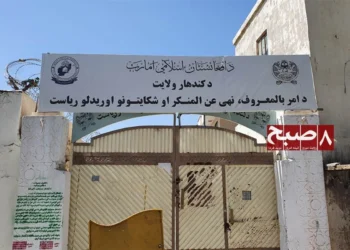
The closed gate of the Taliban’s Propagation of Virtue and Prevention of Vice office in Kandahar Province, where Morality Police activity has expanded. (Photo credit: 8am.media)
Opinion

Under the Guise of Virtue: Taliban Seek to Consolidate Illegitimate Rule

10 October 2026 [t_time:1791639625]

Latest

Loading latest news...

Popular stories

  • An Afghan woman gazes out of her home, reflecting the isolation and challenges faced by women in Afghanistan under Taliban rule. (Photo Credit: 8am.media)

    UN Report Reveals Shifts in Family Attitudes and Rise in Domestic Violence in Afghanistan

    Share
    Share Tweet
  • Taliban Intelligence Deputy in Faizabad Killed with Two Guards

    Share
    Share Tweet
  • Iraq Reports Export of Two Million Barrels of Crude Oil Through Strait of Hormuz

    Share
    Share Tweet
  • Al-Qaeda Releases Hamza bin Laden Message on 9/11 Anniversary

    Share
    Share Tweet
  • Taliban Shoot Young Man from Herat After Torturing Him with Hands Tied

    Share
    Share Tweet

Podcast

Insights
Insights

Join Lynne O’Donnell for 8AM’s podcast series, Insights.
Lynne talks with generals, diplomats, soldiers, journalists, politicians, activists, people who have front row seats for conflicts around the world, and citizens with a story to tell, happy or sad. For this first series, Afghanistan is the focus. Lynne and her guests talk about the collapse of the republic in August, 2021, and the impact since — for the people of Afghanistan, for the security of the region, for the safety of the world. It’s important, interesting and insightful.

Insights/22: Controlling the Narrative with Mina Sharif
byinsights8am

Controlling the Narrative

Lynne O’Donnell talks with Mina Sharif, author, activist, women’s rights campaigner, educator and mentor. They discuss who controls the narrative and who speaks for Afghanistan’s people when the Taliban appear to have seized control not only of the country but of the message, too.

Have a listen

Insights/22: Controlling the Narrative with Mina Sharif
Episode play icon
Insights/22: Controlling the Narrative with Mina Sharif
Episode Description
Episode play icon
Insights/21: Media Meltdown with Zahra Joya
Episode Description
Episode play icon
Insights/20: Terror Inc with Scott Richards
Episode Description
Episode play icon
Insights/19: Busting Stereotypes with Bushra Gohar
Episode Description
Episode play icon
Insights/18: Media Matters with Waliullah Rahmani
Episode Description
Episode play icon
Insights/17: What Goes Around Comes Around with Sima Samar
Episode Description
Search Results placeholder
Hasht-e Subh

8AM Media, also known as Hasht-e-Subh Daily, stands as Afghanistan's premier independent and non-profit newspaper, resonating as a beacon of journalistic integrity since its establishment in June 2007 by esteemed Afghan journalists and human rights advocates. With a steadfast commitment to citizen journalism and civic education, Hasht-e-Subh Daily has earned its place as the most esteemed publication in the nation.

Publisher: Sanjar Sohail
Email: [email protected]
Executive Director: Parwiz Kawa
Email: [email protected]

Read More

UN: Insecurity and Restrictions Have Devastating Consequences for Children in Afghanistan

The Politics We Inherited: Rethinking Afghanistan’s Political Culture

Under the Guise of Virtue: Taliban Seek to Consolidate Illegitimate Rule

UN Women: Honouring Navi Pillay Highlights the Importance of Fighting for Justice

Kabul Residents Decry Rising LPG Prices, Uneven Rates and Weak Market Oversight

Editor’s Choice

Every Saturday morning, 8AM MEDIA English Services Department will guide you through the week’s biggest stories from Afghanistan and the international community.

Subscribe

© 2026 - ©Hasht-e Subh Daily

No Result
View All Result
8am.Media
پښتو ویب‌پاڼه
ویب‌سایت فارسی
اۉزبېکچه ویب‌سایت
  • Home
  • News
    • Afghanistan News
    • World News
  • Opinion
    • Editorial
    • Analysis
  • Reports
    • Daily Reports
    • Investigative Reports
  • Society
    • The story of people
  • Women’s Word
  • Columns
    • Three Years After Afghanistan’s Fall: The Taliban’s Resurgence
    • Towards Equality
    • The Resurgence of the Taliban: Two Years Since Afghanistan’s Fall
    • Hebatullah Report Special Edition
    • Resistance for Education Special Edition
    • Special Column on Taliban’s Education Curriculum
    • Nawroz
  • Interviews
  • Contact Us
    • About Us
    • 8AM MEDIA Annual Awards
    • Submit an Article to Hasht-e-Subh
  • 8am.media

© 2026 - ©Hasht-e Subh Daily