
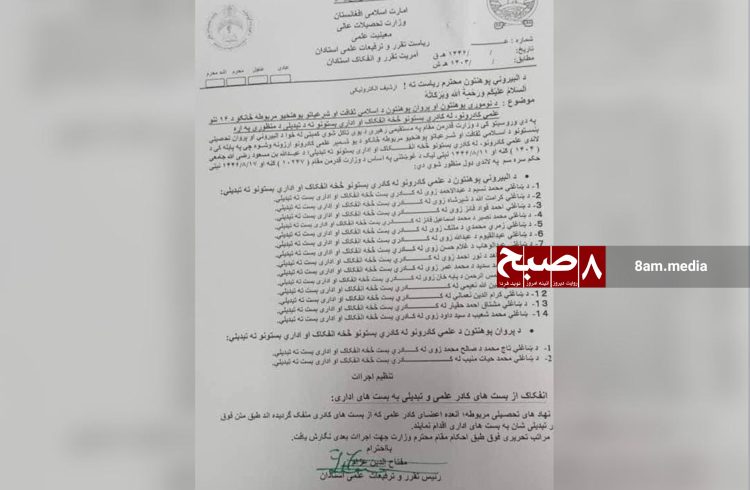
The process of replacing public university faculty members with Taliban-affiliated clerics has intensified. In the latest development, documents obtained by the Hasht-e Subh Daily reveal that the Taliban’s Ministry of Higher Education has appointed 15 of the group’s clerics as lecturers at Parwan and Al-Biruni universities, while simultaneously removing 16 existing academic staff members from their teaching positions and reassigning them to administrative posts.
Several university professors have stated that the exclusion of women, censorship of educational content, ideological vetting of lecturers based on loyalty to the Taliban, and the use of universities as propaganda tools are part of the group’s broader strategy to “Talibanize” higher education institutions. This comes at a time when Al-Biruni University is facing a critical shortage of faculty members. According to the documents reviewed by the Hasht-e Subh Daily, in some cases, a single lecturer is tasked with teaching subjects across unrelated academic disciplines. Meanwhile, some professors have expressed dissatisfaction with what they describe as ethnic discrimination and the reappointment of individuals based on ethnic affiliations.
In a separate development, the Taliban organized a seminar titled “Mullah Omar Studies” at the Ghor Institute of Higher Education, during which the group referred to their former Supreme Leader as “the third Umar”—a title equating him with Umar ibn al-Khattab, the second caliph of Islam.
The Hasht-e Subh Daily has obtained additional documents indicating that, as part of the ongoing campaign to purge faculty in Islamic Culture and Islamic Studies from public universities, the Taliban’s Ministry of Higher Education has dismissed 16 academic staff members from Parwan and Al-Biruni universities. These individuals have been replaced with Taliban affiliates, most of whom are graduates of madrasas in Pakistan.
Sources at Al-Biruni University told the Hasht-e Subh Daily that the Taliban’s Ministry of Higher Education had previously ordered professors to prepare for a seminar that would serve as an evaluation of their performance. Failure to meet expectations would result in dismissal and replacement. According to these sources, just one day before the scheduled evaluation, the Taliban unexpectedly notified faculty members that the seminar topics had been changed to subjects unrelated to their areas of expertise. The sources added that while the official documents stated that the professors would be transferred to administrative positions, in practice, none were assigned such roles and were instead directly dismissed from their posts.
According to proposal No. 3945/3427 dated February 20, 2025, the Taliban Ministry of Higher Education’s Directorate for Faculty Promotion and Recruitment, with the approval of Neda Mohammad Nadeem, the Taliban Minister of Higher Education, formally appointed 15 Taliban-affiliated clerics—most of whom are graduates of Pakistani madrasas—as new faculty members at Parwan and Al-Biruni universities. In conjunction with this decision, existing academic staff were removed from their teaching positions and reassigned to administrative roles. The letter states that the academic staff removed from their posts should be transferred to administrative roles following the provisions of the document.
List of Taliban Clerics Appointed as University Lecturers at Parwan and Al-Biruni Universities
| No. | Name | Father’s Name | Seminary Graduated From | Faculty | University |
| 1 | Abdul Hasib | Sultan Ali | Jamia al-Sahafa, Pakistan | Islamic Education | Parwan |
| 2 | Rahmatullah | Mohammad Ismail | Darul Uloom Abu Bakr Siddiq | Islamic Culture | Parwan |
| 3 | Samiullah | Abdul Aziz | Jamia Muhammadiya, Sahak | Islamic Education | Al-Biruni |
| 4 | Mohammad Ali | Mohammad Khan | Jamia Darul Uloom Siddiqiya, Pakistan | Islamic Education | Al-Biruni |
| 5 | Zabihullah Baik | Mohammad Aman Baik | Shah Madina Seminary | Islamic Culture | Al-Biruni |
| 6 | Mohammad Saber | Mirbaaz | Abdullah Jamia | Islamic Culture | Al-Biruni |
| 7 | Khal Mohammad | Nik Mohammad | Jamia al-Islamiya Ahsan al-Uloom | Islamic Education | Al-Biruni |
| 8 | Sakhi Danish | Qachqaar | Jamia Ikhlas | Islamic Culture | Al-Biruni |
| 9 | Mohammad Shua’ya Yusha | Mohammad Shoaib | Haji Mohammad Aslam, Kunduz | Islamic Culture | Al-Biruni |
| 10 | Abdul Jalil | Abdul Jabbar | Jamia Imdad al-Uloom, Peshawar | Islamic Education | Al-Biruni |
| 11 | Noor Ahmad Rasuli | Saleh Mohammad | Darul Uloom, Herat | Islamic Culture | Al-Biruni |
| 12 | Mahboobullah | Abdul Mohammad | Abdullah bin Masood Seminary, Pakistan | — | Al-Biruni |
| 13 | Samarddin | Shojauddin | Haji Chaman Seminary | Islamic Education | Al-Biruni |
| 14 | Fazl Menallah | Mohammad Akbar | Nusrat al-Uloom, Cheltan, Paghman | Islamic Education | Al-Biruni |
| 15 | Abdul Sabbar | Abdul Ghafar | Jamia Umar ibn al-Khattab | Islamic Culture | Al-Biruni |
List of Academic Staff Dismissed from Faculty Positions and Reassigned to Administrative Roles
| No. | Name | Father’s Name | University |
| 1 | Mohammad Nasim | Abdul Ahmad | Al-Biruni |
| 2 | Karamatullah | Shir Shah | Al-Biruni |
| 3 | Ahmad Fawad | Fayiz | Al-Biruni |
| 4 | Mohammad Nasir | Mohammad Ismail | Al-Biruni |
| 5 | Zamari Mohammadi | Malang | Al-Biruni |
| 6 | Abdul Qayum | Abdullah | Al-Biruni |
| 7 | Abdul Wahab | Ghulam Hassan | Al-Biruni |
| 8 | Mujahid | Noor Ahmad | Al-Biruni |
| 9 | Mohammad Sadid | Mohammad Omar | Al-Biruni |
| 10 | Shamsurrahman | Baba Khan | Al-Biruni |
| 11 | Aminullah Naeemi | — | Al-Biruni |
| 12 | Karamuddin Naemani | — | Al-Biruni |
| 13 | Mushtaq Ahmad Haqyar | — | Al-Biruni |
| 14 | Mohammad Shoaib | Sayed Dawood | Al-Biruni |
| 15 | Taj Mohammad | Saleh Mohammad | Parwan |
| 16 | Mohammad Hayat Muneeb | — | Parwan |
Nevertheless, university professors say the Taliban have transformed academic institutions into their religious seminaries. These professors, who held recognized academic credentials and possessed over 20 years of teaching experience, were replaced by clerics from Pakistani madrasas, appointed without undergoing any formal procedures or faculty qualification examinations.
Professors at Al-Biruni and Parwan universities have also expressed concern over ethnic favoritism and discriminatory practices by the Taliban’s Ministry of Higher Education, in addition to the broader Talibanization of universities. They assert that the group is not only seeking to impose its ideological agenda on the education system but is also carrying out ethnic cleansing within the academic ranks of universities.

However, a document obtained by the Hasht-e Subh Daily shows that two professors previously dismissed by the Taliban have been reappointed following a proposal by the Directorate of Promotion and Recruitment of Lecturers and the approval of Neda Mohammad Nadeem, the Taliban Minister of Higher Education.
According to letter No. 492 dated March 3, 2025, two professors who had been removed from their academic posts by the Taliban’s Ministry of Higher Education have been reinstated. The letter, issued under the name of the Taliban’s Minister of Higher Education, states that based on the assessment of the designated committee, the two professors—Mohammad Shoaib, son of Sayed Dawood, and Aminullah, son of Amanullah—who were previously dismissed from the Islamic Culture department and reassigned to administrative roles, have now successfully passed a re-evaluation and have been rehired.
Meanwhile, credible sources at Al-Biruni University report that the Taliban have dismissed several faculty members at the university on charges of affiliation with Hizb ut-Tahrir and inclination toward Salafism, replacing them with clerics aligned with the group’s ideological views. According to these sources, the university is currently suffering from a severe shortage of academic staff, to the extent that some instructors have been forced to teach two or three subjects outside their fields of expertise.
A timetable from one of the faculties at Al-Biruni University, obtained by the Hasht-e Subh Daily, indicates that a single professor is teaching three subjects across three different disciplines. According to the schedule, this professor teaches Computer Science, History of Global Media, and Psychology.
Sources further state that many lecturers at Al-Biruni and Parwan universities, in an effort to retain their positions, have resorted to “appeasement” tactics—offering praise and outward displays of alignment with the Taliban. According to these sources, many experienced and skilled academic staff have either resigned or left the country. At the same time, students have also been stripped of their previous freedoms and now face humiliating and degrading treatment if they fail to comply with the Taliban’s expectations and standards of behavior.
“Mullah Omar Studies”: Institutionalizing the Cult of Mullah Omar in Universities
Previously, sources had reported that a seminar titled “Mullah Omar Studies” was held at Al-Biruni University. According to these sources, the Taliban forcibly compelled professors and students to attend the event. A few days earlier, the university’s deputy director announced in WhatsApp groups that attendance at the seminar would be mandatory. Professors were instructed to send all students to the mosque, and absence was to be recorded as a violation. Sources emphasized that most students were unwilling to participate, but were met with the Taliban’s aggressive response. The university gates were locked, and students were forcibly taken to the mosque.
The Taliban-controlled Ministry of Higher Education has begun holding seminars under the title “Mullah Omar Studies” across universities nationwide. Following Al-Biruni University, the Ghor Institute of Higher Education also announced the organization of such a seminar. In a statement posted on its official Facebook page, the institute declared that a “specialized seminar” had been held on the life and legacy of Mullah Omar, the former Taliban Supreme Leader, in which he was referred to as the “Third Umar”—a term placing him on par with Umar ibn al-Khattab, the second caliph of Islam.
Meanwhile, the Taliban held a seminar yesterday at Faryab University titled “The Importance of the Beard in Islam,” attended by professors and students. The Taliban-appointed head of the university described shaving the beard as “an imitation of the enemies of Islam and a result of ignorance of religious teachings.” He also claimed that shaving is medically harmful. According to this Taliban official, the reasons for the popularity of shaving among young men include “lack of knowledge about its medical harms, ignorance of its religious prohibition, and emulating global celebrities.”

The Taliban have banned women and girls, including female professors and students, from attending universities.
The Taliban have established an institution called the “Abdullah bin Masoud Society,” through which they recruit madrasa-educated clerics and appoint them as university faculty. This institution functions under the Taliban’s “Directorate of Specialized Societies” and is currently led by a Taliban member named Asadullah Farid. It also operates within the group’s judicial and religious edict (fatwa) divisions, granting Taliban clerics the authority to issue fatwas and make judicial rulings.
Previously, the Taliban’s Ministry of Higher Education removed 26 professors from the faculties of Islamic Studies at Kabul University, Kabul Medical University, Kabul University of Education, and Kabul Polytechnic University, reassigning them to administrative roles as part of its broader strategy to appoint affiliated clerics to university positions.
Since the Taliban issued their official decree in December 2022, all women have been banned from pursuing higher education in both public and private universities. Simultaneously, many experienced professors who were critical of Taliban policies have either been dismissed or forced to flee the country.
Academic content has increasingly shifted toward complete Talibanization, with some fields of study, such as fine arts, being shut down entirely. The academic environment is under intense ideological and security pressure. Professors and students are under constant surveillance, and any expression of dissent can lead to expulsion, arrest, or harassment.
Earlier, Neda Mohammad Nadeem, acting Minister of Higher Education for the Taliban, stated that requiring Taliban members to take academic qualification exams is disrespectful to the group’s fighters. In a speech at Herat University, he emphasized that a Taliban member’s academic rank should be determined by the number of explosives he has planted.
In many universities, Taliban-appointed Morality Police from the Ministry for the Propagation of Virtue and Prevention of Vice monitor students’ dress, speech, and behavior. This situation has fostered fear, self-censorship, and a pervasive atmosphere of distrust within academic institutions. Meanwhile, the departure of experienced faculty and the imposition of sweeping restrictions have severely impacted the quality of education.
The United Nations Assistance Mission in Afghanistan (UNAMA), in its official reports and statements, has condemned the Taliban’s “academic purges,” the ban on female education, and their discriminatory educational policies. In a statement published in December 2022, UNAMA described the ban on women’s education as “a grave human rights violation and a global disgrace.” In its annual reports, the mission has expressed concern over declining academic participation, the dismissal of faculty, and censorship of educational materials, calling these developments a threat to the future of Afghanistan’s educational system.
The United Nations Educational, Scientific and Cultural Organization (UNESCO) also warned in a 2023 report that Afghanistan’s academic institutions are facing a deep crisis regarding academic independence, freedom of expression, and knowledge exchange.
Human Rights Watch has similarly cited the dismissal of critical professors, restrictions on academic content, and the imposition of ideological pressure on universities as part of the Taliban’s broader effort to assert complete control over society.
In its “Academic Freedom Monitoring Project,” the organization Scholars at Risk reported that researchers and students in Afghanistan face repeated and widespread attacks on academic freedom and institutional independence. The report notes that the Taliban have confiscated books deemed inconsistent with Hanafi jurisprudence and have imprisoned several professors for facilitating education for women.
According to the organization’s findings, the Taliban’s stringent regulations have not only violated academic autonomy but have also triggered a wave of faculty migration and escalated security threats against scholars. The report further states that the Taliban have implemented policies aimed at exerting sweeping control over academic and educational content.
You can read the Persian version of this investigative report here:
از علم تا ایدیولوژی؛ تسلط طالبان بر دانشگاهها و استخدام گسترده ملاها | روزنامه ۸صبح