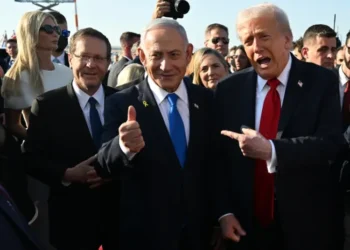
Mohammad Ashraf Ghani, former President of Afghanistan, six years, nine months, and eight days before today (28 November 2019), traveled to Bagram Airfield at the request of Donald Trump, President of the United States, and met with him. That meeting resembled a “summons” more than a formal dialogue between senior officials of two independent states. The meeting caused an uproar at the time, because Trump’s manner toward Ghani was “informal” and far removed from the diplomatic courtesies and protocols usually observed. The most striking and widely reported scene was that Ghani stood a few steps behind Trump, alongside American soldiers, without the host observing diplomatic etiquette, so much so that even the Afghan tricolor flag was not visible beside the American flag. When Ghani’s brief remarks ended, Trump kept him standing a few steps behind, again alongside American soldiers, once more contrary to customary diplomatic practice.
Reading the memoir of John Bolton, National Security Advisor in the first Trump administration, one encounters an account that revives the memory of the Ghani and Trump meeting: the refusal of Adil Abdul-Mahdi, then Prime Minister of Iraq, to meet with Trump at Ain al-Asad military base. Bolton writes in his book The Room Where It Happened that by the time they finished drafting the statement, it became clear that Prime Minister Abdul-Mahdi was not going to come, which was a major mistake on his part. His advisors had convinced him that it would not be fitting for the Iraqi Prime Minister to meet the President at an American base, even though the base was surrounded by an Iraqi base, one that had once belonged to the United States. Instead, Bolton notes, the two had a good phone call, and Trump invited Abdul-Mahdi to the White House, which he describes as a positive sign.
Regarding Bolton’s account, a few points deserve attention. First, according to him, the Iraqi Prime Minister committed a “major mistake.” Second, Abdul-Mahdi’s advisors prevented the meeting; otherwise, he might have gone to Ain al-Asad. Third, Abdul-Mahdi was not only spared reproach but was also praised, and Trump invited him to the White House. If this third point is taken as the standard for judgment, then the criticism directed at Ghani does not seem entirely unwarranted.
At the same time, the two episodes share several common features. First, Ghani and Abdul-Mahdi were both invited to bases where American forces were stationed. Second, the United States maintained a military presence in both countries, Afghanistan and Iraq, with the difference that it later withdrew from Kabul but not from Baghdad. Third, the top officials of both countries were invited to meet the same individual, Trump, with the difference that one accepted immediately and the other did not. Fourth, the ruling systems in both countries had been toppled through American military intervention, within a short span of each other. Fifth, both countries were dependent on the United States at the time, though to differing degrees. Iraq’s dependence on the United States persists to this day, but the same cannot be said with certainty about Afghanistan, since Kabul has since undergone another “regime change,” and the new regime claims to owe no allegiance to major powers, particularly the United States, a claim that remains in doubt.
Among these shared features, the question of dependence deserves particular attention, since Trump appeared to rely precisely on this element when he invited the top leaders of both countries to two military bases. In other words, dependence on the United States functions as a “weakness” for weaker states, leaving their rulers with little choice but to comply with the wishes of the occupants of the White House, though not necessarily under all circumstances. On this basis, some might argue that the twenty-year Republic’s dependence on the United States compelled Ghani to appear at Bagram. However, Abdul-Mahdi’s avoidance of Ain al-Asad weakens this argument, because if the Republic was dependent on the United States, post-Saddam Iraq was arguably even more so.
Iraq is absolutely dependent on the United States in the economic sphere, to the extent that it cannot spend even a single dollar of its oil revenues without the authorization of the United States Federal Reserve. All of Iraq’s oil revenues are deposited into an account at the US Federal Reserve, and Baghdad has no authority to draw on them except with the permission of the White House. An agreement to this effect was concluded between Washington and Baghdad after the fall of the Saddam regime, and it remains in force to this day. The United States has repeatedly used the terms of this agreement as a tool of pressure against Iraq. By contrast, the twenty-year Republic in Afghanistan had a far more limited dependence on the United States in this respect. No country, including the United States, interfered, or interferes, in the management of revenue from Afghanistan’s underground resources.
Iraq is likewise backed against the wall by the United States in the military and security sphere. This degree of dependence has made Baghdad more responsive to the White House than to Tehran. For this reason, both the previous and current Iraqi governments have shown little enthusiasm for dismantling militias aligned with the Islamic Republic of Iran. More importantly, Iraqi airspace has repeatedly been used to launch attacks on Iran, both by Israel and by the United States. By contrast, the rulers of the twenty-year Republic held a clear position on the conflict between Iran and the United States: that they would not fight against Tehran on behalf of Washington. According to the memoirs of two prominent figures of the Republic, Rangin Dadfar Spanta and Mohammad Omar Daudzai, when a journalist asked Karzai, who was at Camp David alongside George Bush, about the Iran-United States conflict, he responded that Afghan territory would not be used by the United States against Iran. This candor, delivered at Camp David of all places, is certainly worth noting. Given this, if the factor of dependence carried significant weight, it should have been Abdul-Mahdi who went to Ain al-Asad, not Ghani who went to Bagram.
The question now is: why did Ghani go to Bagram after all? It is possible that Trump’s particular temperament drew Ghani there. Trump likes to be praised by others and to have his word accepted unconditionally. If this does not happen, he seethes with anger, especially when he is disregarded by the leader of a country that survives on American funding. Of course, Trump has also shown flexibility at times, and Abdul-Mahdi’s refusal to go to Ain al-Asad, without facing reproach from Trump, is a clear and notable example of this. Trump’s visit to Iraq had been coordinated in advance with the Iraqi government, and Abdul-Mahdi had made his meeting with Trump conditional on it being “official” in nature. For this reason, some believe that if resistance is shown to Trump, there is a strong likelihood that he will back down.
In addition, at that time, negotiations with the Taliban were in full swing, and Trump had no hesitation in granting concessions to the group. Zalmay Khalilzad had opened the door to talks with the Taliban and was continually presenting a new image of the group to the world. The Afghan government of the time had also come to understand that it was being sidelined. On this basis, Ghani felt compelled to go to Bagram to win Trump’s favor and shift his approach toward the Taliban, an effort that produced the opposite result: Ghani went, and the Taliban returned.
At the same time, Ghani was, in his own words, at war with “islands of power” across the country. For whatever motive, he did not want to include them in the government; though his approach later changed, it was, so to speak, a case of “henna after Eid,” coming too late to be of any use. To suppress these islands of power, Ghani needed foreign support, particularly from the United States and other Western countries that had little patience for “warlords.” Therefore, going to Bagram and standing alongside Trump and American soldiers also served as a warning to the islands of power, signaling that the government enjoyed American backing and had no fear of traditional ethnic power centers.
In the end, the personal perceptions of state leaders also matter. Concepts such as pride, dignity, prestige, self-respect, and magnanimity, which fall under the umbrella of ethics, may not have carried serious weight for Ghani, at least not in the realm of politics. Nor was this unique to him; it applied to many others as well. It has often happened that leaders, when facing high-stakes dilemmas, have sacrificed these ethical considerations for the sake of “expediency.” On this basis, Ghani, too, in that critical moment, apparently prioritized the expediency of his government, namely its survival, above all else.
You can read the Persian version of this analysis article here:
غنی رفت، عبدالمهدی نرفت؛ درباب دعوت ترمپ از هردو در دو پایگاه نظامی