• 8AM.MEDIA
  • ویب‌سایت فارسی
  • پښتو ویب‌پاڼه
  • اۉزبېکچه ویب‌سایت
  • Podcast
Monday, October 26, 2026
Hasht-e Subh
  • Home
  • News
    • Afghanistan News
    • World News
  • Opinion
    • Editorial
    • Analysis
  • Reports
    • Daily Reports
    • Investigative Reports
  • Society
    • The story of people
  • Women’s Word
  • Columns
    • Three Years After Afghanistan’s Fall: The Taliban’s Resurgence
    • Towards Equality
    • The Resurgence of the Taliban: Two Years Since Afghanistan’s Fall
    • Hebatullah Report Special Edition
    • Resistance for Education Special Edition
    • Special Column on Taliban’s Education Curriculum
    • Nawroz
  • Interviews
  • Contact Us
    • About Us
    • 8AM MEDIA Annual Awards
    • Submit an Article to Hasht-e-Subh
  • 8am.mediaBack
Subscribe
No Result
View All Result
  • Home
  • News
    • Afghanistan News
    • World News
  • Opinion
    • Editorial
    • Analysis
  • Reports
    • Daily Reports
    • Investigative Reports
  • Society
    • The story of people
  • Women’s Word
  • Columns
    • Three Years After Afghanistan’s Fall: The Taliban’s Resurgence
    • Towards Equality
    • The Resurgence of the Taliban: Two Years Since Afghanistan’s Fall
    • Hebatullah Report Special Edition
    • Resistance for Education Special Edition
    • Special Column on Taliban’s Education Curriculum
    • Nawroz
  • Interviews
  • Contact Us
    • About Us
    • 8AM MEDIA Annual Awards
    • Submit an Article to Hasht-e-Subh
  • 8am.mediaBack
No Result
View All Result
Hasht-e Subh
No Result
View All Result

Ghazni’s Bala Hissar Fortress Falls to Ruin as Resident Families Are Trapped Between Poverty and a Repair Ban

Translated by Farhad Farhaad | Originally reported in Persian by Ilya

Mohammad Farhaad Mohammad Farhaad
26 October 2026 - Solar Hijri Date: 1405/08/04 [t_time:1793019811]
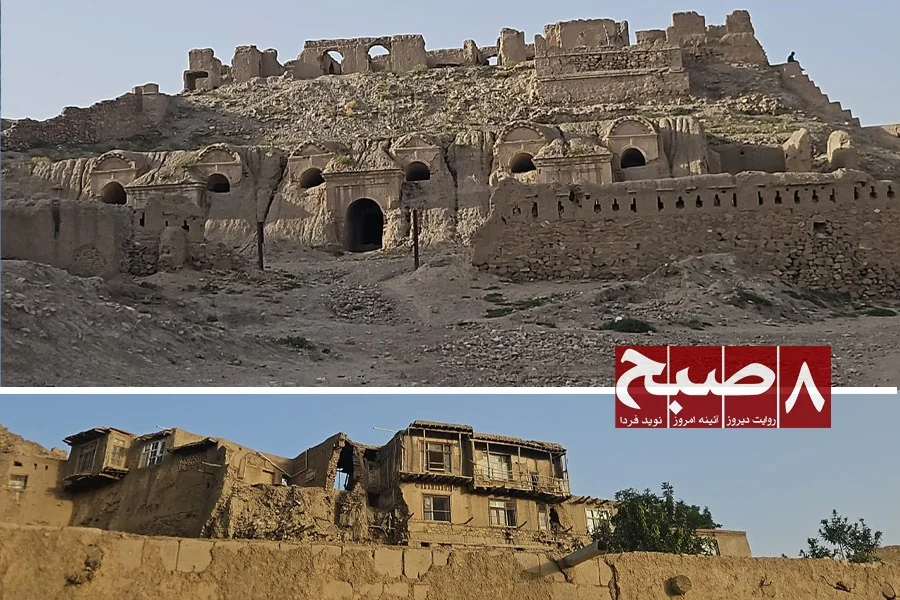
Crumbling walls of the historic Bala Hissar Fortress and a damaged residential house inside the compound in Ghazni, where families can neither leave nor repair their homes. (Photo credit: 8am.media)

8am.media

Residents of Ghazni city are calling for the families living inside the historic Bala Hissar Fortress to be relocated. They say that the families’ presence inside the fortress, along with damage from rain and snow and a lack of effective maintenance, has accelerated the destruction of this historic structure. They stress that to prevent further damage to the fortress, land and the necessary facilities must be provided to relocate the families living there.

Meanwhile, families living in the Bala Hissar Fortress say they cannot leave their homes because of economic hardship, and that the Taliban’s Department of Information and Culture does not allow them to repair these houses. According to them, their damaged homes have not only harmed parts of the fortress but also put the lives of their family members at risk. These families are asking for land to be provided so they can move elsewhere, or for permission to repair their homes.

Zarmina, a resident of Ghazni city, complains about the Taliban’s and the responsible institutions’ neglect of the protection of the historic Bala Hissar Fortress. She says that every year, after rain and snow, parts of the fortress are damaged and collapse, yet no effective action is taken to protect this historic structure. According to her, the Bala Hissar Fortress is part of Ghazni’s historical and cultural identity, and its destruction means the loss of a part of the city’s history.

Zarmina says: “Historic sites are part of our culture and identity and must not be destroyed. If these sites disappear, our history disappears with them. The Bala Hissar Fortress has faced serious erosion for years. Its walls and towers have been badly damaged, and parts of them have collapsed. Sometimes only minor repairs are carried out, and money is wasted on them, whereas if the fortress were fundamentally rebuilt, further destruction could be prevented. There are also residential houses inside the fortress, many of which are dilapidated and on the verge of collapse.”

Hanzala, another resident of Ghazni city, says that the families’ residence inside the fortress and the Taliban’s neglect of its protection have intensified the destruction of this historic structure. He adds that, because of the lack of oversight and accountability, some residents treat parts of the fortress arbitrarily, without regard for its historical value. In his view, the destruction will continue until the families living in the fortress are relocated, and an effective plan to protect it is undertaken.
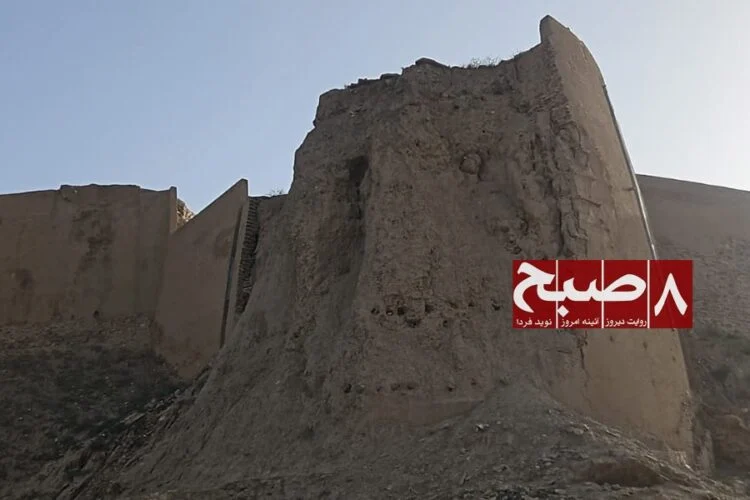
A weathered mud-brick tower and eroded walls of the historic Bala Hissar Fortress in Ghazni, where parts of the structure have collapsed over the years. (Photo credit: 8am.media)

The young man says: “Every year a part of the Bala Hissar Fortress collapses, and the work done to rebuild it is mostly superficial. The fortress where Mahmud of Ghazni and earlier kings ruled has now turned into ruins. This structure is part of our historical identity and must be protected. Until the residential houses are moved out of the fortress and an effective plan to protect it is undertaken, this historic structure will suffer further damage. By relocating the families and creating the conditions to attract tourists, the income from tourism could be used to rebuild and maintain the fortress.”

Kitabkhan Faizi, a cultural expert, also stresses the need to relocate the families living in the Bala Hissar Fortress and to provide suitable accommodation for them. He says the fortress is one of Ghazni’s important historical monuments and dates back to the pre-Islamic era, but that it was damaged in various historical periods as a result of invasions.

Mr. Faizi says: “The Bala Hissar Fortress of Ghazni is one of the important historical monuments, dating back to the pre-Islamic era, but it was also damaged in various historical periods as a result of invasions. The residential houses inside this compound have led to its growing destruction, and tourists cannot visit this historic site properly. I believe alternatives should be provided for the owners of these houses, and land and the necessary funds for their relocation should be set aside so that further destruction of this historic structure can be prevented.”

Meanwhile, families living in the Bala Hissar Fortress say that the houses and drainage channels in the compound have damaged parts of the historic structure, but that they cannot leave their homes because of economic hardship. These families add that the Taliban’s Department of Information and Culture does not allow them to repair their homes either, and they are asking the authorities to find a solution, either by relocating them or by allowing them to repair their houses.

Noor Ul Ain, a resident of the Bala Hissar Fortress in Ghazni, says his family cannot afford to leave the house because of economic hardship and, on the other hand, has not received permission to rebuild it. According to him, continuing to live in a damaged house has put his family members at risk.

The young man says: “Our family has lived here since the time of my father and grandfather. The roof of my house is damaged, and every time it rains, I am afraid it will collapse. I gather my children in a corner so they will not be hurt. We can neither afford to leave the house nor are we allowed to rebuild it. If the aim is to protect the Bala Hissar Fortress, then arrangements must be made to relocate the resident families, or they must be allowed to repair their own homes. The economic situation of the people here is difficult. In one compound, five or six brothers live with their families, and sometimes two or three families live in a single house. We are forced to stay here because of poverty.”

The historic “Ghaznin” Fortress in the old city of Ghazni is a structure more than a thousand years old, built on top of a high hill within a compound covering 80 hectares in the heart of this historic city. This ancient fortress, regarded as one of the country’s most important cultural heritage sites, has 34 towers and four gates. In certain periods of history, all of Ghazni’s residents lived inside this fortress, and at times it served as the seat of rule of Sultan Mahmud of Ghazni.

In 2013, the province of Ghazni was named the “Cultural Capital of the Islamic World” by the Organisation of Islamic Cooperation (OIC). However, more than a decade later, the rebuilding of the historic fortress and the old city of this province remains unfinished and in limbo.


You can read the Persian version of this report here:

قلعه تاریخی غزنی در حال ویرانی؛ خانواده‌ها نه توان رفتن دارند، نه اجازه ترمیم
ShareTweetSendSendShare

Related Posts

Afghanistan Freedom Front Slogan displayed (Photo: @AfgFreedomAFF/X)
Afghanistan News

Afghanistan Freedom Front: Two Taliban Members Killed in Kabul

26 October 2026 [t_time:1793012519]
A view of a busy street in Kandahar, Afghanistan, showing vehicles, pedestrians, and commercial buildings
Afghanistan News

Sources: Taliban to Demolish Around 2,000 Shops in Kandahar

26 October 2026 [t_time:1793009047]
The Milak crossing border entrance (Photo: Social Media)
Afghanistan News

Taliban: Transit Traffic Between Afghanistan and Iran Now Operating 24 Hours a Day

26 October 2026 [t_time:1793005562]

Latest

Loading latest news...

Popular stories

  • Hossein Mohabbi - Spokesperson for Iran's Islamic Revolutionary Guard Corps (IRGC) (Photo: Tasnim)

    Iran’s Revolutionary Guards Say They Are Preparing to Unveil “Father of All Bombs”

    Share
    Share Tweet
  • UN Report Reveals Shifts in Family Attitudes and Rise in Domestic Violence in Afghanistan

    Share
    Share Tweet
  • Trump Calls Norway a “Garbage Country”

    Share
    Share Tweet
  • Trump Calls Iran’s Hope of War Lasting Beyond US Midterm Elections a “Dream”

    Share
    Share Tweet
  • Beyond Victimhood: How the Women of Afghanistan Became Actors of Civil Resistance Against Gender Apartheid

    Share
    Share Tweet

Podcast

Insights
Insights

Join Lynne O’Donnell for 8AM’s podcast series, Insights.
Lynne talks with generals, diplomats, soldiers, journalists, politicians, activists, people who have front row seats for conflicts around the world, and citizens with a story to tell, happy or sad. For this first series, Afghanistan is the focus. Lynne and her guests talk about the collapse of the republic in August, 2021, and the impact since — for the people of Afghanistan, for the security of the region, for the safety of the world. It’s important, interesting and insightful.

Insights/22: Controlling the Narrative with Mina Sharif
byinsights8am

Controlling the Narrative

Lynne O’Donnell talks with Mina Sharif, author, activist, women’s rights campaigner, educator and mentor. They discuss who controls the narrative and who speaks for Afghanistan’s people when the Taliban appear to have seized control not only of the country but of the message, too.

Have a listen

Insights/22: Controlling the Narrative with Mina Sharif
Episode play icon
Insights/22: Controlling the Narrative with Mina Sharif
Episode Description
Episode play icon
Insights/21: Media Meltdown with Zahra Joya
Episode Description
Episode play icon
Insights/20: Terror Inc with Scott Richards
Episode Description
Episode play icon
Insights/19: Busting Stereotypes with Bushra Gohar
Episode Description
Episode play icon
Insights/18: Media Matters with Waliullah Rahmani
Episode Description
Episode play icon
Insights/17: What Goes Around Comes Around with Sima Samar
Episode Description
Search Results placeholder
Hasht-e Subh

8AM Media, also known as Hasht-e-Subh Daily, stands as Afghanistan's premier independent and non-profit newspaper, resonating as a beacon of journalistic integrity since its establishment in June 2007 by esteemed Afghan journalists and human rights advocates. With a steadfast commitment to citizen journalism and civic education, Hasht-e-Subh Daily has earned its place as the most esteemed publication in the nation.

Publisher: Sanjar Sohail
Email: [email protected]
Executive Director: Parwiz Kawa
Email: [email protected]

Read More

Ghazni’s Bala Hissar Fortress Falls to Ruin as Resident Families Are Trapped Between Poverty and a Repair Ban

Water Shortages and Heavy Bills Leave Kabul’s District 7 Residents Worried

CNN: U.S. Preparing for Large-Scale Military Operations Against Iran

Storms Cut Power to More Than 150,000 Homes in Northern Europe

Afghanistan Freedom Front: Two Taliban Members Killed in Kabul

Editor’s Choice

Every Saturday morning, 8AM MEDIA English Services Department will guide you through the week’s biggest stories from Afghanistan and the international community.

Subscribe

© 2026 - ©Hasht-e Subh Daily

No Result
View All Result
8am.Media
پښتو ویب‌پاڼه
ویب‌سایت فارسی
اۉزبېکچه ویب‌سایت
  • Home
  • News
    • Afghanistan News
    • World News
  • Opinion
    • Editorial
    • Analysis
  • Reports
    • Daily Reports
    • Investigative Reports
  • Society
    • The story of people
  • Women’s Word
  • Columns
    • Three Years After Afghanistan’s Fall: The Taliban’s Resurgence
    • Towards Equality
    • The Resurgence of the Taliban: Two Years Since Afghanistan’s Fall
    • Hebatullah Report Special Edition
    • Resistance for Education Special Edition
    • Special Column on Taliban’s Education Curriculum
    • Nawroz
  • Interviews
  • Contact Us
    • About Us
    • 8AM MEDIA Annual Awards
    • Submit an Article to Hasht-e-Subh
  • 8am.media

© 2026 - ©Hasht-e Subh Daily