
Several residents of Tolak district in Ghor province are complaining about the Taliban’s decision to allocate the revenue from the district’s lead and zinc mine to the construction of a 200-kilometer Kandahar-Uruzgan road. They say this decision has been made while the people of Tolak and other parts of Ghor are facing widespread deterioration of roads. According to them, the condition of some routes is so poor that transporting patients to health centers is delayed, and in some cases even endangers patients’ lives.
These residents, speaking to the Hasht-e Subh Daily, say they have repeatedly asked Taliban officials and officials of the extraction company to spend the mine’s revenue on developing and rebuilding Ghor’s infrastructure, but these requests have so far produced no result. They are calling on the Taliban to spend the revenue from the Tolak mine on building the Ghor-Herat and Ghor-Kabul roads, which they say are among the basic needs of the central regions, instead of allocating it to the Kandahar-Uruzgan road.
According to them, while the people of Ghor suffer from deteriorating roads and a lack of infrastructure, the Taliban have allocated the province’s mining revenue to road construction in other provinces. They say this decision disregards the needs of the people of Ghor and diminishes the province’s share of its own natural resources.
Ahmad (pseudonym), a resident of Ghor province, criticizes the Taliban’s decision to allocate revenue from the lead and zinc mine in the province’s Tolak district to the construction of the Kandahar-Uruzgan road. He says that given its widespread lack of infrastructure, Ghor needs the mine’s revenue more than many other provinces, and that income from the province’s natural resources should not be spent on projects outside Ghor.
According to Ahmad, if the revenue from the Tolak mine is to be spent on road construction, it should be allocated to improving Ghor’s roads, particularly the Ghor-Herat and Ghor-Kabul roads.
This Ghor resident, who criticizes the lack of attention to the province’s transportation problems and their absence from media coverage, told the Hasht-e Subh Daily: “Today I saw on Facebook that National Radio and Television reported that the lead and zinc mine in Tolak district of Ghor is being extracted, and in exchange, a 200 kilometer Kandahar-Uruzgan road will be built, while the people of Ghor are deprived of many basic facilities. Why does the voice of the people of Ghor not reach anyone, and why is this deprivation not shown? If you don’t believe it, at least take a few minutes to see the condition of the people up close; then you will understand what injustice is being done to the people of Ghor.”
Ahmad adds that revenue from Ghor’s natural resources should not be allocated to projects outside the province without taking the needs of its people into account.
This Ghor resident says: “This is part of the grievances of the deprived people of Ghor, who have been crying out for years, but their voice has not been heard to this day. When the previous government had just collapsed, the Taliban said the previous government was corrupt and that they would build the Ghor-Herat highway; but today the people of Ghor still face the same problem.”
Ehsan (pseudonym), another resident of Ghor province, says that the allocation of revenue from the lead and zinc mine in Tolak district to the construction of the Uruzgan-Kandahar road has taken place while the people of this district continue to face a shortage of basic infrastructure. He adds that the lack of a standard road, health services, schools, drinking water, and job opportunities are among the major problems facing the people of Tolak, and that the mine’s revenue could be spent on addressing these needs. Ehsan emphasizes that before allocating the mine’s revenue to projects outside Ghor, the Taliban should prioritize the urgent needs of the province’s people.
Ehsan says: “If Ghor’s mining revenue is being spent on the development of Uruzgan and Kandahar, why is the share of Ghor’s deprived people being ignored? Justice requires that a significant portion of this revenue be spent on developing Ghor, creating job opportunities and improving the lives of the people of Tolak. The mine should be an opportunity for the people of the region, not a continuation of their deprivation.”
Atiq (pseudonym), a resident of Ghor province, says that elders and residents of Tolak district have held talks with Taliban officials and the company extracting the lead and zinc mine to have part of the mine’s revenue spent within the district, but these talks have so far produced no result. He adds that the people of Tolak face a severe shortage of infrastructure, particularly roads, and that in winter, transporting patients to the district center and other areas is difficult. According to him, despite these problems, no specific plan has yet been adopted to spend the mine’s revenue on road construction and improving Tolak’s infrastructure situation.
Atiq says: “The people of Tolak district have spoken up many times, but have gotten no result. Since the mine is extracted from Tolak district, the people of this very region have the right of priority; they should be given a share in work and employment, and the mine’s revenue should be used for road construction.”
Asadullah (pseudonym), another resident of Ghor province, says that the people of Tolak district should have a greater share of the revenue from the district’s lead and zinc mine. He adds that when natural resources are extracted from this district, part of the revenue should be spent on solving local problems, particularly building and rebuilding roads and developing Ghor’s infrastructure.
Asadullah says: “Our request, especially that of the people of Tolak district, is that since the mine is located in our region, the local people’s priority right to use its revenue be taken into account. What we want is for Ghor’s own roads to be built and for the mine’s revenue to be spent on developing the province and improving people’s lives.”
Shekab (pseudonym), another resident of Ghor province, says that in his view, the Taliban take into account the interests of individuals and groups close to them in their decision-making. He adds that the people of Ghor have no role in decisions regarding the province’s resources and projects, and that their protests have so far produced no result.
This Ghor resident says: “Everything is in the hands of the Pashtuns; the Amir is one of their own, and the decision-making is in their hands too. Whatever we say goes unheard, and our voice reaches nowhere.”
Meanwhile, several other residents of Ghor province have criticized the Taliban’s decision to allocate revenue from the Tolak district lead and zinc mine to the construction of the Kandahar-Uruzgan road, publishing news reports and images of the poor condition of the province’s roads and infrastructure. On their Facebook pages, they have written that despite having natural resources, Ghor remains deprived of standard roads and basic infrastructure, and have called for justice in the distribution and use of mining revenue.
Yasin Azhand, one of these residents, wrote on his Facebook page criticizing the decision: “The revenue from the lead and zinc mine in Tolak district of Ghor province is set to be used to pave roads in two of Afghanistan’s poorest provinces, Kandahar and Uruzgan; this even though Ghor province, with five thousand kilometers of vehicle roads, has only 10 kilometers of paved road, and even that is being destroyed.”
Taimur Shah, another resident of Ghor, also wrote in reaction to the decision: “This is the same old story; one person has the mine, another gets the road, and the owner of the mine only watches the road’s dust. Perhaps a day will come when, in the lexicon of development, Ghor too will be counted as a province of Afghanistan, not just a land for mineral extraction.”
These criticisms come as the Taliban had previously announced that a factory for extracting and processing the lead and zinc mine of Tolak district in Ghor province has been built in Herat, with the work fifty percent complete. Under the contract, the extraction company is also responsible for building the 200-kilometer Kandahar-Uruzgan road in exchange for extracting and processing the mine.
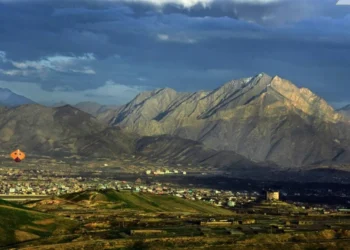
The lead and zinc mine of Tolak district, covering an area of about 800 square kilometers, is considered one of the country’s largest lead and zinc mines, and two companies are active in its exploration and extraction. In a report broadcast by Taliban-controlled National Television, an official of one of the contracting companies said that construction of the Kandahar-Uruzgan road, which has been entrusted to the company under this contract, has also progressed to some extent.
However, residents of Ghor say that while the province’s natural resources have been allocated to a project outside Ghor, the infrastructure and transportation problems facing its people persist. They are calling for the needs of the province’s people to also be taken into account in the spending of revenue and benefits derived from Ghor’s mines.
You can read the Persian version of this report here:
غور خود سرک ندارد؛ عواید معدن تولک برای ساخت جاده قندهار-ارزگان هزینه میشود