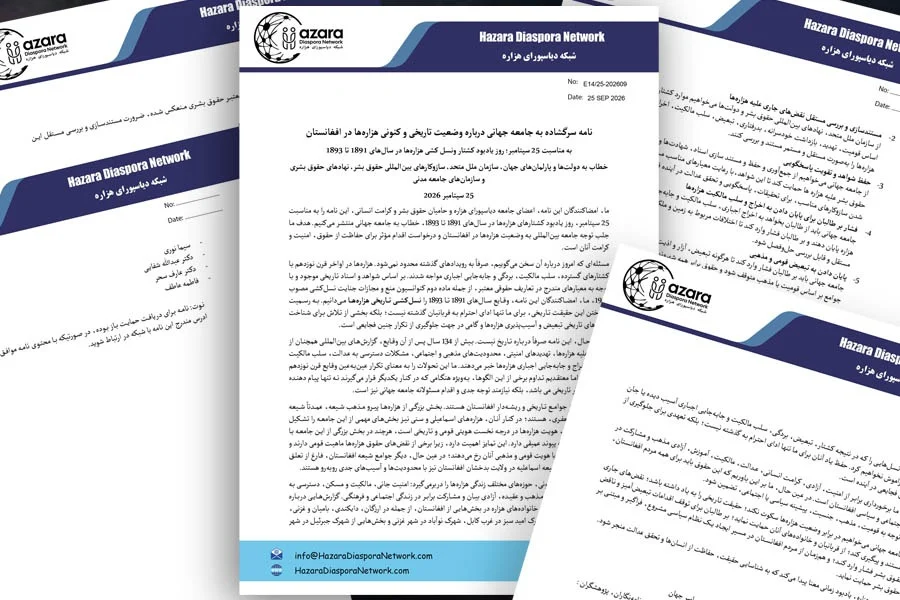
The Hazara Diaspora Network, in an open letter marking September 25, the anniversary of the “mass killing of the Hazaras,” has called for these events to be recognized as the “Hazara genocide.” The letter has also been endorsed and signed by a number of political and civil society activists. Citing the United Nations (UN) Convention of 1948, the signatories describe the massacres of 1891 to 1893 as constituting “genocide” and call for urgent action by the international community to end the structural discrimination, property seizures and forced displacement currently taking place in Afghanistan.
The signatories say their aim is not limited to past events alone, but that existing historical evidence and documents show that the Hazaras faced mass killings, dispossession, enslavement and forced displacement in the late nineteenth century. According to them, based on the criteria set out in authoritative legal definitions, including Article Two of the Convention on the Prevention and Punishment of the Crime of Genocide (the Genocide Convention), adopted in 1948, the signatories recognize the events of 1891 to 1893 as the “Hazara genocide.” The signatories believe that recognizing this historical truth is not merely a tribute to the victims, but a necessary step toward understanding the historical roots of discrimination, the community’s ongoing vulnerabilities, and preventing the recurrence of similar atrocities in the future.
In their letter, these political and civil society activists have emphasized that recognizing this historical truth is, for them, not only a tribute to past victims, but part of an effort to understand the historical roots of discrimination and vulnerability faced by the Hazaras, and a step toward preventing the recurrence of such atrocities.
The letter states that more than 134 years after those events, international reports continue to document discrimination against the Hazaras, security threats, religious and social restrictions, difficulties in accessing justice, dispossession, and cases of eviction and forced displacement. In the letter, they state: “We do not consider these developments to be a repetition of the exact events of the nineteenth century; however, we believe that the persistence of some of these patterns not only recalls the tragic events of history, but also requires serious attention and responsible action from the international community.”
The signatories cite numerous human rights reports on the eviction and forced displacement of Hazara families in the provinces of Uruzgan, Daikundi, Bamyan and Ghazni, and state that cases of dispossession and forced eviction have also been documented in urban areas, including the Omid-e Sabz township in western Kabul, the Now Abad township in Ghazni city and the Jibrael township in Herat. According to them, these cases stand out as prominent examples of violations of housing and property rights and require independent international investigation and documentation.
The letter states that Hazara identity is, first and foremost, an ethnic and historical identity, although for a large part of this community it is also deeply linked to Shia religious identity. According to the signatories, this distinction matters because some violations of Hazara rights are ethnic in nature, while others occur in connection with both their ethnic and religious identity. At the same time, other Shia communities in Afghanistan, regardless of ethnic background, including followers of Ismaili Shia Islam in Badakhshan province, also face serious restrictions and harms.
The signatories state: “We also emphasize that the Hazara issue is not confined to the geography of Afghanistan alone. Many members of the Hazara community today live in various countries around the world, yet through their families, relatives, and historical and cultural ties, they remain deeply connected to Afghanistan. Therefore, the denial of Hazara rights and any harassment, threats, discrimination, violence, forced displacement or harm to their families and relatives in Afghanistan directly and negatively affects the peace of mind, social life and morale of members of the Hazara diaspora.”
The letter states: “Our emphasis on the situation of the Hazaras does not mean disregarding the suffering of other people of Afghanistan. We are also deeply concerned about violations of the rights of women and girls, human rights defenders, journalists and media activists, former security and defense forces, former government employees and officials, and other victims, and we support international efforts to protect all victims and document the violations of their rights. This letter’s focus on the situation of the Hazaras is intended solely to highlight the specific situation and concerns of this community and should not be understood as a comparison with or a diminishing of the suffering of other victims.”
The signatories say they want the international community to view the situation of the Hazaras not as a collection of isolated incidents, but as an ongoing issue within the field of human rights and the prevention of atrocity crimes in Afghanistan. They have also called for the documentation and independent investigation of current human rights violations against the Hazaras, support for victims and their families, the preservation of evidence for future accountability, and the use of diplomatic and human rights tools to pressure the Taliban to halt discriminatory and rights-violating actions against the Hazaras.
The letter calls on the international community to support the people of Afghanistan and inclusive political and civil processes that can lead to the formation of a legitimate, accountable and inclusive government, based on the will of the people and committed to human rights, a government in which all citizens, regardless of ethnicity, religion, gender or social background, enjoy equal rights. They have made clear that this support should be directed at the people of Afghanistan and inclusive political and civil processes, and should not be understood as recognizing or granting political legitimacy to the existing exclusionary and discriminatory structures.
The signatories have called on the international community to support the historical evidence and documents relating to the mass killings of the Hazaras in 1891 to 1893, to back independent efforts to document these events, to work toward preserving these records and enshrining them in historical memory, and to prevent the denial, distortion and forgetting of these atrocities.
They have also called on the UN, human rights institutions and governments to take continuous action to investigate and document targeted killings, harassment, arbitrary detentions, mistreatment, discrimination, dispossession and forced eviction of the Hazaras.
Another part of the letter states that documents, testimonies and evidence related to violations of the human rights of the Hazaras should be collected and preserved for use in future accountability mechanisms and judicial investigations. They have also called for an end to the forced evictions and seizure of the property of Hazara families and communities, and for the fair and independent resolution of land and property disputes. They have further called for pressure to be placed on the Taliban to end all forms of discrimination, harassment and restrictions against the Hazaras and other communities, and to guarantee equal rights for citizens without discrimination.
The signatories say they have emphasized respect for the right to life, security, property, housing, education, freedom of religion and belief, freedom of expression, and the social and cultural participation of the Hazaras, and have called for the pursuit of any deprivation arising from ethnicity or religion.
The letter states that governments and international institutions should consult with the Hazara diaspora, victims’ families, women, youth, journalists and independent researchers in their assessments and policymaking related to Afghanistan. It also emphasizes support for inclusive political and civil processes based on the will of the people and human rights, without granting political legitimacy to the current exclusionary and discriminatory structures.
The signatories have also emphasized that the asylum cases of Hazara refugees should be assessed individually and carefully, and that the principle of non-refoulement should be fully respected in cases where returning an individual would expose them to the risk of torture, persecution, or inhumane treatment. They have stressed that they will not forget the victims and the generations harmed or lost, and that preserving their memory is, for them, not merely a tribute to the past, but a commitment to preventing the recurrence of such atrocities in the future.
At the bottom of the letter, the Hazara Diaspora Network has also signed, stating that it is composed of 52 active and official institutions and organizations of the Hazara diaspora community around the world. Human rights activists, civil society campaigners, journalists, researchers and independent political activists have also signed the letter.
Among those who have signed the letter are Dr. Mohammad Amin Ahmadi, Dr. Rangin Dadfar Spanta, Dr. Suraya Dalil, Engineer Abbas Noyan, Dr. Habiba Sarabi, Dr. Abbas Basir, Dr. Aliya Yalmaz, Dr. Sardar Mohammad Rahimi, Dr. Haroon Badakhshi, Dr. Zaker Hussain Ershad, Dr. Batool Haidari, Dr. Taher Sharan, Shahgul Rezayee, Dr. Mohammad Qasim Erfani, Dr. Jumakhan Mohammadi, General Murad Ali Murad, Sima Noori, Dr. Abdullah Shafayee, Dr. Arif Sahar, Fatima Atef, Dr. Sima Samar, Dr. Shakardokht Jafari, Dr. Dawood Ali Najafi, Fahim Kargar, Liaqat Ali Amiri, Yama Yara Kamal and Mumina Yari.
You can read the Persian version of this report here:
دهها فعال سیاسی و مدنی خواستار بهرسمیتشناختن «نسلکشی هزارهها» از سوی جامعه جهانی شدند