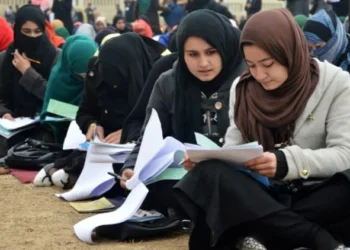
Many residents of Balkh province describe the Taliban’s rule over Afghanistan as a “reign of poverty and hunger.” They report that numerous families are marrying off their young daughters in arranged marriages due to poverty and unemployment, using the bride price to meet their immediate living needs. These families stress that, beyond meeting necessities, they hope to rescue their daughters from “uncertainty” and secure their futures. Previous reports have also highlighted that many girls are being forced into early and arranged marriages due to a lack of education and employment opportunities.
Some residents of Balkh claim that the Taliban’s dominance and the restrictions on education and employment for girls and women have worsened unemployment and poverty in the province. They argue that the ongoing situation and the absence of the rule of law have led many families to exploit their daughters, turning “girl selling” into a cultural norm. They express concern over the rise of underage and forced marriages, noting that poverty, unemployment, and the spread of Taliban ideology have pushed some families into these arrangements.
Fazila (pseudonym), a resident of one of Balkh’s districts, refrains from naming her district due to social pressures. She shares that her husband, who worked in the former local police, was killed in a clash with the Taliban five years ago. Fazila confirms that over the past three years, she has married off her three daughters, aged 13, 14, and 15.
This woman, who has recently engaged her 13-year-old daughter, explains: “I have five daughters and one son. Two of my daughters are already married, and now I’m marrying off my 13-year-old. They have no father to provide for them. Since my husband’s martyrdom, I’ve been suffering from shortness of breath and cannot afford to support my children. I had no choice but to marry off my daughters to save them from destitution and help us avoid starvation.”
While Fazila worries about her daughters’ futures, she insists that survival forces her to arrange forced marriages for her young daughters, one after the other. She says: “I still have two younger daughters. I don’t know what their fate will be, but if life continues this way, I’ll have to marry them off young as well to relieve us of our needs. I have no other option. My fate is bleak, and now my children’s future is even bleaker.”
Fazila is not alone. Dozens of other women in Balkh face similar struggles and necessities.
Laila (pseudonym), another woman from Balkh, lost her husband to COVID-19. She recounts how she married off her daughters, aged 13 and 15. Sharing her harsh life story, she says: “After my husband’s death, I faced many difficulties and had to rely on spinning thread to feed myself and my children. Now, with no jobs available for women and everything forbidden to us, how can a woman meet her needs and living expenses on her own? I had no choice but to make difficult decisions for the survival and future of my children.” She adds, “I married off my daughters to prevent them from begging for food.”
Meanwhile, some residents argue that underage and forced marriages stem from local customs and traditions, where daughters are viewed as “dollars.” In certain communities, it is common to marry off young girls as a matter of tradition.
Mukhtar, a resident of Shulgara district in Balkh Province, recently married off his 13-year-old daughter, claiming he followed local customs and traditions. Mukhtar explains, “In our region, it’s customary to send girls to their husbands while they’re still young. There’s a saying here: if a girl doesn’t fall when you hit her with a cap, she should be married off. In families where a girl is born, everyone tells the father that he has become the owner of dollars. From the day a girl is born, the family thinks about her bride price, and when she reaches the age of 13 or 14, she is married off for 500,000 to 600,000 Afghanis.”
Some residents of Balkh express concerns that girls in certain districts are being treated like “commodities,” with families pushing their daughters into marriages with wealthy men who have connections to the Taliban as soon as an opportunity arises.
In the past three years, intimidation by Taliban members has become one of the main drivers of forced marriages in the country. Many prominent Taliban members and fighters have taken second and third wives, emboldening those who sell girls and violate children’s rights.
Notably, the Hasht-e Subh Daily, in its latest report from Badakhshan province, highlighted a rise in suicide rates and forced marriages among girls and women in the region.
You can read the Persian version of this daily report here:
حاکمیت فقر و گرسنهگی؛ ازدواجهای اجباری در بلخ افزایش یافته است | روزنامه ۸صبح