An Iranian passenger plane is flying over Turkmenistan when it suddenly learns it no longer has permission to cross the country’s airspace and must turn back or choose another route. A company can spend years building a market and wake up one morning to find that the bank, platform, or infrastructure provider it relies on no longer wants to work with it. An entrepreneur may build a product that has customers, yet its continued operation depends on infrastructure whose accessibility ultimately rests on a decision made in a capital thousands of kilometers away. These are no longer exceptional events. The news these days about restrictions on Iranian flights in the region is not only about one government’s aviation industry. A plane that cannot find permission to cross a country’s airspace is a small picture of a larger reality. In today’s economy, where businesses depend on one another like links in a chain, owning a business does not necessarily mean controlling all the infrastructure it needs to keep operating.
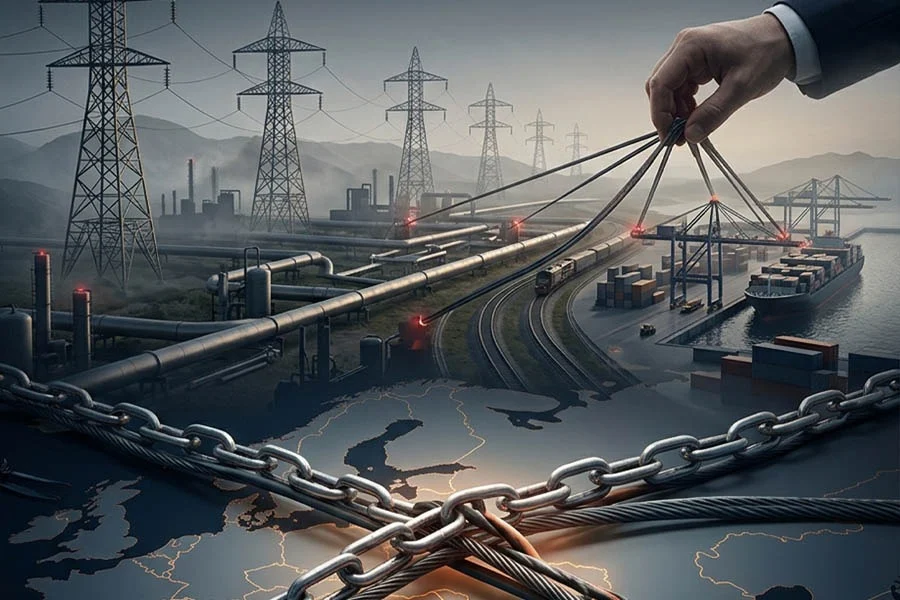
For years, we spoke of the global economy as an open and interconnected network. Capital came from one country, technology from another, payments were processed on a global network, data was stored in a foreign cloud, and a customer could buy a product from anywhere. This model seemed to work as long as politics stayed out of the operational layers of the economy. Today, the line between economics and geopolitics has become sharper. Sanctions, regulations, export controls, financial restrictions, and decisions by multinational companies can, within hours, turn what was long considered ordinary commercial infrastructure into a point of vulnerability.
This problem is familiar to Iran, but it would be a mistake to treat it as only Iran’s problem. Neighboring countries have also, each in their own way, experienced dependence on infrastructure and decisions beyond their borders. Even the countries that are now taking action to enforce Iran-related restrictions have themselves, in certain periods, faced limits on access to parts of the global financial, currency, and technology systems.
The economic history of the region offers a simple lesson: no country remains the owner of infrastructure forever. Today a country may own a route, a bank, a payment network, or a market, and tomorrow it may become a customer of that same infrastructure. Therefore, the central issue should not be framed only as why one country took action against another. The more important economic question is why the economies of the region are still so dependent on the decisions of others for their critical infrastructure.
Imagine a private aviation company that, with private investment, leases aircraft, hires staff, creates new routes, and eventually finds customers. This company is building an economic asset, but if its flight route depends on the decision of another government, the loss does not fall only on the company’s shareholders. Capital, employees, passengers, airports, hotels, travel agencies, and dozens of other businesses are harmed in a chain reaction. This is the point at which a political decision becomes an economic cost.
This logic applies not only to aircraft. A payment gateway, a cloud service, a reservation system, a banking network, or even a software tool can play the same role. On ordinary days, depending on foreign infrastructure may be the best business decision. Why should a young foreign company build its own payment system when a global company offers one more cheaply and with better quality? But under abnormal conditions, the calculation changes. What was cheap may suddenly become risky, and what was efficient may become fragile. Most importantly, what seemed global may in practice depend on the laws and political decisions of another government.
This is where we need to think more seriously about a new generation of regional companies. The point is not to cut the markets of Afghanistan, Iran, Central Asia, and the Middle East off from the global economy. On the contrary, these markets should become even more connected to the world, but through more diverse routes and more options, which reduces the points of complete failure. At the same time, we should not confuse this idea with complete self-sufficiency. The goal is to create the possibility of choice. An economy that has only one bank, one settlement route, one platform, or one infrastructure provider is vulnerable to the decisions of others. But an economy that has a second option for each of these layers can keep functioning even when one route is closed.
A “resilient economy” does not produce everything itself. It has alternatives when a route is cut. If a bank withdraws from cooperation, another settlement route should be available. If a platform leaves the market, businesses in that field should not face a complete shutdown. If an infrastructure provider halts cooperation, the company’s operating cycle should not stop. In such conditions, the region’s young businesses are not merely private actors. They can become part of the region’s economic resilience infrastructure, especially when they reduce dependence on a single provider or a single legal jurisdiction.
AryaBooking (aryabooking.com) is a small example of this shift. This infrastructure is not meant to replace Booking.com (booking.com) or the large online travel agencies (OTAs) worldwide, and its importance does not lie in such competition. Its importance lies in the fact that a private infrastructure, built with regional capital and regional human resources, operates in a market that many international companies see as risky, complex, and unattractive. When large companies withdraw from vulnerable markets for political reasons, demand does not disappear; it simply goes unanswered. This very gap creates room for regional players to grow. AryaBooking has expanded in Afghanistan, Iran, and the emerging markets of Central Asia, and has built part of its supply chain within the region itself. At first glance, this may seem a small story about one startup, but on a larger scale it carries a different meaning: whenever a regional business can meet a real need without complete dependence on a foreign company, one fewer point of vulnerability forms in that region’s economy. This is the same reduction in dependence that was presented in the earlier sections of this piece as a condition for economic resilience.
Nevertheless, none of this means opposing global companies. Their presence matters for market growth, technology transfer, access to customers, and greater competition. The problem arises when an economy has no other option, the very point at which dependence on foreign infrastructure turns into risk. Real competition also does not necessarily mean competing on product price. For some businesses, the ability to keep operating in difficult conditions is itself part of the operational advantage. A business built from the start in an environment full of restrictions, sanctions, currency fluctuations, payment disruptions, and geopolitical risk is forced to learn solutions that companies in more stable markets have rarely had to face. This is not an ideal advantage for a startup owner; it is an operational reality.
For years, foreign companies profited from the markets of the region. They booked hotels, sold tickets, processed payments, collected data, and won local customers, and in many cases this presence helped the market grow. But a political crisis raises an important question: when conditions become difficult, who stays? This question matters to investors because investment is not only about “returns,” but also about the risk of access. If a company builds its entire infrastructure on services that can be cut off at any time without prior notice, it has handed part of its business risk over to the decisions of others. This risk may go unnoticed for years, but when it becomes visible, changing infrastructure is usually difficult, costly, or even impossible. These are the very costs that the region’s economy is now seeking to reduce.
For this reason, the countries of the region should not settle for attracting large foreign companies alone. They should also think about building their own homegrown players. These companies can operate alongside global players, compete or cooperate with them, and create alternative options in the areas that are vital to the economy. Companies operating in Afghanistan, Central Asia, or parts of the Middle East, separate from the interconnected global systems, should not see these markets only as consumer markets. They can also be markets for producing services and infrastructure.
This path is not easy. Capital is limited, markets are fragmented, legal frameworks differ, and financial systems are not sufficiently connected or uniform. Above all, political risk is high. Even so, if the region’s economy waits until the environment is completely safe, markets are fully integrated, and global politics is entirely predictable, such an opportunity will probably never arrive. An entrepreneur cannot wait for such conditions. He or she must build a product in this very environment, create routes, find customers, and provide infrastructure that can keep the business running tomorrow as well.
From this perspective, today’s restrictions are not merely bad news; they are also an economic signal. They show which dependencies have grown too large, which infrastructure needs an alternative, and where there is room to build. Answering these questions does not necessarily mean cutting ties with the global economy. It can mean diversifying connections and reducing dependence on a single route, a single provider, or a single legal jurisdiction.
Perhaps, in the end, the main question is not why a country, under pressure from a more powerful state, restricts its airspace; that decision is for that country to answer. The question the market must answer for itself is something else: why should a decision made elsewhere be able to stop a business here? If we answer this question by building more companies, more critical infrastructure, and more alternative options, today’s restrictions may become tomorrow’s investments. The aim is not to build an isolated economy, but one that can trade with the world and, at the same time, does not depend entirely on the decisions of others for its own survival.
The world will remain “global.” But perhaps one of the important lessons of this decade is that being global, without having alternatives, is not the same as the picture we once had of an open and interconnected economy.
You can read the Persian version of this article here: