• 8AM.MEDIA
  • ویب‌سایت فارسی
  • پښتو ویب‌پاڼه
  • اۉزبېکچه ویب‌سایت
  • Podcast
Thursday, September 17, 2026
Hasht-e Subh
  • Home
  • News
    • Afghanistan News
    • World News
  • Opinion
    • Editorial
    • Analysis
  • Reports
    • Daily Reports
    • Investigative Reports
  • Society
    • The story of people
  • Women’s Word
  • Columns
    • Three Years After Afghanistan’s Fall: The Taliban’s Resurgence
    • Towards Equality
    • The Resurgence of the Taliban: Two Years Since Afghanistan’s Fall
    • Hebatullah Report Special Edition
    • Resistance for Education Special Edition
    • Special Column on Taliban’s Education Curriculum
    • Nawroz
  • Interviews
  • Contact Us
    • About Us
    • 8AM MEDIA Annual Awards
    • Submit an Article to Hasht-e-Subh
  • 8am.mediaBack
Subscribe
No Result
View All Result
  • Home
  • News
    • Afghanistan News
    • World News
  • Opinion
    • Editorial
    • Analysis
  • Reports
    • Daily Reports
    • Investigative Reports
  • Society
    • The story of people
  • Women’s Word
  • Columns
    • Three Years After Afghanistan’s Fall: The Taliban’s Resurgence
    • Towards Equality
    • The Resurgence of the Taliban: Two Years Since Afghanistan’s Fall
    • Hebatullah Report Special Edition
    • Resistance for Education Special Edition
    • Special Column on Taliban’s Education Curriculum
    • Nawroz
  • Interviews
  • Contact Us
    • About Us
    • 8AM MEDIA Annual Awards
    • Submit an Article to Hasht-e-Subh
  • 8am.mediaBack
No Result
View All Result
Hasht-e Subh
No Result
View All Result

Khatam al-Nabieen: When “Islamization” Leads to the Elimination of an “Islamic University”

Translated by Farhad Farhaad | Originally written in Persian by Kiomars Samadi

Mohammad Farhaad Mohammad Farhaad
17 September 2026 - Solar Hijri Date: 1405/06/26 [t_time:1789671198]
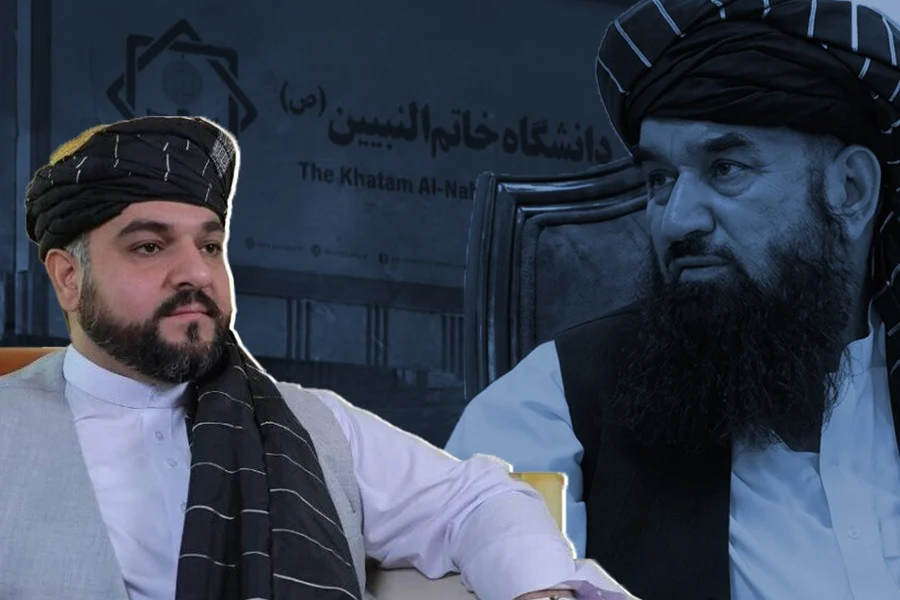
A university official is seen alongside a senior Taliban figure against the backdrop of the Khatam al-Nabieen University building, following the closure of the university. (Photo credit: Social Media)

Social Media


The closure of Khatam al-Nabieen University in Kabul and Ghazni cannot be regarded merely as an administrative decision, the revocation of an operating license, or a dispute over compliance with the regulations of the Taliban Ministry of Higher Education, even though the ministry’s spokesperson has attributed the revocation of the university’s license to its failure to observe “Islamic values,” as well as to violations of the ministry’s policy and misuse of the university’s standing and reputation. Viewed from a broader perspective, Khatam al-Nabieen actually stands at the intersection of two processes: first, the general erosion of universities and higher education in Afghanistan under Taliban control; and second, the process of threatening, restricting, and eliminating institutions that, in religious, intellectual, and organizational terms, do not fit within the Taliban’s official and exclusive interpretation.

The first issue begins with the fact that the Taliban have not merely closed university doors to girls; rather, through a set of ideological policies, they have altered the university environment in such a way that the concept of the university as an independent institution for producing knowledge, cultivating critical thinking, and training skilled professionals has faced gradual erosion. The removal of women and girls from higher education is, by itself, a structural blow to the university, since sidelining half of society from the higher education cycle correspondingly diminishes the country’s human, scientific, and professional capacity.

But the story does not end there. Male students, too, when confronted with a Taliban-style curriculum, growing restrictions within the university environment, and increasing interference in their lifestyle and appearance, no longer necessarily maintain the same relationship with the university as before. Professors, too, experience disillusionment in such an environment. As a result, hundreds of university professors have fled the country, and those who remain are on the verge of resignation. From this perspective, even if the university’s doors remain open, that openness does not necessarily mean the university is truly alive. A university may have buildings, classrooms, students, and professors, but if it lacks academic quality and an open, free environment, it will not cure any real problem.

Private universities, meanwhile, face a more complicated situation: on one hand, they are under pressure from Taliban policies and restrictions, and on the other, they face the economic crisis affecting families across Afghanistan. When a family loses the ability to pay university tuition, private higher education is often the first item cut from its budget, particularly when graduates’ career prospects are also bleak. Private universities are thus squeezed from both sides: from above, by Taliban pressure, and from below, by the erosion of society’s economic capacity.

Khatam al-Nabieen, however, adds another layer to this equation. If the Taliban are fundamentally seeking to bring universities into conformity with their own particular values and interpretation of Islam, Khatam al-Nabieen presents a notable case in point, since it is neither a secular institution that could be targeted for its distance from religion, nor an institution that has concealed its religious identity. Its name is openly Islamic; its history is tied to religious education and activities; and its academic and administrative structure has taken shape within a context in which Shia identity is prominent.

Here lies the apparent contradiction: if the issue is the university’s Islamic character, what exactly is Khatam al-Nabieen lacking? The issue, apparently, is not simply whether the university is “Islamic” or “not Islamic”; rather, the issue is which interpretation of Islam has the right to define the university and determine the boundaries of its activity. If an Islamic university must necessarily be organized according to the Taliban’s particular interpretation of Islam, then the Islamization of the university could shift from being a cultural and educational project into a project of “epistemic homogenization,” meaning the university would no longer be a space for encounter and dialogue among different Islamic interpretations, but rather a reflection of a single official and dominant interpretation of religion.

It is precisely at this point that the issue of Shiism becomes significant. Khatam al-Nabieen is a predominantly Shia institution, and this fact confronts it with another question: can a university in Taliban-administered Afghanistan be both Islamic and Shia at the same time? If the answer is no, then what meaning would the claim of “Islamizing” the university actually carry? This question takes on greater importance given that the Taliban, on the one hand, emphasize the Islamic character of the education system, while on the other hand, they are preventing an academic institution with an openly Islamic and specifically Shia identity from continuing its activities. It would therefore be more accurate to distinguish between “Islamizing” the university and “Talibanizing” it: the former can mean the presence of religious values within education, while the latter means that a particular interpretation of religion seeks to bring the entire educational, epistemic, and cultural structure of a country under its control.

This issue is especially sensitive in Afghanistan, a country that is ethnically, religiously, and linguistically diverse. If the educational structure of such a country moves toward religious and intellectual homogenization, the result will not be merely a change in curriculum; it could dissolve “social pluralism” into a single “official narrative” of national and religious identity.


You can read the Persian version of this analysis article here:

خاتم‌النبیین؛ وقتی «اسلامی‌سازی» به حذف «دانشگاه اسلامی» می‌رسد

ShareTweetSendSendShare

Related Posts

A hazy skyline of Kabul stretches toward the mountains as residents report a rise in nighttime armed robberies across the city. (Photo credit: Pexels)
Daily Reports

Armed Robberies Rise in Kabul as Residents Voice Fears Over Insecurity

17 September 2026 [t_time:1789667209]
Construction work is underway on the Kabul-Kandahar Highway widening project in Ghazni city. (Photo Credit: Social Media)
Afghanistan News

Sources: Kabul-Kandahar Highway Widening Project in Ghazni Inaugurated Again

17 September 2026 [t_time:1789665327]
Diplomats stand together during a United Nations meeting as 43 countries call for the removal of restrictions on women and girls. (Photo credit: @franceonu)
Afghanistan News

43 Countries Urge Taliban to Lift Restrictions on Women and Girls

17 September 2026 [t_time:1789661770]

Latest

Loading latest news...

Popular stories

  • Hamza bin Laden - the son of Osama bin Laden (Photo: Social Media)

    Al-Qaeda Releases Hamza bin Laden Message on 9/11 Anniversary

    Share
    Share Tweet
  • Sajjad Haider Khan: Those with Valid Visas Will Continue Their Studies in Pakistan

    Share
    Share Tweet
  • UN Report Reveals Shifts in Family Attitudes and Rise in Domestic Violence in Afghanistan

    Share
    Share Tweet
  • Taliban Shoot Young Man from Herat After Torturing Him with Hands Tied

    Share
    Share Tweet
  • German Politician Calls for Faster Deportation of Undocumented Afghan Migrants

    Share
    Share Tweet

Podcast

Insights
Insights

Join Lynne O’Donnell for 8AM’s podcast series, Insights.
Lynne talks with generals, diplomats, soldiers, journalists, politicians, activists, people who have front row seats for conflicts around the world, and citizens with a story to tell, happy or sad. For this first series, Afghanistan is the focus. Lynne and her guests talk about the collapse of the republic in August, 2021, and the impact since — for the people of Afghanistan, for the security of the region, for the safety of the world. It’s important, interesting and insightful.

Insights/22: Controlling the Narrative with Mina Sharif
byinsights8am

Controlling the Narrative

Lynne O’Donnell talks with Mina Sharif, author, activist, women’s rights campaigner, educator and mentor. They discuss who controls the narrative and who speaks for Afghanistan’s people when the Taliban appear to have seized control not only of the country but of the message, too.

Have a listen

Insights/22: Controlling the Narrative with Mina Sharif
Episode play icon
Insights/22: Controlling the Narrative with Mina Sharif
Episode Description
Episode play icon
Insights/21: Media Meltdown with Zahra Joya
Episode Description
Episode play icon
Insights/20: Terror Inc with Scott Richards
Episode Description
Episode play icon
Insights/19: Busting Stereotypes with Bushra Gohar
Episode Description
Episode play icon
Insights/18: Media Matters with Waliullah Rahmani
Episode Description
Episode play icon
Insights/17: What Goes Around Comes Around with Sima Samar
Episode Description
Search Results placeholder
Hasht-e Subh

8AM Media, also known as Hasht-e-Subh Daily, stands as Afghanistan's premier independent and non-profit newspaper, resonating as a beacon of journalistic integrity since its establishment in June 2007 by esteemed Afghan journalists and human rights advocates. With a steadfast commitment to citizen journalism and civic education, Hasht-e-Subh Daily has earned its place as the most esteemed publication in the nation.

Publisher: Sanjar Sohail
Email: [email protected]
Executive Director: Parwiz Kawa
Email: [email protected]

Read More

Khatam al-Nabieen: When “Islamization” Leads to the Elimination of an “Islamic University”

Armed Robberies Rise in Kabul as Residents Voice Fears Over Insecurity

Rising Unemployment: Afghanistan’s Youth Give Up on Many of Their Dreams

UN Fact-Finding Mission: US Committed War Crimes in Iran

Malala Fund: No One Held Accountable for Depriving Girls in Afghanistan of Education

Editor’s Choice

Every Saturday morning, 8AM MEDIA English Services Department will guide you through the week’s biggest stories from Afghanistan and the international community.

Subscribe

© 2026 - ©Hasht-e Subh Daily

No Result
View All Result
8am.Media
پښتو ویب‌پاڼه
ویب‌سایت فارسی
اۉزبېکچه ویب‌سایت
  • Home
  • News
    • Afghanistan News
    • World News
  • Opinion
    • Editorial
    • Analysis
  • Reports
    • Daily Reports
    • Investigative Reports
  • Society
    • The story of people
  • Women’s Word
  • Columns
    • Three Years After Afghanistan’s Fall: The Taliban’s Resurgence
    • Towards Equality
    • The Resurgence of the Taliban: Two Years Since Afghanistan’s Fall
    • Hebatullah Report Special Edition
    • Resistance for Education Special Edition
    • Special Column on Taliban’s Education Curriculum
    • Nawroz
  • Interviews
  • Contact Us
    • About Us
    • 8AM MEDIA Annual Awards
    • Submit an Article to Hasht-e-Subh
  • 8am.media

© 2026 - ©Hasht-e Subh Daily