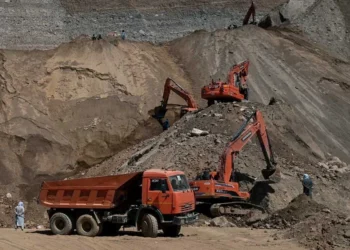

Several private construction and logistics companies say that officials in the Taliban’s contract facilitation sector are extorting and demanding bribes from them. According to these companies, the Taliban impose restrictions and create obstacles, demanding a specific share in every project, and if payments are not made, they not only reject applications but also create additional problems for the companies. They emphasize that if the officials’ demands are not accepted, issues are deliberately created under the pretext of rejecting “offers,” and there is no independent body to address their complaints.
Amid ongoing complaints of widespread and systemic corruption within the Taliban regime, several private companies that have participated in the group’s contract bidding processes report extortion and bribery in procurement procedures. They say that no work progresses without the payment of bribes and project shares, and that officials of the group take a cut in all contracts. According to these companies, most contracts are awarded to individuals who are affiliated or in partnership with the Taliban.
One contracting company says that in every project, a third party negotiates between the Taliban and the companies over the amount of bribery and the demanded share in the project. According to this source, the Taliban’s contract department conveys its demands through this intermediary, and if the companies do not accept them, various problems are created for them under different pretexts. He stresses that even if complaints are filed, they are not addressed.
Another source says that some Taliban members present their demands indirectly through phone calls and request face-to-face meetings. This source shared written messages from one of the Taliban’s intermediaries with the Hasht-e Subh Daily, which show that the Taliban have directly requested a share in contracts.
The source adds that companies are unable to take action and are powerless. He says, “We cannot work, and we cannot resist. There is no independent body either. Only a section within the relevant institution handles complaint registration, which is not satisfactory, and they find solutions in their own favor for every decision.”
Sources among contracting companies cite, as examples, projects such as the Hairatan road, the construction of a canal from Dahan Bagh to Baraki, the Shiwaki road, and projects of the national power company, which usually involve electrical equipment, lines, and cables. They say that the Taliban have demanded bribes and shares from companies that participated in bid openings. According to these sources, because companies rejected these demands, they received negative responses and faced additional problems under various pretexts. They emphasize that there is no transparency or accountability in these contracts, and that the Taliban award contracts to anyone who provides them with a share and partners with them. Furthermore, no one is aware of the details or value of these contracts.
The companies stress that the Taliban’s demands are not limited to a percentage share in contracts, but extend to seeking partnership in all projects, both large and small.
Other sources also confirm that the Taliban do not execute any formal contract without taking bribes and shares. A credible source, who did not want to be named in the report, says that during the previous government, paying bribes was more difficult than it is now under the Taliban. According to him, Taliban officials openly and without fear accept bribes. He states: “In the past, they took bribes with fear, but now, when we construct buildings, the district police chief comes directly to the office, we pay him, and he sends someone to ensure no one interferes. In the past, when we did this, another commander from the district would come and secretly take money, but these people have no fear of taking money.”
Previously, sources had exposed widespread corruption and the allocation of shares in contracts within the Taliban’s Ministry of Interior. According to these sources, in the procurement and contracts sector, Taliban officials often award contracts to relatives, family members, or individuals who provide them with a share in return. These sources also emphasized that in the distribution of fuel within the Deputy Ministry for Counter-Narcotics, there are multi-million dollar embezzlements, and that Taliban security districts in Kabul are connected with drug distributors and receive shares from them.
These sources further stated that in the Taliban’s Ministry of Interior, contracts are awarded to companies without going through legal procedures or competitive bidding, under the label of “security confidentiality.” According to the sources, even the inspection department and other relevant bodies of the group do not have the authority to review or monitor these contracts.
This comes as, following the Taliban’s takeover, the group has widely dismissed existing staff and appointed its own fighters and affiliates within state institutions. Government employees who were dismissed by the Taliban stress that officials of the group are each seeking to place their relatives and friends in key and financial positions, despite lacking the necessary knowledge and managerial skills, and are employed solely due to their affiliation with or proximity to the Taliban.
Meanwhile, Transparency International has ranked Afghanistan under Taliban rule at 169th place in the 2025 Corruption Perceptions Index, a drop of four positions. According to this ranking, Afghanistan scored 16 out of 100, placing it among 182 countries and territories.
In its report, Transparency International states that in the Asia-Pacific region, fragile countries such as Afghanistan with low scores are vulnerable to corruption due to restricted civic space, opaque financial and political systems, and the absence of democratic checks and balances and an independent judiciary.
You can read the Persian version of this report here:
قراردادهای بدون شفافیت؛ فساد ساختاری و سهمخواهی طالبان از شرکتها