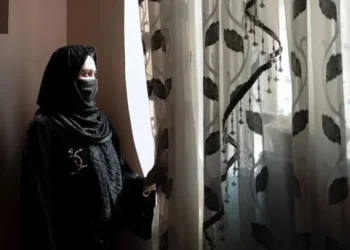

Women and girls in Afghanistan report a dramatic and unprecedented rise in domestic violence since the Taliban imposed sweeping restrictions and dismantled legal protections and support institutions. Many now say they have no access to the judicial or legal systems and believe this legal vacuum has emboldened perpetrators of violence within families. They argue that the absence of legal safeguards has created an atmosphere of fear and repression, enabling many men to act with impunity in the home.
Some women subjected to violence say the lack of responsive legal and judicial institutions is a key factor behind the growing prevalence of abuse. In the current climate under Taliban ideology, they explain, women face violence not only in public but increasingly within their own homes.
Lida, 28, a mother of three, lives in Kabul. According to her mother, she was raised in Iran and has little experience with domestic chores—a fact that, in her in-laws’ eyes, ignited hostility and resentment.
Sultana, Lida’s mother, recounts: “My daughter was newly married and trying to light a samovar. Her father-in-law was watching to see how many matchsticks she used. When he saw she’d used more than a few, he got furious and smashed her head against the wall. He beat her until she lost consciousness.”
Sultana says her daughter was unconscious in the hospital for a week. After she awoke, she suffered from intense headaches, tremors, and erratic behavior—changes that eventually distanced her from her children.
“Sometimes she would scream. Other times she would sit silently,” Sultana adds. “At first, I thought it might be related to her pregnancy, but the doctor said she had suffered a psychological breakdown. My daughter is no longer herself. She never leaves the house and lives in constant fear.”
Lida’s mental condition has continued to deteriorate. She now lives in her father’s home. Her mother describes her state as “a slow death” and adds, “My heart breaks when I see that my daughter has no life left in her. She’s not a good mother anymore—she’s the one who needs saving. But there’s no one to turn to, no one to file a complaint with. And if we do speak out, she’ll be the one blamed. Where can we go?”
In Afghanistan’s deeply traditional society, entrenched social structures place women in highly vulnerable positions. Many mothers like Sultana, under cultural pressures to preserve family honor and reputation, urge their daughters to remain in abusive marriages, not realizing that such insistence may lead to their daughters’ psychological collapse.
“Bano,” a pseudonym used by another woman who has suffered domestic violence, says she lost her six-month-old child due to repeated beatings by her husband, and now has no legal avenue to seek justice. She emphasizes that the Taliban not only fail to respond to women’s complaints, but are themselves part of a system that violates women’s rights and enables the spread of violence.
“I feel awful,” Bano says. “No one hears my voice anywhere. My husband beats me. I told his family several times, but my mother-in-law said, ‘He’s a man, it’s his right to raise his hand.’ She told me to protect our family’s honor—that a woman must endure. She asked where I would go with two small children. Even my father-in-law beat me, but I never told anyone. Now, there’s no institution left to hear us. It used to be better—at least there was the Ministry of Women’s Affairs, someone who would listen. But now, who can we turn to? The Taliban, who themselves are the violators of our rights?”
Bano believes that families should thoroughly investigate the character and background of prospective in-laws before marrying off their daughters. She asserts that women in Afghanistan are living in a state of total lawlessness. “There is no institution to defend us, no court to hear a woman’s voice. If a woman is beaten at home, there is no recourse—not even her own family supports her; instead, they encourage silence.”
Women’s rights activists also stress that the absence of legal recourse and protective mechanisms is a major barrier to supporting victims of violence. They argue that this vacuum forces women to suppress their pain and remain silent in the face of abuse.
Sabera Saeedi, a women’s rights activist, explains:
“Women in Afghanistan today have no access to legal institutions to raise their voices. This could have devastating consequences, as a vital segment of society is being erased from public life.”
In a recent and tragic incident, Abida, a young woman from the Tayora district of Ghor province, set herself on fire last week after being pressured into marrying a Taliban member. The case has drawn widespread domestic and international condemnation.
While the Taliban’s Ministry for the Promotion of Virtue and Prevention of Vice labeled her death as a case of “domestic violence,” local sources and media reports cite forced marriage as the primary cause of her self-immolation.
Richard Bennett, the UN Special Rapporteur on Human Rights in Afghanistan, expressed deep concern over rising gender-based violence and described Abida’s case as a shocking example of the systematic oppression of women. He called for serious accountability, expanded psychosocial support, and urgent international action against what he termed “gender apartheid.”
The British Embassy in Afghanistan, citing United Nations data, stated that 46% of married women in the country experience physical violence, 34% suffer psychological abuse, and 6% are subjected to sexual violence. These figures reflect a structural crisis in women’s rights, one that has deepened since the collapse of institutions such as the Ministry of Women’s Affairs, the Independent Human Rights Commission, and women’s shelters.
Human rights organizations and women’s advocates have described the current situation as “gender apartheid” and are urging the international community and the United Nations to officially recognize it as such.
Amnesty International’s 2024 annual report documented at least 840 cases of gender-based violence against women and girls in Afghanistan between January 2022 and June 2024. Of these, 332 resulted in murder. The report also revealed that in just the first half of the previous calendar year, at least 1,500 women were imprisoned by the Taliban.
In its latest report covering the period from January to March 2025, the United Nations Assistance Mission in Afghanistan (UNAMA) stated that the lack of access to legal institutions has left women increasingly vulnerable to both domestic and societal violence.
You can read the Persian version of this report here:
افزایش خشونتهای خانوادهگی علیه زنان؛ نهادی برای دادرسی وجود ندارد