At exactly 11:00 a.m. on Sunday, she realized the Taliban had taken control of Afghanistan. For a moment, she fell into silence, then, with trembling hands, she took her violin from the shelf. She said her final goodbye to it, gently wrapping it in a cloth. As the bow brushed against the violin, it produced a sound—not a melody anymore, but an echo of her shattered dreams and the silence that now overshadowed her life.
Nooria (pseudonym), a 19-year-old girl, once created art through the notes of her violin, unaware of the confined, restrictive world that the Taliban would later impose on her. She didn’t just play music; her words painted life, her drawings spoke, and her writings inspired.
Now, silence and helplessness cast a shadow over Nooria’s life. The vibrant girl is left with nothing but profound sorrow. Her eyes, filled with grief, hold a gaze that carries thousands of questions, pain, and a flicker of hope. She says, “Every day I wake up, I see another piece of my dreams cracking, and I find myself drowning in destruction and helplessness.”
The young woman explains, “Provinces were falling one after another, and only Kabul remained. When my father came home, I prayed it was a lie, hoping the Taliban hadn’t reached Kabul, that perhaps negotiations were still underway, leaving a glimmer of hope so that women wouldn’t be imprisoned as they were during the group’s first rule. But, unfortunately, contrary to all expectations, neither schools nor universities remained. Gradually, the deprivations intensified.”
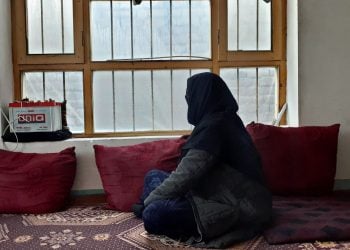
Nooria was an outstanding student, always shining brighter than her peers. But now, everything has changed. Universities have closed their doors to her. She learned the violin as an amateur, but her dream of music classes has withered in her heart and memories, leaving no trace of that passion and energy. Now, she neither writes, plays, nor smiles. She spends her days in her room.
This girl deprived of education and art says, “When you can’t pursue what your soul calls for, you slowly fade into silence. I, too, have gone silent.”
Safia (pseudonym), a journalism student, always nurtured a dream of learning the guitar. With a bitter smile, she says, “The first time I heard a guitar was in a film. At that moment, something awoke in my heart—a passion that never faded.” For her, the guitar’s sound wasn’t just music; it was the voice of freedom, the expression of emotions, and hope for a brighter future.
“When I entered university, that love grew with me. At night, after work, I sometimes wrote down songs I loved. Even without an instrument, their sounds played in my mind. I imagined one day sitting on a dark, warm stage somewhere in Kabul, playing. But I didn’t realize this love and passion would come to an end before it could fully bloom.” She adds.
Safia says, “When Kabul fell, everything changed. I was in my final year of university. They initially closed the university but later allowed us to resume classes. In those days, I went to university in fear, wearing a black chador, under heavy gazes, in an environment stripped of art and freedom. I didn’t even dare walk past the arts faculty. Still, I held onto hope, telling myself that after graduation, I might buy a guitar, play again, or perhaps leave Afghanistan to continue… but everything came to an end.”
Before the Taliban’s takeover of Afghanistan, women and girls played a prominent and active role in the country’s modern and classical music scenes. Numerous music schools operated in Kabul and other cities, where girls not only established a strong presence but also showcased a different, hopeful image of Afghanistan to the world.
Many female singers performed at concerts and events both inside and outside the country, with widespread participation from women and girls. But after Afghanistan fell to the Taliban, the sound of instruments and the melodies of rubabs fell silent, replaced by a heavy silence over the country’s music scene.
The Taliban have officially banned music, and many individuals have been arrested, tortured, or had their instruments destroyed by Taliban forces for playing music or singing. Media outlets have also been ordered to refrain from broadcasting any music.
A significant number of Afghanistan’s artists have been forced to flee the country and seek refuge abroad after the Taliban’s takeover. Those who remain have largely ceased their artistic activities. Women and girls, in particular, have been completely erased from the artistic sphere. Now, a heavy silence, like a dark cloud, looms over Afghanistan’s artistic landscape—a silence that has engulfed not only stages but also hearts.
In addition to imposing widespread restrictions on women and girls, the Taliban have intensified their suppression of art and music, destroying and burning musical instruments, shutting down art schools, and subjecting many artists to threats, arrests, or forced silence.
In August 2024, the Taliban’s Ministry for the Propagation of Virtue and Prevention of Vice announced that it had destroyed 21,328 musical instruments over the past year, describing the burning of these instruments as one of their “achievements.”
You can read the Persian version of this report here:
سکوت نتها؛ رویاهای سوخته دختران افغانستان در سایه ممنوعیت موسیقی