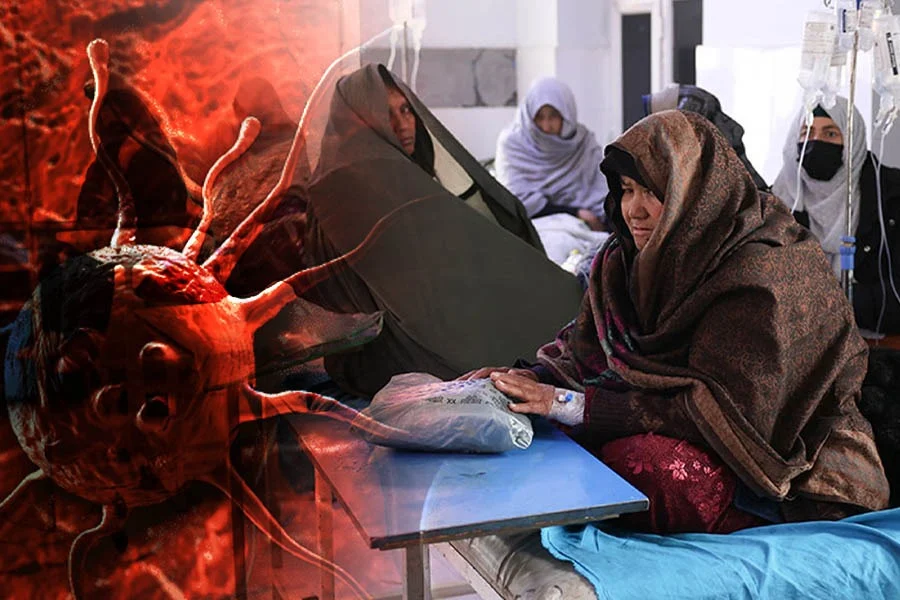
Coinciding with Breast Cancer Awareness Month, several doctors in Kabul have expressed concern about a rise in breast cancer cases. They say that low awareness among women, delayed visits to doctors, and limited access to diagnostic services are key factors behind the increase. According to the doctors, some women delay seeing a doctor after noticing suspicious symptoms because of fear, shame, and financial difficulties. They add that in some cases this delay means the disease is diagnosed at advanced stages, making treatment more difficult.
Speaking to the Hasht-e Subh Daily, the doctors stressed that women should visit health centers for timely diagnosis after noticing any unusual change in the breast. They also cited the shortage of diagnostic facilities and professional staff in the provinces as challenges facing breast cancer patients.
Ahmad Omar Amiri, a general surgery and oncology physician in Kabul, says breast cancer cases among patients seeking treatment have increased. He adds that at the Department of Abdominal Surgery and Cancer at Kabul University of Medical Sciences (KUMS), one to two out of every 10 hospitalized patients have a breast tumor.
The physician said: “There is no organized and coherent information center at the national level. Numerous treatment centers operate under the title of cancer centers, but there is no cooperation or coordination among them. For this reason, the statistics presented on cancer cases in the country may not be complete. At the Department of Abdominal Surgery and Cancer at KUMS, breast tumor cases among the patients who visit are on the rise, and in some cases, one to two out of every 10 hospitalized patients have a breast tumor.”
Amiri says facilities for diagnosing breast cancer have improved compared to the past, and some pathology and imaging services are now available in the country. However, he considers the lack of immunohistochemistry (IHC) testing in pathology one of the major challenges to accurately diagnosing cancer. According to him, diagnostic facilities are relatively available in Kabul, Herat, and a few other large cities, but in most provinces such services are not available, and patients visit larger centers for diagnosis and treatment.
The physician said: “The lack of immunohistochemistry (IHC) testing in pathology is a major challenge. These facilities are relatively available in Kabul, Herat, and a few large cities, but in about 90 percent of the provinces there are no such diagnostic facilities, and patients are forced to go to larger centers for diagnosis and treatment.”
Mr. Amiri also considers the shortage of professional staff in the cancer sector a serious problem for patients. He adds that there are not enough specialists in pathology, in the administration of cancer drugs, and in radiotherapy, and that radiotherapy is currently not carried out inside the country. According to him, the high cost of treatment also places heavy economic pressure on patients and their families, because cancer treatment requires long-term care.
Amiri said: “Training a professional generation in all cancer departments, providing the necessary equipment and facilities, and establishing financial support and an insurance system for cancer patients are essential. At present, chemotherapy can be carried out, but radiotherapy is not available in the country.”
Najm al-Sama Shafajo, an obstetrics and gynecology physician, says delays in women visiting a doctor make the diagnosis and treatment of breast cancer more difficult. She adds that poverty, economic problems, low levels of awareness, and shame about going for an examination are among the factors that cause some women to be diagnosed late. According to Shafajo, early detection of breast cancer can make treatment easier and lead to a better outcome for the patient.
Ms. Shafajo said: “In Afghanistan, there are very many factors that delay the diagnosis of breast cancer. Poverty, a weak economy, low awareness, illiteracy, and shame cause women not to go to a doctor and not even to tell their own families.”
This physician says changes in the color of the breast skin, thickening of the skin resembling orange peel, a dimple or inward pulling of the breast, and a lump in the breast or armpit are signs that should be taken seriously. She stresses that women who notice such changes should see a doctor for examination and diagnosis.
Ms. Shafajo said: “We cannot call every lump that appears cancer. Breast tumors are divided into two types, benign and malignant. But a change in skin color, thickening of the skin like orange peel, inward pulling of the breast, and lumps under the armpit should be taken seriously, and family medical history should also be taken into account.”
Meanwhile, several women in Afghanistan who have been diagnosed with breast cancer complain about the difficulty of diagnosis and the high cost of treatment.
Amina (pseudonym), a 45-year-old woman who recently learned she has breast cancer, complains about the shortage of specialist doctors for diagnosing and treating the disease. She says that although she went to doctors after noticing a lump under her armpit, her illness was not properly diagnosed during her first visits. According to her, another doctor eventually diagnosed breast cancer, and she is now undergoing treatment.
The woman said: “When I went to the doctor, I noticed a lump in my armpit. I went to several doctors, but it was not diagnosed correctly. In the end, I went to another doctor, and he said I had breast cancer. I was heartbroken and thought I was going to die. Now I am under treatment, and I hope to get better. I ask women, if they feel a change or a lump in their body, to definitely go to a doctor. Perhaps the disease can be cured with treatment in its early stages.”
Amina complains about the high cost of treatment and the lack of some treatment facilities in the country. She says that because of the restrictions and challenges that exist, she cannot travel abroad to continue her treatment. Amina hopes that better treatment facilities and conditions will be provided inside the country so that patients will not be forced to go to other countries to receive medical services.
She said: “We sold all of my gold for my treatment, and nothing is left for me. Going to Iran and Pakistan is also very hard; they do not give visas. Conditions here are not good enough for a person to get treated either. We want attention to be paid to this. The life of a human being is very valuable.”
October of each year is recognized in many countries around the world as Breast Cancer Awareness Month, and the pink ribbon is the symbol of this global campaign. During this month, programs are held to raise awareness about the symptoms of the disease, early detection, and support for patients.
According to a report by the World Health Organization (WHO), breast cancer is the most common cancer among women in the world. In 2021, the WHO launched the “Global Breast Cancer Initiative,” setting a target of reducing breast cancer mortality by 2.5 percent annually until 2040, a goal that, if achieved, could prevent the deaths of about 2.5 million women.
However, accurate and regular statistics on the number of women with breast cancer and the mortality rate from the disease are not available in Afghanistan. The Taliban have previously reported an increase in the number of cancer patients in the country, but they have not provided figures on the extent of the increase or the number of women with breast cancer. International organizations have also not published specific figures on the number of people with breast cancer and the annual death toll from the disease in Afghanistan.
You can read the Persian version of this report here:
سرطان پستان؛ تشخیص دیرهنگام و کمبود امکانات درمانی جان زنان را تهدید میکند