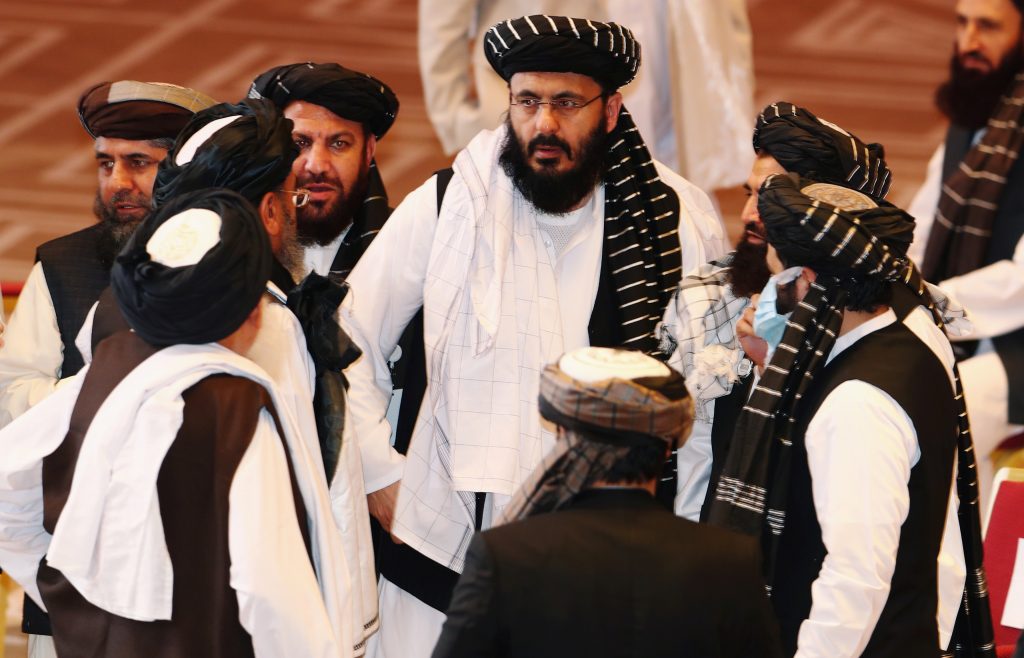
With negotiations between the Afghan government and the Taliban under way, many in the West and Afghanistan are banking on the fact that the Taliban movement have changed and that, having failed to defeat them militarily, it is time to embrace them. Although the latter is indeed true – that we have failed to defeat the Taliban militarily – the former deserves more scrutiny. The Taliban movement is a heterogenous umbrella organization for various factions operating under the same name. Before embracing them, we must understand which part of the Taliban, if any, have actually changed and weigh the indications and evidence for this transformation. Particular questions stand out as crucial to our examination at this pivotal moment as we seek to assess whether the movement has become acceptable to the Afghan people and the international community. First, has the Taliban movement cut their ties with Al Qaeda and other global and regional terror outfits? Second, how do they rule in the areas they currently control? Third, have their views on women’s rights, minorities rights, and the conduct of international relations evolved? And finally, how do Afghans feel about and perceive these changes?
As policy makers and foreign diplomats grapple with these questions, the Afghan people are experiencing two realities on the ground in Afghanistan. The first is the new Afghanistan, the Islamic Republic, underwritten and supported by almost two decades of US and Western support. The second is the newly emboldened Taliban, with their sympathizers and regional supporters who believe that they have finally prevailed and are on the verge of military and political victory. In the near future, these realities will somehow need to exist side by side in peace and tranquility as neither reality can override or erase the other in pursuit of a monopoly of power and resources. The alternative is a full-fledged civil war and the continuation of the current Afghan conflict, with some even referring to it as the “Syrianization” of Afghanistan. With negotiations under way, those who represent the new Afghanistan have made it clear that the Republic is ready to accept the Taliban within the folds of a pluralistic and democratic future. The question that remains is whether the Taliban have changed enough to accept the new Afghanistan.
Many Afghans, including members of the Republic’s negotiation team, do not believe that the Taliban have changed, noting that they still hold to their medieval, totalitarian, and dogmatic ideologies. In fact, they are more confident of their ideology because they believe that they have finally prevailed. At the same time, some circles within the American diplomatic and foreign policy community as well as some of the United States’ western allies believe that the Taliban have in fact changed, having learnt important lessons during these years of war. In their view, the time has come for the West and Afghans to stop thinking of the Taliban as international terrorists but rather view them as a nationalist politico-military group and embrace them. It is time, they claim, to focus on helping the movement to adapt to being a conventional political player in Afghan politics and on the world stage, and to help them iron out their ideological flaws and rigid worldview through exposure and education.
This American premise of a changed Taliban is based on a number of converging interests and developments. Chief among these are the military stalemate of the Afghan conflict and the United States’ rush to exit Afghanistan. This view is also influenced by the negotiating skills of the group’s political office in Doha during the US-Taliban talks, their quick adaptation of tools like social media, drones, and other technological innovations to pursue their political and military ends, and finally, their media savvy spokespersons. It is worth noting that that the Taliban previously deemed all of these things un-Islamic during their reign in the 1990’s. This view is also reinforced by the prevailing belief that by bypassing the Afghan government – which is considered to be distanced from its population – and engaging with the Taliban directly, the international community and the region will be able to socialize them via exposing to the modern world, thereby paving the way for the Taliban to accept new ways of doing politics and governance. It is hoped that this exposure will lead to a change in their ideology, political approach, and military strategy that will transform the Taliban from a military force into an acceptable and legitimate political movement able to play by the script of democracy and which, importantly, will no longer present a threat to the United States and the West.
Many believe that these assumptions – implying that “white washing,” re-educating, and legitimizing of a brutal force will make it ready for governance – are wrong and that this strategy will fail. In their view, the Taliban has evolved little since the 1990s and, importantly, has little incentive to pursue change now given their belief that they have finally prevailed over the United States, NATO, and its western allies. Once we understand the political and military context in which the Taliban emerged and evolved, the movement’s governance and service delivery programs, and its relationship with the jihadist universe as well as global terror groups like Al Qaeda, it becomes quite clear why many hold this view.
Taliban – The Militia
The Taliban movement emerged in the mid 1990s as a justice dispensing and “rule of law” militia group in Kandahar province. Unlike the existing Mujahidin groups, they considered themselves to be national and not aligned to any ethnic group or region of Afghanistan. Traders and local elders who were tired of the high crime rates and the prevailing anarchy of the time mobilized, armed, and supported their rise to power. Later, Pakistani intelligence agencies and global terror groups such as Al Qaeda also aligned themselves with the movement. The Taliban quickly became famous for their swift methods of dispensing justice and brutal enforcement of the rule of law. Many of us who lived during their initial rule welcomed them as saviors, having grown tired of constant fighting within the Mujahidin. It was not until later that we noticed many foreign fighters in their ranks who pursued a different agenda, such as a global jihad with goals other than bringing stability and prosperity to Afghanistan.
The Taliban quickly took over southern and western Afghanistan. As they made their way to capture Kabul, frictions began to emerge between various nationalist Taliban commanders, including Mullah Bor Jan, who was considered one of the star commanders of the Taliban and the key architect of the capture of Kabul as well as their Arab and Pakistani fighters. According to many Taliban sources, Mullah Bor Jan was shot in the back by his own men, an event which signaled the beginning of the difficult relationship the Taliban has had with their foreign sponsors and comrades in arms from across the world. Moreover, it demonstrated the Taliban’s lack of preparedness to govern and rule over their foreign fighters. As the group assumed power in Kabul and formed their Islamic Emirate, the Taliban struggled to make sense of government structures and programs. Above all, they lacked the money to dispense critical and basic services to the Afghan public. It is at this time that the Saudi billionaire and jihadist Osama Bin Laden came to their rescue, underwriting and financially supporting Taliban expenses and government budgets.
Today, it seems that history is repeating itself. With warlords gaining power and the Afghan government confined to cities and struggling to govern, anarchy is prevalent and many injustices are taking place in the countryside. Meanwhile, the Taliban – who believe they are once again on the verge of a military victory – continue to face the same dilemmas of dispensing rule of law and justice in the countryside, how to manage their foreign sponsors and comrades, how to cut ties with global terrorism, and how govern and dispense services in the areas they control.
Taliban in Government – The Emirate
When the Taliban captured Kabul in the mid-1990s, they had no funds and no plan or program for governance beyond a vague and generalized idea of a government based on the Sharia system, which is itself vague and subject to many interpretations within various Islamic schools of thought. Matters were further complicated by the fact that there were two centers of power, one with Mullah Rabbani Akhund – the nominal President who had his own cabinet – and the other with Emirul Momineen Mullah Mohammad Omar Akhund, the Emir based in Kandahar. In addition, there was an Ulema Council, which had the final say on all matters including decisions of war and peace. For money, the Taliban relied heavily on Osama Bin Laden’s wealth, money from the drug trade, subsidies provided by the Pakistani establishment and Saudi intelligence, and handouts from wealthy Arab Gulf businessmen which were channeled through the Haqqanis. While the Taliban were fierce enforcers of the law and swift dispensers of justice, the Afghan people enjoyed no rights and only minimal services, most of which were delivered by NGOs and United Nations agencies through various aid programs. The Taliban had poor relations with the world, with only three states – Pakistan, Saudi Arabia, and United Arab Emirate (UAE) – officially recognizing them as the lawful government of Afghanistan.
Taliban leaders blamed the ongoing war for their inability to deliver services and their lack of respect for human and women’s rights, claiming that they had to prioritize jihad over all other matters until they controlled the entire country. Lack of funds and resources were also cited as a reason for the Taliban’s failure to deliver services, including women’s education. In truth, many Taliban leaders who assumed the charge of various ministries had little education and lacked basic management skills or knowledge of their portfolios. The Taliban’s system of governance – often referred to as the “andiwali system” – was based on a network of friends presiding over a ministry or a battlefield. There was no vision or concrete program for civil service or the Afghan military. Both the existing civil service and the Afghan military were thus used as clerks or as a support for the andiwali system of governance and warfare.
Taliban today hold pretty much the same views and system of governance as above, except that they have become more sophisticated in their use of technology and are better integrated within the jihadi universe.
Taliban in Exile – The Insurgency and Proxy
There are two common interpretations of the fate of Taliban leaders and commanders after the fall of their regime. The first holds that Taliban leaders and commanders initially retreated to Afghan villages to pursue a peaceful and non-political life following their defeat, but that they were later forced to go to Pakistan and rearm in response to American and Afghan government raids on their houses and properties. The other view holds that the Taliban leadership proactively decided to retreat from cities following their defeat in order to prepare for a long guerilla war with the United States and its Afghan allies.
Long time Taliban observers such as Antonnio Giustozzi and Felix Kuehn believe that we created the Taliban by pursing – under the pretext of counter-terrorism – the wrong military and political policies during the early years of US intervention in Afghanistan. These policies included night raids and military operations on the homes and properties of Taliban leaders, commanders, and sympathizers, which forced many of them to retreat to the remote countryside or move to Pakistan to regroup and rearm. Once displaced, Taliban leaders formed shadow government structures and council “shuras” in order to undermine the Afghan government and wage a guerilla war from hideouts and safe havens across the border in Pakistan. These safe havens created a dependency and subsequently introduced a proxy element to the Afghan Taliban, as the Pakistani establishment pursued a dual policy of cooperating with the Americans on the surface while secretly opposing the US presence by supporting the Taliban’s efforts inside Afghanistan. With Taliban leadership based safely in Pakistan, they were able to pursue the long-game with considerable support from the Pakistani Inter-Service intelligence (ISI) agency and military.
Today, one big question remains: how would the Taliban transition their shuras and shadow structures – with all the fissures and frictions in their ranks – to an effective post peace settlement government? In addition, how would they decrease and eventually cut a dependency on the Pakistani military and political establishment in order to act as a nationalist movement ready to govern?
Taliban the Unknown – Is there a Taliban 2.0?
US Special Envoy for Peace Zalmay Khalilzad – in several of his interviews with local Afghan TV channels – has insisted that the Taliban have changed and have acknowledged their past mistakes with women’s education, their relations with the world, and in harboring of terror groups. There is, however, little evidence to support these claims. According to recent studies by the Afghan Analyst Network’s “Living with the Taliban” and “One Land, Two Rules” series, the Taliban still rule through fear; heavily tax local populations; close down schools in areas that they control; have no representation of women; and provide few public services. The recent intra-Afghan negotiations in Doha also indicate clearly that the Taliban have not changed in critical ways, as their team did not include women or minorities and they implicitly objected to “Fiq Jaffari” (the Shia interpretation of Islamic jurisprudence).
Importantly, the Taliban have also failed to spell out a specific vision for the future of Afghanistan, and are once again unable present a program for governance, service delivery, or maintenance of rule of law. They continue to resort to vague and generalized statements, and have neither been able – nor willing – to clearly spell out their views on education, health, reconstruction, and beyond. The Taliban’s belief in a military victory, however, has made them more confident of their cause and ideology. The group currently sees itself as unique within the jihadist universe in having defeated the United States and forcing it to negotiate an exit. This has made them quite popular and a center of gravity within the jihadi world. At this stage, the Taliban do not believe that change is necessary and have no incentives to acknowledge the realities of the new Afghanistan.
Tamim Asey is the founder and executive chairman of the Institute of War and Peace Studies in Kabul, Afghanistan, the former Afghan deputy minister of defense, and an expert adviser on the Atlantic Council’s Strategic Dialogues on Afghanistan.