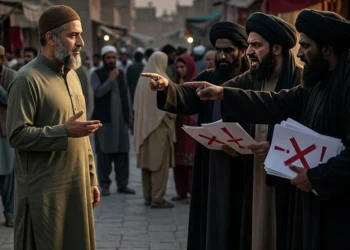
In the past year, a large number of non-Pashtun commanders, one after another, have separated from the Taliban. In previous years, some of these commanders were the commanders of Taliban fighters in the war against the military forces of the previous government of the country. Ethnic domination, monopoly of political power, and exclusion of other ethnic groups from the body of power are some of the things that provoked the protest of these non-Pashtun military commanders against the Taliban, and they finally separated from the Taliban army. Political experts believe that the Taliban do not believe in national participation and therefore, the non-Pashtun commanders feel alienated in the system of this group, and one by one they leave the Taliban forces.
Salah ul-Din Ayubi was one of the most prominent Uzbek commanders of the Taliban, who has recently parted ways with the Taliban. According to reports, this Taliban commander cut ties with the Taliban in protest against the “Monopoly in power, and exclusion of other ethnic groups from within the system”, and he left Kabul for his base in Faryab province.
Salah ul-Din Ayubi was one of the first Taliban commanders who entered Kabul in August last year, after the escape of former president Mohammad Ashraf Ghani, and captured the presidential palace. He also commanded hundreds of Uzbek militants of the Taliban in the past two decades, fought for the interest of the Taliban in the north of the country with the military forces of the previous government, and played a significant role in the fall of the northern provinces into the hands of the Taliban. The Taliban are trying to prevent the possibility of chaos against this group in the north by using the influence of Nizamuddin Qaisari, the former representative of Abdul Rashid Dostum.
Besides this, Makhdoom Alam Rabbani, another Uzbek commander of the Taliban, was one of the most influential figures of this group in the north of the country in the last five years. He played a decisive role in the armed battles of this group with the security forces of the previous government in Faryab province and caused this province to fall into the hands of the Taliban. This Uzbek commander of the Taliban was arrested in the Mazar-e-Sharif province by Mullah Mohammad Fazl Mazlum, Deputy Minister of Defense of the Taliban regime, in December 2021 and transferred to Kabul.
The arrest of Makhdoom Alam provoked a wave of anger and protest from the Uzbek Taliban, and they, in an unprecedented action, disarmed the Pashtun Taliban militants in Faryab province, and accused the Taliban officials of “ethnic discrimination”. Faryab’s protests were quickly suppressed by the Taliban regime, during which at least two people were killed. After being arrested by Taliban forces, Makhdoom Alam Rabbani spent about three months in prison and was finally released due to what is said to be an intermediary between a number of prominent figures of the Uzbek Taliban, including Salah ul-Din Ayubi.
After months of bad luck, and the sharp criticism of Marshal Abdul Rashid Dostum, the leader of The National Islamic Movement of Afghanistan, that the Taliban’s policies are mono-ethnic, this Uzbek commander of the Taliban has been appointed as the Taliban security commander for Ghazni province. Since Ghazni province does not have any Uzbek residents, supporters of Makhdoom Alam Rabbani have described his appointment as the security commander of this province as “self-imposed exile”. After being appointed to this post, he has been removed from the capital, and by this, he has been kept away from the decision-making Taliban leadership circle.
Along with dozens of other military commanders of Uzbek origin, including Maulvi Khan Mohammad Arif, who was in charge of Aqina Port, the Taliban also excluded Hazara and Tajik members from their ranks. Maulvi Mehdi was the only Hazara commander of the Taliban, who opposed the decisions of the Taliban leadership in Kabul, went to the Balkhab district of Sar-e Pol province in the month of June this year, after the Taliban marched its forces to this district, he fought with them, was defeated and fled.
The Taliban had sent hundreds of fighters from the neighboring provinces to defeat him. After the defeat, Maulvi Mehdi planned to go to Iran but was arrested by Taliban forces in Herat Province and was killed by them in July this year. The Taliban have named the reason for his murder as “Rebellion against the Islamic Emirate”. In a Facebook message, Muhammad Mohaqiq, the leader of the People’s Islamic Unity Party of Afghanistan, condemned the killing of Maulvi Mehdi by the Taliban and considered it a war crime. Muhammad Mohaqiq said that Maulvi Mahdi had separated himself from this group due to the exclusivity and brutality of the Taliban.
According to these cases, political experts believe that the Taliban as a movement is extremely ethnic and bigoted and can never accommodate other ethnic groups in its body. Wais Nassery, an expert on political affairs, said in a conversation with the Hasht-e Subh Daily: “In the framework of a group that wants to impose the rule of a group and an ethnicity in Afghanistan, ethnic relocations or ethnic reconciliations are difficult and impossible.” Mr. Nassery adds: “The Taliban do not believe in national participation.” “Unfortunately, the Taliban leadership council believes in the sovereignty of one ethnicity in Afghanistan, and therefore, the presence of figures from other ethnicities alongside this group is used as a tactic, not as a written national strategy or a necessity for national participation.”
According to this political expert, people, and commanders from other ethnic groups who were with the Taliban because of their political and religious beliefs, now they have felt that the Taliban do not trust any non-Pashtun commanders, nor do they value people from other ethnic groups, as they did in their previous rule over the country.
Meanwhile, the Taliban group was formed in Kandahar in 1994 as a local movement by the Pashtuns. The first fighters of this group were young people from Kandahar, Uruzgan, and Helmand provinces. However, not even a year had passed since the formation of this group, and many students from religious schools, most of whom were Uzbeks and Tajiks, also joined the body of this movement. Some of these people who joined them were students of religious schools in Pakistan.
For example, Maulvi Abdul Raqib of Uzbek descent was one of the new members of this movement, who had a special influence on the Uzbek members of the religious community of this group. He was born in the province of Takhar and was busy teaching in religious schools in Pakistan. Maulvi Abdul Raqib pledged allegiance to Mullah Mohammad Omar in 1995, one year after the formation of the Taliban movement. With the allegiance of this influential Maulvi, hundreds of Uzbek members of this community were encouraged to join the Taliban group.
Abdul Salam Hanafi is a member of Uzbek descent and a veteran of the Taliban group. He is still the highest-ranking member of Uzbek origin in the Taliban regime and serves as the Acting Second Deputy Prime Minister of the Taliban. Abdul Salam Hanafi was born in Faryab province and joined this group through religious schools. Abdul Salam Hanafi worked as the Deputy Minister of Education of Afghanistan during the first period of Taliban rule over the country. Although a number of Uzbeks have been allied with this group since the establishment of the Taliban Movement, by regaining power in Afghanistan, the Taliban are trying to remove non-Pashtun members and commanders, including Uzbeks, from its main body of power.
Along with the Hazara and Uzbek commanders, the Taliban have separated some of their Tajik commanders from their ranks and imprisoned some of them. Maulvi Aghamir, the head of the Taliban intelligence in Panjshir, Abdul Hamid Khorasani, the security chief of the Panjshir Security Authority, and many district governors of this group in Panjshir have been dismissed by the Taliban. Also, Maulvi Zarif Mozafari, the key commander of the Tajik Taliban in Sar-e Pol province, Halim Kohnaqoli, and the Tajik commander of this group in Badghis province have also left the ranks of the Taliban.
According to reports, a number of senior Taliban commanders, including Maulvi Noorullah, have been removed from the ranks of the Taliban and imprisoned by this group. Haji Malek was one of the former Jihadi commanders who joined the Taliban group after the Taliban took control of the country. The Taliban appointed him as the director of intelligence of the Panjshir province administration, but soon he was arrested and imprisoned. After being released from Taliban prison, Haji Malek joined the National Resistance Front.
Political experts continue to warn that if the Taliban do not stop their ethnic hatred and strategy of mono-ethnic rule, their ranks will be dispersed even more and new fronts will be formed against this group. Wais Nassery, an expert on political affairs, says in this regard: “With the same mentality of ethnic and religious hatred, forced migrations and ethnic cleansing in their policy, the Taliban will never be able to keep commanders of other ethnicities and other forces that have been by their side until today.”
However, the Taliban always emphasize national unity and deny acts of ethnic hatred. Three days ago (October 14), the Taliban Ministry of Defense announced the meeting of Mullah Yaqoob Mujahid, acting head of the ministry, with the newly recruited soldiers of Panjshir Province at the National Military Academy of Afghanistan. In this meeting, Mullah Yaqoob said without referring to a specific case: “The Islamic Emirate is the common home of all of us, the enemies of the system want to disrupt our unity under the name of ethnicities and parties.”
While political experts are warning about the possibility of the formation of anti-Taliban fronts, the former vice president of Afghanistan, Mohammad Sarwar Danesh, has recently announced the unity of anti-Taliban groups. Mr. Danesh published a note on his Facebook page on Sunday, October 16, and wrote that creating new political movements, means not surrendering to authoritarian rule. According to him, regardless of what is the approach, strategy, and positions of the newly created political groups, who are their members, and where they get support from, the formation of anti-Taliban groups is important.
The former vice president of the country has announced the unity of the groups against the Taliban, while dozens of political figures outside the country, led by Mohammad Haneef Atmar, the foreign minister of the previous government, and Mohammed Masoom Stanekzai, the former head of the National Directorate of Security (NDS), have formed a political movement under the name “Afghanistan National Movement for Peace and Justice”. At the opening ceremony of this political movement, Mohammad Haneef Atmar spoke about the absence of a legitimate system in the country and emphasized that the political system can only be ruled in Afghanistan through the votes of the citizens. Along with this newly established movement, dozens of other political movements, including political parties, have declared their opposition to the Taliban regime in Afghanistan. In the meantime, in the past year, the National Resistance Front and some other Fronts, along with their political opposition, have also continued armed encounters in several parts of the country, especially the Panjshir province.