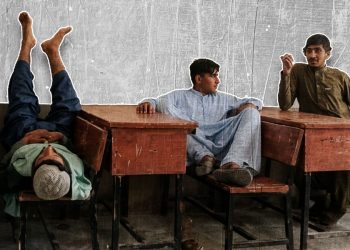
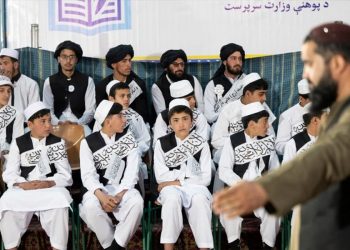
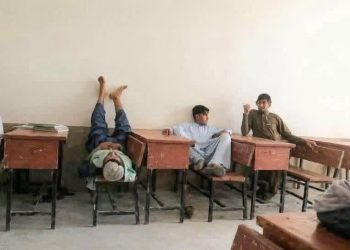
Over the past three years, the Taliban have constructed 85 madrasas for every new modern school, in a bid to entrench their authority and ideology across Afghanistan. According to official data from the Taliban’s Ministry of Education, the group has established 22,972 Islamic religious centers during this period, while only 269 new modern schools have been built. Additionally, they have set up 420 dormitories in various provinces to accommodate more than 21,000 students from these religious institutions.
The Taliban have revised the content of 18 religious textbooks in the subjects of Hadith, Seerat (Islamic Biography), and Taaleem-ul-Islam (Islamic Teachings), authoring them in both Persian Dari and Pashto, and submitted the materials to their Quality Assurance Committee. Textbooks on history and geography for grades 7 to 12 in madrasas have also been reviewed and amended in line with the Taliban’s perspectives.
Furthermore, the Taliban have allocated 87,592 positions specifically for madrasas, with recruitment already completed for 73,738 of them. However, some religious scholars argue that this approach may exacerbate various crises, including sectarian tensions, and warn that religious studies alone cannot address the country’s complex socio-economic challenges. They fear that the proliferation of such institutions will fuel extremism, and graduates will become pawns in the agendas of regional powers.
In a report titled Key Achievements of the Ministry of Education, the Taliban announced that 269 modern schools have been built since their return to power. Comparative figures indicate that for every modern school, more than 85 madrasas have been established.
The report also cites a directive from Hibatullah Akhundzada stating that over 420 dormitories for religious students were constructed within the 1403 Afghanistan fiscal year (March 2024 – March 2025). These dormitories currently house 21,250 students, with all costs covered by the Taliban’s Ministry of Education.
According to the ministry, 55,077 religious clerics across the country were tested jointly by the Ministry’s Islamic Education Department and the Taliban’s Ministry of Higher Education. Among them, 43,818 received certification. Additionally, 21,989 individuals who had memorized the Quran were examined, and 19,136 were granted certificates.
The report further states that the Taliban distributed three-year academic transcripts (known as Kashf al-Darajat) to 9,200 clerics across the country. Moreover, 7,300 candidates took entrance exams for advanced Islamic seminaries (Darul Ulooms), and 4,700 of them were admitted into the 13th grade.
The Taliban’s Ministry of Education also announced that the content of 18 religious textbooks was revised in Hadith, Seerat, and Islamic Teachings, authored in Persian Dari and Pashto, and submitted to the group’s Quality Assurance Committee. In addition, the textbooks for history and geography for grades 7 to 12 in madrasas were revised under the Taliban’s ideological framework.
The report states that in the year 1402 (March, 2023 – March, 2024), the Taliban distributed 57,368 religious textbooks to their so-called Jihadi schools in 10 provinces and 439,641 textbooks to other madrasas across 22 provinces. For students in grades 13 and 14 of Darul Ulooms, 268,150 books were distributed, while in the fiscal year 1403, another 172,134 textbooks were supplied to seminaries and Quran memorization centers across 10 provinces. Overall, 87,592 posts were allocated for madrasas nationwide, with 73,738 already filled.
Meanwhile, Mohammad Moheq, a religious scholar and former Afghanistan ambassador to Egypt, told the Hasht-e Subh Daily that the Taliban’s madrasa-building campaign is a recipe for future crises in Afghanistan. From a sectarian standpoint, he said the move deepens religious tensions by promoting a singular religious interpretation while sidelining others. Moheq also warned of a looming expertise crisis, noting that Afghanistan, like other nations, requires diverse fields of modern knowledge to sustain social life and development.
He argued that religious studies alone do not serve a pivotal role in solving societal issues, as they do not offer practical or modern solutions. He referenced countries such as Germany, Canada, and the Scandinavian nations, which have created thousands of specialized vocational programs to develop skills and professions critical to economic and social advancement.
According to Moheq, the Taliban’s education system neglects the fundamental needs of society in Afghanistan, and continues to invest heavily in fields that do not contribute to the country’s progress. He warned that as graduates of madrasas enter the job market, a new crisis will emerge. Many of these individuals will be placed in roles unrelated to their training, such as customs management, traffic oversight, economic affairs, and media monitoring, despite lacking the technical skills required for such positions.
He emphasized that allowing one academic discipline—religious studies—to dominate all others marginalizes and suppresses other fields, creating yet another layer of crisis. Moheq also warned that Taliban madrasas indoctrinate students in isolated environments through ideological teachings, fostering a culture of extremism. These students often carry such teachings back to their homes and communities, spreading intolerance, violence, and rigid beliefs.
Moheq cautioned that some of these graduates could eventually serve as fighters in wars that have no benefit for Afghanistan. Instead, they may be used as ideological fuel for regional conflicts, participating in battles that primarily serve foreign powers. He pointed out that the wars of the past 50 years have brought nothing but destruction, and that radicalized youth may continue to be exploited in future conflicts. He stressed that Afghanistan urgently needs development in sectors such as agriculture, mining, and vocational trades that can create jobs and improve livelihoods. Nevertheless, public funds and resources continue to be funneled into building madrasas, intensifying the nation’s structural crises.
Previously, several human rights organizations have criticized the Taliban’s madrasa-building policy as a vehicle for promoting their extremist ideology and have expressed serious concern over its nationwide expansion.
Richard Bennett, the UN Special Rapporteur on the situation of human rights in Afghanistan, has warned that the Taliban’s focus on building madrasas and restricting education to religious content could foster extremist ideologies. He noted that this policy not only deprives children of acquiring essential skills for modern life but also creates fertile ground for the spread of extremist views, thereby increasing the risks of domestic terrorism, regional instability, and global security threats.
You can read the Persian version of this report here:
روند رو به رشد مدرسهسازی؛ طالبان در بدل هر مکتب ۸۵ مدرسه ساختند