
The Taliban’s Central Fatwa Council (the Fatwa Council), acting on orders from Taliban Supreme Leader Hibatullah Akhundzada, has prepared a treatise titled “The Effects of Obedience in Strengthening the Islamic System” and distributed it widely among the public and the group’s fighters. The Taliban stated that the work was produced for “the general public” and their fighters to instill unconditional obedience to the group’s supreme leader, and to make clear that questioning Hibatullah’s orders and commands is not permissible. According to the Taliban, neither the public nor the group’s members have any right to question Hibatullah’s commands, as those commands contain wisdom the supreme leader does not wish to be made public. The treatise equates obedience to Hibatullah with obedience to God and the Prophet, framing it as foundational to the strength of the Islamic system. Its introduction claims that the fall of the Umayyad, Abbasid, and Ottoman caliphates was not caused by enemy attacks, but by the “rebellion of subjects against their rulers.” The treatise warns that if the Taliban fail to obey their leader, their own regime will face the same fate. Hibatullah, who wrote the foreword to the work, describes obedience as indispensable, claiming that without it, no aspect of life can function properly. The Fatwa Council further asserts that anyone who dies without pledging allegiance will have died “the death of ignorance.”
Continuing in the same vein, the Fatwa Council states that members of the group must “bow their heads” before Hibatullah Akhundzada unless they witness an “open error” from him, arguing that the Taliban’s success depends on precisely this compliance. The treatise also emphasizes that within the “Islamic system,” all social authority belongs to the leader, and no one may act in public affairs without his consultation and approval.
Obedience to the Leader as Obedience to God
The Fatwa Council equates following Hibatullah with obeying God and the Prophet, presenting it as a religious obligation from which no Muslim may deviate. The council states that defying the leader’s orders is not merely impermissible but outright forbidden, citing definitive religious texts as additional grounds for this position.
Individual Will Has No Standing Against the Leader’s Command
The Fatwa Council insists that people must obey the group’s leader in all circumstances, whether in hardship or ease, in contentment or in displeasure. The treatise makes clear that personal preferences and individual desires do not constitute valid grounds for disobedience, and that orders must be followed regardless of conditions. It explicitly states that no Taliban member, nor any person living under what the group calls the “Islamic system,” has any right to protest or disobey.
Allegiance to the Leader Until Death
The treatise holds that breaking a pledge of allegiance is both impermissible and unacceptable. According to the Taliban, doing so constitutes a grave sin and an unlawful act. The Fatwa Council adds that anyone who dies without pledging allegiance will have died “the death of ignorance.”
The council states that obedience to Hibatullah in matters of jihad is obligatory, asserting that under the “Islamic system,” sole authority over such matters rests with the imam. Decisions on war, peace, and ceasefire fall entirely within the leader’s purview, and all “subjects” are required to comply, regardless of whether those decisions align with their own wishes.
Jihad Is Obligatory Only Upon the Leader’s Command
The Fatwa Council states that jihad becomes obligatory in three circumstances: when a person is already present on the battlefield; when the leader issues an order to engage; and when non-Muslims occupy a Muslim city. The treatise adds that if Hibatullah orders fighters to stand down, compliance is mandatory, and no one has any right to oppose or defy that order.
The treatise further states that subordinates cannot cite a failure to understand the wisdom or purpose behind an order as grounds for defying it. Nor should anyone ask the leader to explain his commands, as the Fatwa Council claims that the public interest requires the rationale behind such decisions to remain undisclosed.
Monopoly Over Jihadi Authority by the Leader
To justify unconditional obedience to Hibatullah, the Fatwa Council draws on the writings of classical jurists, including Imam Sarakhsi, Ibn Qudama, Karaysi, and Mawardi, citing their views on independent reasoning, jihad, and obedience.
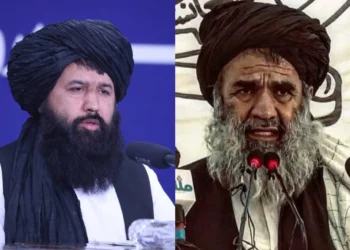
Last year, Nida Mohammad Nadim, the Taliban’s Minister of Higher Education, compared Hibatullah Akhundzada to the Prophet of Islam, declaring that obedience to him is “obligatory” and that insulting him is “forbidden.” The Ministry of Higher Education published an audio recording of these remarks on its X account, in which Nadim equates following Hibatullah with following the Prophet of Islam.
This comes as Abdul Hakim Shariai, the Taliban’s Minister of Justice, had previously ordered the revocation of operating licenses for all political parties in the country. He warned that even naming a political party is a criminal offense and that anyone criticizing the Taliban regime would face severe repression. Shariai claimed that political parties have no basis in Islamic law and do not serve the interests of the people, and therefore, their activities are wholly prohibited in Afghanistan.
Before that, Abdul Kabir, the Taliban’s Minister of Refugees and former Deputy Political Chief of the group’s Council of Ministers, had warned the public to stay silent and refrain from speaking against the group. During meetings with residents of Khost, Paktia, and Paktika provinces, he urged attendees to silence anyone who criticizes the Taliban. He warned that the regime “will not allow anyone, whether in the mountains, on the plains, or in the streets, to speak against the Taliban.”
You can read the Persian version of this report here:
«اثرات اطاعت در استحکام نظام شرعی»؛ منع پرسش و اطاعت مطلق از هیبتالله