Farmers in Kunduz province report a significant increase in grape yields compared to previous years. However, they face serious challenges due to the lack of a market and cold storage facilities. They criticize the Taliban for failing to provide chemical fertilizers, pesticides, or improved seeds, accusing the group of showing up only during harvest to collect tithe and zakat while helping only their affiliates.
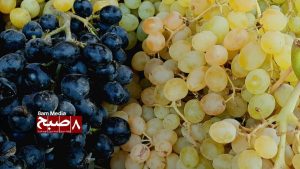
In recent years, many farmers have shifted to grape cultivation, recognizing that Kunduz soil is well-suited for this crop. While satisfied with the higher yields, several farmers note that the price per seer (7 kilograms) of grapes has dropped to 130–150 Afghanis, compared to 300 Afghanis in previous years.
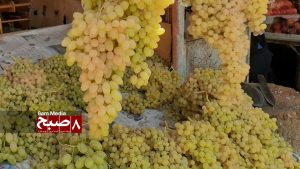
Farmers emphasize that they invest significant effort and expenses throughout the year to boost their yields, but without a market, they struggle to recover these costs. Out of necessity, they sell their produce at very low prices to avoid spoilage.
Gul Mohammad, a farmer from Chila Mazar in Kunduz province, has cultivated a 15-hectare vineyard with various grape varieties. He reports that although production has risen significantly this year, buyers are scarce, and only small quantities are sold to neighboring provinces. “We haven’t made any profit and haven’t even covered our costs,” he explains. “The yield is high, but without a market, grapes are sold cheaply. If we don’t sell them, they’ll spoil because we have no cold storage.”
Qalandar, who rents 20 hectares of vineyards in the Angoor Bagh area, also reports a good harvest but faces the same challenge of finding buyers. “We sell our products at half price, but even then, it’s hard to find suitable buyers,” he says. “There’s no cold storage, and we’re forced to buy expensive, low-quality fertilizers and pesticides. We demand access to high-quality fertilizers.”
Some farmers also complain about the Taliban’s Directorate of Agriculture, Irrigation, and Livestock in Kunduz. They claim the office focuses solely on collecting tithe and zakat, offering no support or services to farmers. According to them, the directorate assists only those affiliated with the group.
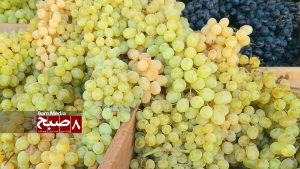
Some traders and vendors praise the high quality and sweetness of grapes from Kunduz province, stressing the need for export routes through Sher Khan Border Customs to prevent farmers’ hard work from going to waste each year. They argue that with proper cold storage facilities, there would be no need to import fresh fruits from other countries during the winter and spring seasons.
Meanwhile, local Taliban officials at the Kunduz Directorate of Agriculture, Irrigation, and Livestock claim grape production in the province has risen by 90% this year, with around 2,006 metric tons harvested from 1,493 hectares of vineyards.
It is important to note that many residents of Kunduz rely on farming and horticulture for their livelihoods. However, not only are grapes sold at low prices, but other agricultural products also fail to provide sufficient income.
Local Taliban officials from the Directorate of Agriculture, Irrigation, and Livestock regularly visit vineyards and farmlands to collect tithe and zakat but offer no support in distributing chemical fertilizers, pesticides, or improved seeds—except to their affiliates.
An article titled “218 Agricultural Product Management Projects Cover All Districts of Kunduz Province,” published in 2020 on the Ministry of Agriculture, Irrigation, and Livestock’s website, reports that Kunduz has over 282,000 hectares of arable land. Of this, more than 233,000 hectares are irrigated, with the remainder relying on rainwater. The article also notes that 88% of the province consists of flatlands, while the other 12% is mountainous or semi-mountainous terrain.
You can read the Persian version of this daily report here:
دست طالبان به جیب باغداران؛ دهقانان کندزی از نبود بازار انگور شکایت دارند | روزنامه ۸صبح