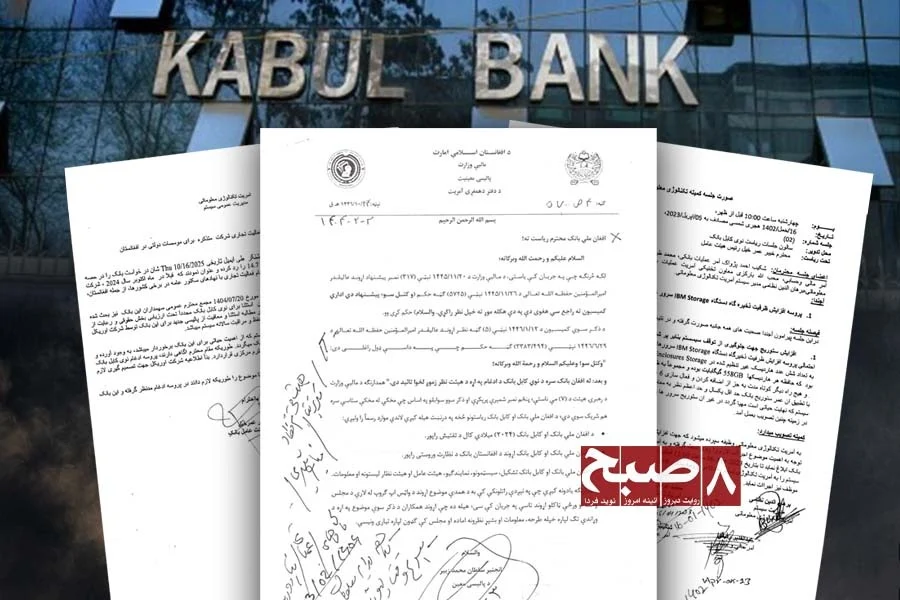
The Hasht-e Subh Daily has obtained documents showing that Hibatullah Akhundzada, the Taliban Supreme Leader, has approved a proposal by the Taliban’s Ministry of Finance and the Taliban’s administrative commission to merge Kabul Bank with the Taliban-controlled Bank-e-Millie Afghan (BMA). The findings of this report show that, beyond its financial problems, Kabul Bank is also struggling with serious system-related challenges, and the documents indicate that the bank has even come to the brink of a breakdown of its internal systems. According to these documents, Oracle has rejected Kabul Bank’s request to upgrade its core software, FLEXCUBE, from version 14.3 to version 14.7, and has limited its services to the annual maintenance and support of the system. The report also reviews the minutes of Kabul Bank’s General Assembly of Shareholders and its Information Technology Committee, which show that the bank’s storage devices had reached the end of their operational life and that the central database storage capacity had reached about 92 percent in 2023. Meanwhile, the minutes of the bank’s General Assembly of Shareholders show that a decision on Kabul Bank’s strategic plan for 2026 to 2028 has been postponed because of the merger process with BMA. This comes as the Supreme Economic Council of the former government, acting on a proposal from the then Ministry of Finance, had agreed to merge these banks. The ministry had announced at the time that Kabul Bank, Pashtany Bank and BMA would be merged.
The Hasht-e Subh Daily has obtained documents showing that Hibatullah Akhundzada, the Taliban Supreme Leader, has issued an order to merge Kabul Bank with BMA, which is under the control of this group. The findings of the report show that Hibatullah issued this order based on a proposal from the Taliban’s Ministry of Finance.
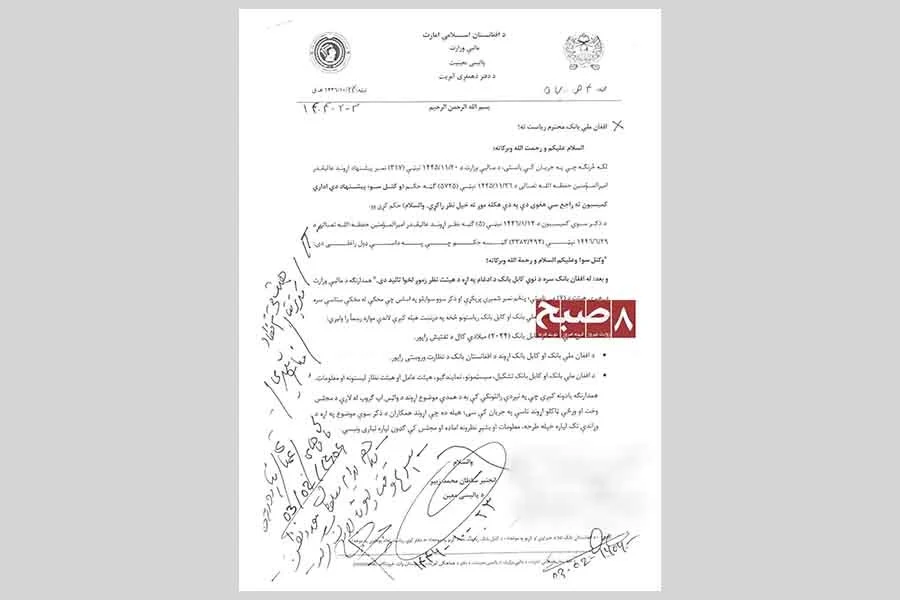
The letter, which the Taliban’s Ministry of Finance sent to the central bank under the control of this group, shows that the process of merging Kabul Bank with BMA was launched based on the Ministry of Finance’s proposal and the approval of Hibatullah Akhundzada, the Taliban Supreme Leader. The letter shows that the Taliban Ministry of Finance’s proposal was first referred by Hibatullah’s office to this group’s administrative commission, and the Taliban Supreme Leader then approved the commission’s opinion.
The original text of the letter, written in Pashto, states that following proposal No. (317) of the Taliban’s Ministry of Finance dated May 28, 2024, Hibatullah gave the following instruction in decree No. (5725) dated June 3, 2024: “Noted; it is proposed that the matter be referred to the administrative commission so that it presents its opinion to us. Peace be upon you.”
Subsequently, opinion No. (5) of this Taliban commission, dated July 18, 2024, was sent to the office of Hibatullah Akhundzada, and in decree No. (3383/494), dated December 30, 2024, he gave the following instruction: “Noted; and upon you be peace, God’s mercy and His blessings! Further, the board’s opinion regarding the merger of New Kabul Bank with Afghan Bank is approved by us.”
Likewise, based on decision No. (5) of the seventh meeting of the leadership board of the Taliban’s Ministry of Finance, and with reference to the fact that records related to the said matter had previously been shared with the Taliban-controlled central bank, the heads of BMA and Kabul Bank were asked to submit the 2024 audit reports of both banks and the latest supervisory reports of the central bank on them.
In the letter, the Taliban’s Ministry of Finance also asked the heads of BMA and Kabul Bank to share lists and information related to the organizational structure, systems, branches, management board, and supervisory board of both banks.
The letter notes that the time and date of the meeting on the said matter will be communicated to the bank in the near future through a WhatsApp group. It also expresses hope that the relevant bank officials will prepare their plans, information, and comprehensive views on the said matter in order to advance the process and make the necessary preparations to take part in the meeting.
Kabul Bank Acknowledges Inability to Procure Software
In a letter to Da Afghanistan Bank (DAB), the central bank of Afghanistan under Taliban control, Kabul Bank also reported serious problems in its system, saying that Oracle, which was responsible for updating the bank’s software system, has refused the bank’s request to update the software version.
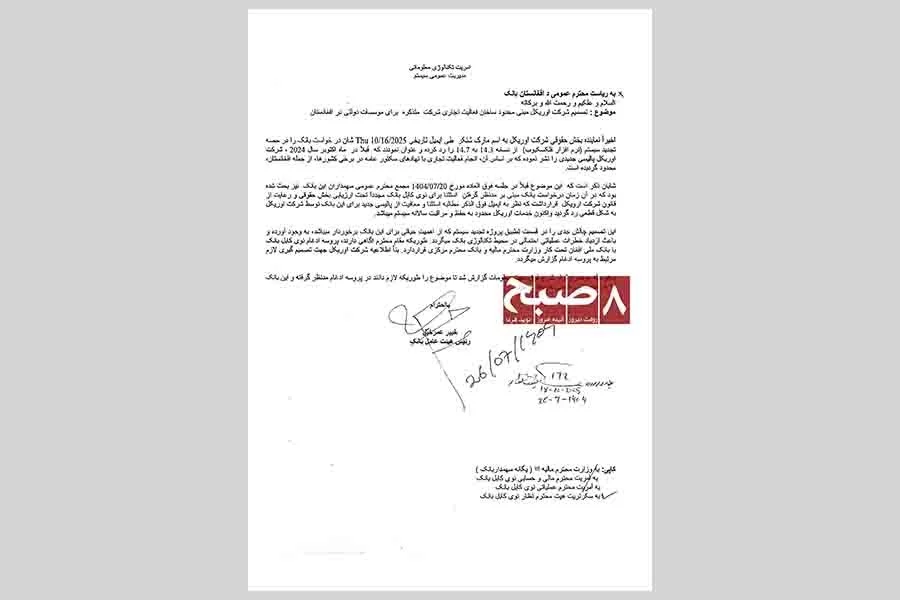
The Kabul Bank letter, a copy of which has been provided to the Hasht-e Subh Daily, shows that the bank wrote about Oracle’s decision to limit its commercial activities with government institutions in Afghanistan. In the letter, Kabul Bank said that a representative of the company informed bank officials that Oracle’s activities in Afghanistan would be restricted.
The letter, addressed to DAB under Taliban control, states: “Recently, a representative of Oracle’s legal department, Mark Shenker, in an email dated October 16, 2025, rejected the bank’s request to update the FLEXCUBE software system from version 14.3 to version 14.7, and announced that in October 2024 Oracle published a new policy under which commercial activities with public sector entities in some countries, including Afghanistan, have been restricted.”
In the letter, Kabul Bank referred to the extraordinary meeting of the bank’s General Assembly of Shareholders dated October 12, 2025, and said that at the time, the bank’s request for an exception for New Kabul Bank was once again under review by Oracle’s legal and compliance department. However, according to Kabul Bank, based on the said email, the bank’s request for an exception and exemption from Oracle’s new policy has been definitively rejected, and the company’s services are now limited to the annual maintenance and support of the system.
The bank stressed that this decision has created a serious challenge in implementing the system modernization project, which is of vital importance to Kabul Bank, and has increased potential operational risks in the bank’s technology environment.
The letter notes that the process of merging New Kabul Bank with BMA is under review by the Taliban’s Ministry of Finance and the central bank, and that the matter announced by Oracle has also been reported so that the necessary decisions can be made regarding the merger process.
In the letter, Kabul Bank asked the central bank under Taliban control to provide the necessary guidance in the process of merging this bank with BMA.
Minutes of Kabul Bank’s Information Technology Committee
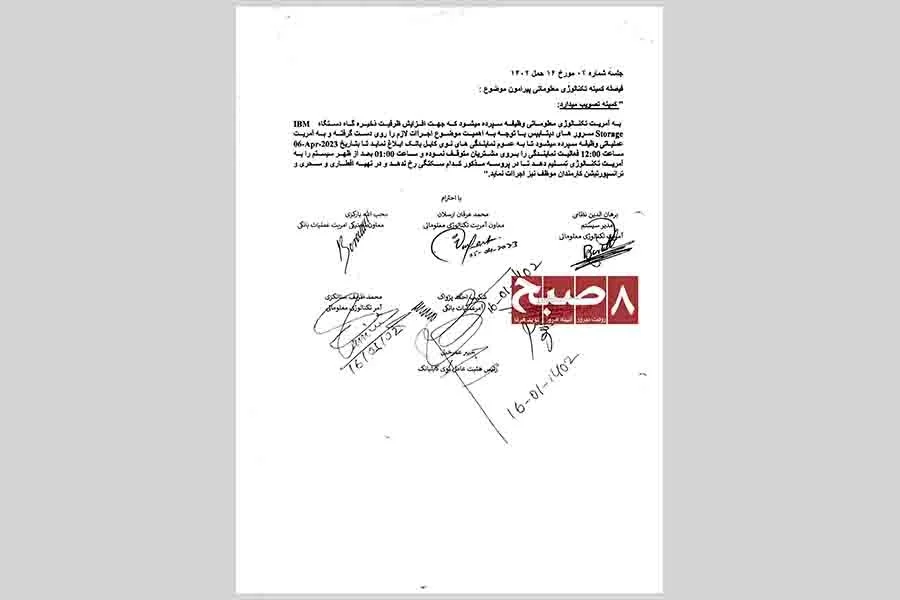
Some of the minutes of Kabul Bank’s Information Technology Committee, which have been provided to the Hasht-e Subh Daily, also show that the bank has been facing serious problems in its technical infrastructure and data storage system. The minutes of one of the committee’s meetings state that the bank’s AIX servers and IBM storage device had reached the end of their operational life, and that IBM had also stopped providing technical maintenance and support services for this equipment years ago.
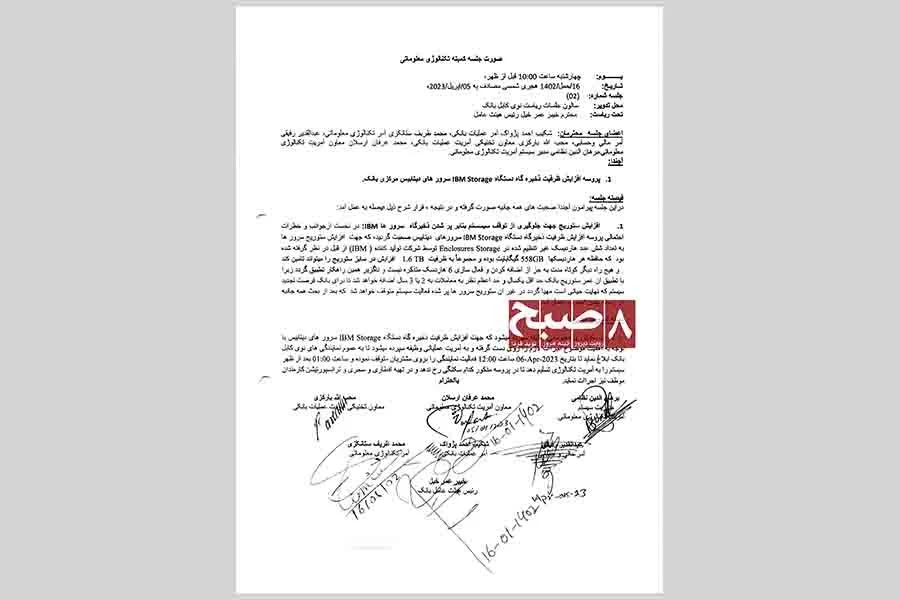
The report states that the storage capacity of Kabul Bank’s central database had reached about 92 percent in 2023, and that the continuation of this situation could create serious risks for the operation of the banking system and even lead to its shutdown. For this reason, the system administration had proposed activating six unused hard disks, each with a capacity of 558 gigabytes, in order to increase storage capacity. According to the system administration’s assessment, this measure could extend the useful life of the storage by at least one year and at most two to three years, depending on the volume of transactions.
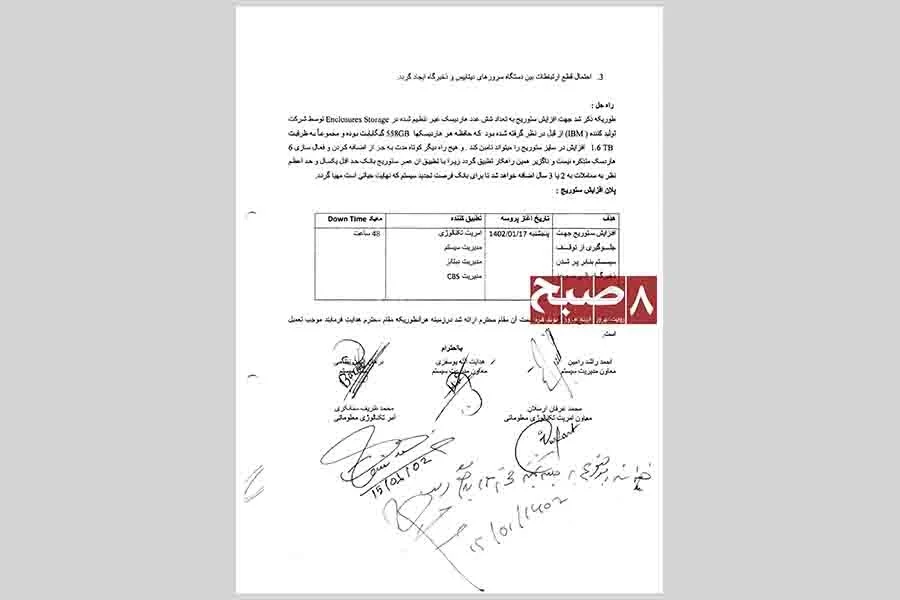
However, implementing the plan to increase storage capacity has also been accompanied by technical risks. The report refers to the possible shutdown of the GPFS cluster, inconsistency between cluster nodes, and disconnection between the database servers and the storage device. Despite these risks, the system administration described activating the six hard disks as the only short-term solution to prevent a system shutdown.
Minutes of Kabul Bank’s Annual General Assemblies of Shareholders
A copy of the minutes of the 1404 (2025) General Assembly of Shareholders of Kabul Bank, held on April 8, 2026, has reached the Hasht-e Subh Daily. The document shows that at this meeting, the bank’s 2024 financial reports were reviewed and approved, and that financial challenges, access to technical equipment, and the bank’s future strategic direction were discussed.
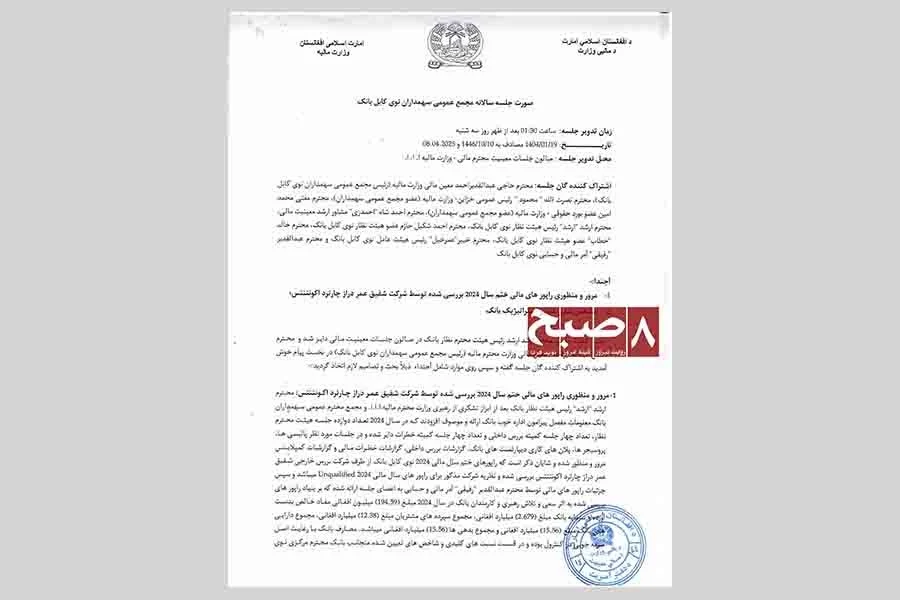
According to the minutes, Kabul Bank officials complained about the difficulty of procuring the information technology equipment the bank needs because of international sanctions. The chairman of the bank’s management board asked for cooperation in procuring technical equipment and specifically named the Hardware Security Module (HSM) security device, which is needed to secure automated teller machine (ATM) and point-of-sale (POS) systems. According to bank officials, procuring such equipment in Afghanistan has become difficult or impossible because of restrictions resulting from sanctions.
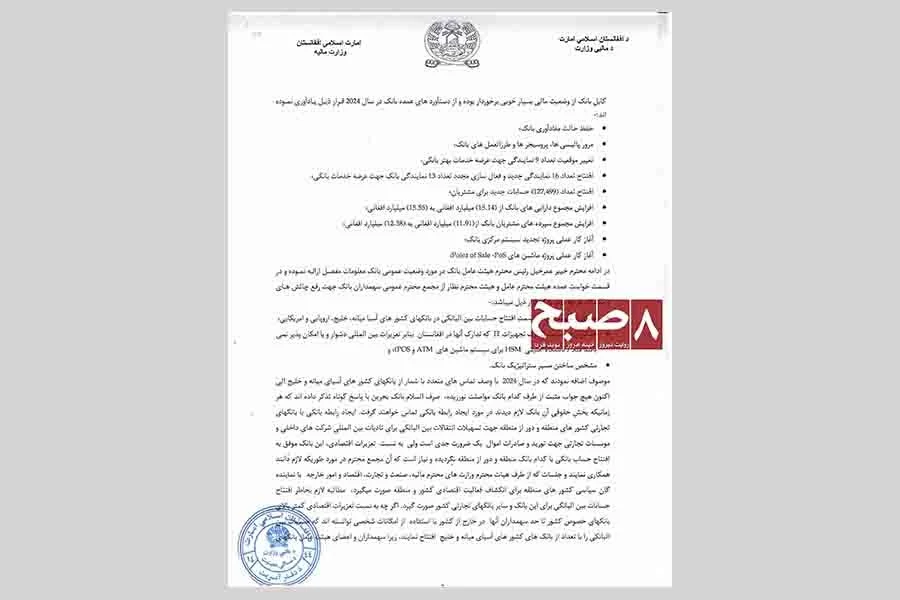
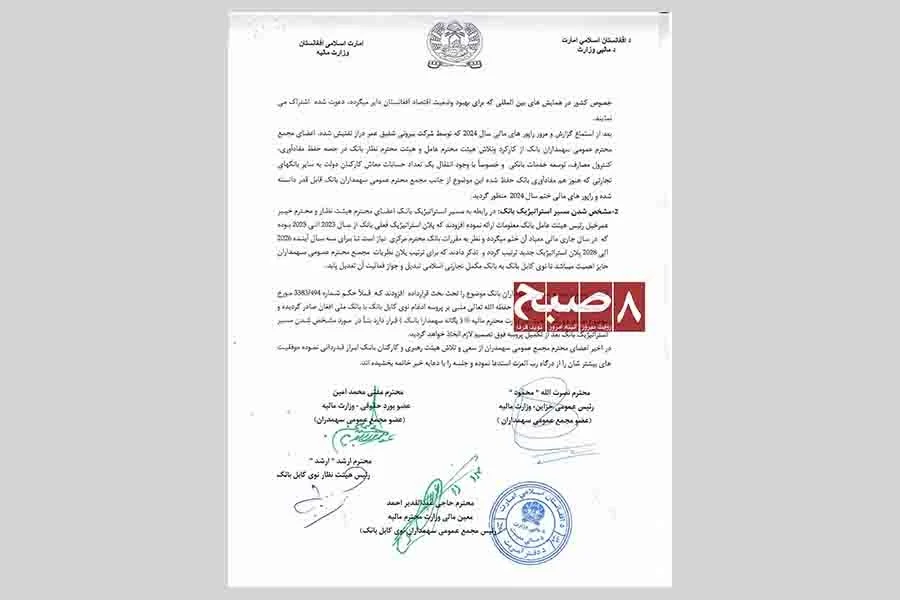
Another section of the minutes states that Kabul Bank’s current strategic plan for 2023 to 2025 was nearing its end and that the bank had to draw up a new strategic plan for 2026 to 2028. According to the minutes, the aim of the plan was described as transforming Kabul Bank into an Islamic commercial bank and amending its operating license. However, members of the General Assembly of Shareholders have left the decision on the bank’s future strategic direction until after the completion of its merger with BMA.
The minutes also refer to Hibatullah Akhundzada’s decree approving the board’s opinion on merging Kabul Bank with BMA. According to the document, since the merger process was being handled by the Taliban’s Ministry of Finance, the decision on the bank’s new strategic plan has been postponed until the fate of this merger becomes clear.
Some time ago, the Hasht-e Subh Daily also obtained a copy of a follow-up supervisory report by DAB, under Taliban control, on Kabul Bank, which pointed to continuing problems in the bank’s management, internal oversight, compliance with banking regulations and implementation of corrective measures. The findings of that report showed that weak control over customer transactions, shortcomings in vault management, thousands of dormant accounts, violations of banking regulations, a shortage of specialized staff, a reliance on income from fees and commissions, and the lack of proven practical readiness to deal with a liquidity crisis were among the bank’s major challenges.
Since When Has Kabul Bank Been in This Situation?
According to reports, in 2010 Kabul Bank faced a severe financial crisis after a major financial corruption case was exposed, involving illegal loans granted to shareholders and individuals connected to the bank’s management. Hundreds of millions of dollars of the bank’s assets were lost as a result of illegal loans and transactions linked to influential individuals. At the time, the crisis also severely affected Afghanistan’s banking system.
A report by the Special Inspector General for Afghanistan Reconstruction (SIGAR), numbered SIGAR 20-06-AR and published in November 2019, shows that the government of Afghanistan had recovered about 40 percent of the total 987 million dollars embezzled in the Kabul Bank case, while about 60 percent of this amount had still not been returned by the time the report was published.
According to reports by the International Monetary Fund (IMF), in 2011 Afghanistan’s central bank revoked the operating license of the former Kabul Bank and renamed it New Kabul Bank. The new Kabul Bank began operating on April 21, 2011, and its ownership was transferred to the government of Afghanistan at the time.
Media reports show that during the presidency of Hamid Karzai, the Kabul Bank case was referred to a special court, and its judicial verdict was issued in 2013. However, the handling of the case, the level of punishment for those involved, and the way the embezzled assets were to be recovered faced criticism and questions, to which no clear answers have been given so far.
The former government’s Ministry of Finance had announced that one of the most important decisions of the former Presidential Palace regarding the fate of New Kabul Bank was the plan to merge it with BMA. According to a report by the former government’s Ministry of Finance, in 2020 the Supreme Economic Council, chaired by Ashraf Ghani, agreed to merge New Kabul Bank and BMA. The then Ministry of Finance had announced that the aim of this decision was to increase efficiency and improve the quality of services of state-owned banks.
On September 5, 2020, the former government’s Ministry of Finance announced that a meeting chaired by Abdul Hadi Arghandiwal, the then acting head of the ministry, had been held on merging New Kabul Bank and BMA. According to this report, officials from the central bank and the Ministry of Finance, as well as the heads of both banks, attended the meeting and presented their views. In the end, the Ministry of Finance was tasked with presenting the views raised to the then presidency.
Likewise, the then Ministry of Finance announced in 2014 that, based on a decision of the Supreme Economic Council, Kabul Bank, Pashtany Bank and BMA would be merged with one another.
What Kind of Bank Is Bank-e-Millie Afghan?
On its website, the bank states that it was established on April 29, 1933, and was the first bank to introduce the banking structure in Afghanistan. The bank also says that until the establishment of DAB in 1939, it also carried out the functions of a central bank, and that it has been renowned in Afghanistan and around the world for more than 90 years.
The bank states that it began its banking activities with an initial capital of 9.6 million Afghanis, of which 72 percent belonged to the private sector and the other 28 percent to the public sector. According to information on the bank’s website, BMA was fully nationalized by the government of the time in 1976, and its aim was to advance banking activities in support of the development of major sectors such as trade, industry, and agriculture.
BMA currently has 17 branches, including its head office in Kabul, and 24 branches in the provinces of the country. The bank also has 30 ATMs.
You can read the Persian version of this investigative report here:
پایان تلخ یک تراژدی بانکی؛ طالبان کابلبانک را با «بانک ملی افغان» ادغام میکنند