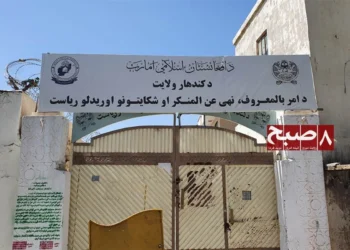
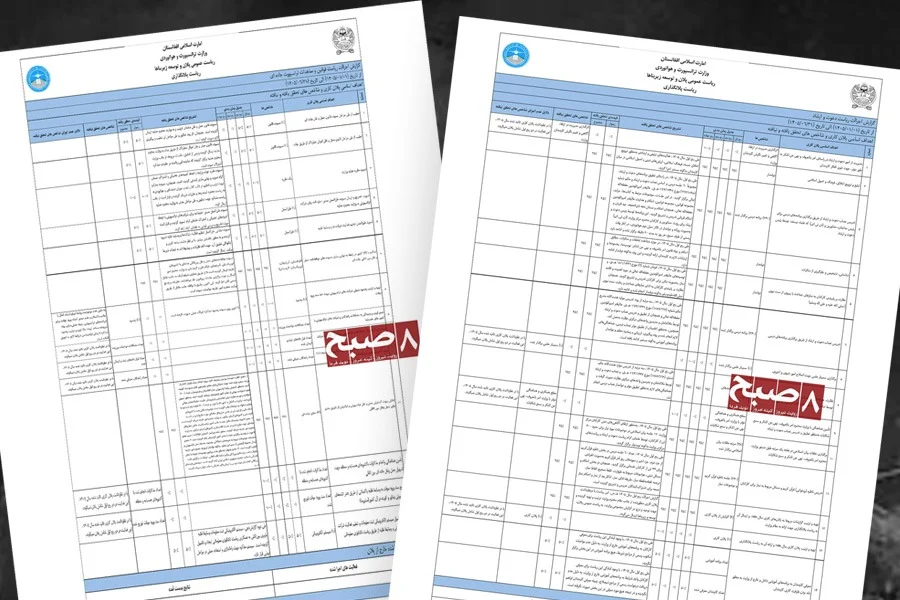
Copies of reports from various directorates of the Taliban’s Ministry of Transport and Civil Aviation have been obtained by the Hasht-e Subh Daily. This report examines only the activities of the Directorate of Transport Laws and Treaties and the Taliban’s Directorate of Call and Guidance. According to the report, the Taliban finalized four agreements with four countries over the past six months, but have not received any response from these countries during this period. At the same time, the Taliban’s Directorate of Call and Guidance at this ministry held 132 sessions on teaching prayer, ritual purification, and other religious matters, and stated that due to a lack of opportunity, no assessment has been conducted on the extent of change in employees’ attitudes. This comes as Afghanistan ranks 139th in the World Bank’s Logistics Performance Index.
Six-month report of the Directorate of Transport Laws and Treaties of the Taliban’s Ministry of Transport
The Directorate of Transport Laws and Treaties of the Taliban’s Ministry of Transport stated in its six-month work report that during this period, it finalized draft international road transport agreements with Kazakhstan, Azerbaijan, Uzbekistan, and Georgia, and sent them to these four countries through the group’s Ministry of Foreign Affairs. According to the report, by the end of the six months, no response had been received from the aforementioned countries.
The report states that developing guidelines for introducing transport companies for obtaining temporary entry documents, collecting the problems of drivers and transport companies with neighboring countries, registering and forwarding the contracts of transport companies with Iranian companies, introducing drivers for obtaining Uzbekistan visas, and distributing temporary entry documents for Pakistani vehicles were among the tasks that this directorate was unable to carry out.
The Directorate of Transport Laws and Treaties of the Taliban’s Ministry of Transport stated that due to the absence of active diplomatic relations with Pakistan and the non-issuance of temporary entry documents for transport companies, the ground for implementing this activity has not been prepared, and the preparation of guidelines has been postponed until the necessary conditions are met. This is even though the Taliban maintain an active embassy in Pakistan, and Pakistan’s embassy is also active in Kabul.
The report states that the Directorate of Transport Laws and Treaties of the Taliban’s Ministry of Transport held technical committee meetings at this ministry to prepare procedures, with the participation of Taliban scholars, and presented the procedures to Taliban scholars for final review.
Taliban religious training for employees: 132 religious sessions held
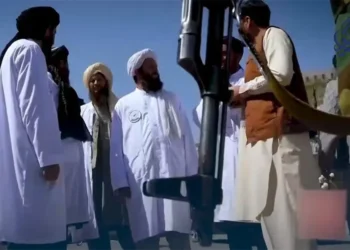
The Directorate of Call and Guidance of the Taliban’s Ministry of Transport reported in its six-month report that it held 132 guidance sessions for employees of this ministry during the first six months of the year 1405 (2025-2026). According to the report, 60 sessions were held on teaching the curriculum of call and guidance, 12 general sessions of mullahs’ lectures, and 60 sessions on teaching the Holy Quran and the rules of prayer.
The report states that during this period, 60 training sessions were held on Quran recitation and the rules of prayer. These sessions were held daily and continuously, at the start of the official morning working hours, for about 20 minutes. In these programs, topics such as the rulings and matters related to the first ten days of Dhul Hijjah, Eid al-Adha, and the rules of sacrifice were also taught and explained.
According to the report, this program covered portions of the Holy Quran, including the second Juz, the final Juz, and the surahs of the last quarter. Ritual purification, the method of performing prayer, and the rulings of Friday prayer were also among the other educational topics of these Taliban programs for transport employees.
Additionally, the Taliban’s Directorate of Call and Guidance held 12 sessions of “corrective speech” during the first six months of the year for around 300 employees at the central office of the group’s Ministry of Transport. In these sessions, mullahs affiliated with this directorate delivered lectures on religious topics and the recommendations the group intends for its employees.
Monitoring of congregational prayer
The Taliban’s Directorate of Call and Guidance at this ministry stated that alongside its educational programs, it has also monitored employees’ adherence to congregational prayer. According to the report, in this process, the rulings and recommendations related to the importance of prayer have been explained to employees, and monitoring of the performance of congregational prayer has continued on an ongoing basis. According to the report, employees who did not participate in some of the guidance programs of the Taliban’s Morality Police have also been identified and given recommendations.
The six-month report of the Directorate of Call and Guidance of the Taliban’s Ministry of Transport states that no assessment has yet been conducted of the extent to which this directorate’s activities have influenced changes in employees’ attitudes, nor has any seminar been held to reform their worldly and spiritual affairs. The report states that the implementation of these programs is planned for the following quarters of the year.
At the same time, employees of this ministry say that as Muslims, they are already well acquainted with all the principles and rules of prayer and the main and secondary tenets of the religion. According to them, instead of holding professional and specialized programs to build employees’ capacity, the Taliban take them to religious training sessions in the mornings, when they have just arrived at work and still have energy; training they say that they have known since childhood. They say that this process causes employees to spend their working hours on training they are already familiar with, instead of focusing on essential matters and carrying out their duties.
This is despite the fact that, according to credible international reports, including a World Bank report, Afghanistan faces serious difficulties in the transport sector. In the World Bank’s Logistics Performance Index (LPI) for 2023, Afghanistan received a score of 1.9 out of 5 and ranked 139th among the countries surveyed. Afghanistan’s score in the quality of trade and transport-related infrastructure was also about 1.7 out of 5, indicating the weakness of transport and logistics infrastructure in the country.
In the road sector as well, Afghanistan faces considerable challenges. According to a 2025 profile by the Asia Transport Outlook, Afghanistan’s road network is approximately 177,700 kilometers, of which nearly 91 percent consists of local and rural roads.
In terms of vehicles, Afghanistan also has a low level of motorization. According to a 2024 report, there were approximately 51 vehicles per one thousand people in Afghanistan, while this figure averaged around 317 vehicles per one thousand people in the Asia-Pacific region.
Furthermore, World Health Organization (WHO) estimates for 2021 show that the road traffic fatality rate in Afghanistan was 24.1 deaths per 100,000 people. According to the report, this figure is higher than the regional average of 15.2 deaths per 100,000 people in the Asia-Pacific region.
You can read the Persian version of this report here:
چهار موافقتنامه بیپاسخ و ۱۳۲ جلسه دینی؛ وزارت ترانسپورت طالبان چه میکند؟