
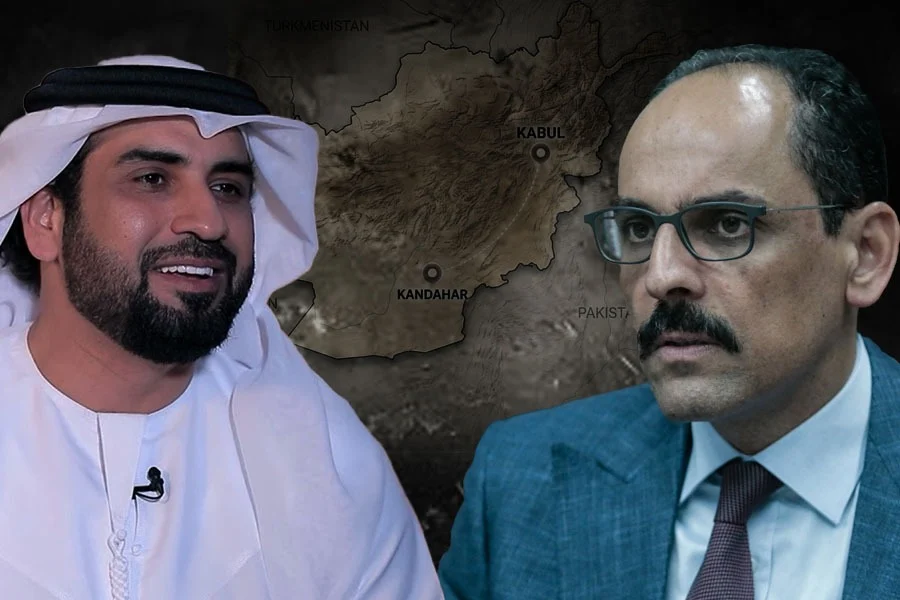
Two senior security officials from Turkey and Qatar came to Kabul and met with and held talks with several prominent Taliban figures: Abdul Ghani Baradar, Mullah Yaqoob, Sirajuddin Haqqani, and Abdul Haq Wasiq. The Turkish security official also traveled to Kandahar hoping to meet with the Taliban Supreme Leader, but instead of meeting him, he ended up meeting Mullah Sherin, the governor of that province. After that, he traveled to Pakistan and held meetings and consultations with officials of that country.
The trip by these two foreign officials generated a great deal of news coverage and speculation, as though some major event were looming over Afghanistan. Some believe they carried an important message from the United States. Others link the visit to the conflict between Saudi Arabia and the Houthis, arguing that Riyadh wants to use the Taliban as a tool against the Islamic Republic of Iran. However, if Saudi Arabia had such an intention, it would not entrust this mission to Qatar, a country that is its rival. Setting that aside, such an objective, at least for now, is not on Saudi Arabia’s agenda. The Taliban, too, have grown shrewd enough to avoid becoming a tool used by one side against another, and continue to regard “maintaining balance” as their guiding approach. Donald Trump, being preoccupied with larger issues, is not focused on the situation in Afghanistan, let alone sending a message to the Taliban Supreme Leader through two major regional countries. Even if he wanted to do so, Zalmay Khalilzad is an active and capable messenger and could carry out this task better than anyone else.
The joint presence of the Qatari and Turkish delegations in Kabul recalls the efforts of these two countries to end the crisis between Pakistan and the Taliban. It will be recalled that when the Taliban and Pakistan came into conflict, Ankara and Doha made efforts to bring the dispute to an end. Doha first hosted representatives of the parties to the conflict, followed by Ankara. The efforts of both hosts, although they led to the establishment of a fragile and partial ceasefire, did not persuade the parties to the conflict to bring the war to a complete end. On this basis, it is evident that the hosts want to carry out their unfinished mission to completion. From information leaked to the media and the Turkish delegation’s trip to Islamabad, it can also be understood that ending the dispute between the Taliban and Pakistan is a priority.
It appears that this time, unlike in the past, the mediators seem more serious. The trip to Kabul and Kandahar and separate meetings with five senior Taliban officials suggest an effort to present the Taliban with an ultimatum. The same applies to the unsuccessful attempt to meet with the Taliban Supreme Leader. So too does the Turkish delegation’s departure from Kabul and Kandahar bound for Islamabad. Given all this, Pakistan’s final message has been placed on the table before the Taliban.
The case of Tehrik-i-Taliban Pakistan (TTP) and the dispute between the Taliban and Islamabad over it is a serious problem, one whose consequences, if not managed, will spill beyond the borders of Afghanistan and Pakistan. On this basis, whichever country manages to neutralize the TTP issue, or at least contain it in the short term, will have achieved a major and impressive accomplishment. Doha is seeking to attain such an accomplishment, given the elevated place of “mediation diplomacy” in Qatar’s foreign policy. Turkey harbors the same ambition, particularly now that it is a member of the “Mecca Agreement,” and is making a serious effort to protect its nuclear-armed ally in South Asia from the damage of potential storms of events.
Regarding what has been discussed, an important question arises: will the efforts of Doha and Ankara produce results? The answer to this question is difficult, even for the mediators and the parties to the conflict themselves. However, based on past and present indications and evidence, it can be said that the parties to the conflict will yield to the mediators’ demands, but not permanently; this means they will agree not to end the dispute entirely, but to reduce the intensity of the tension. In this scenario, the TTP will remain in Afghanistan, not entirely defiant but relatively subdued and calm. Of course, the current situation (neither war nor peace) is acceptable to the mediators to a certain extent. The parties to the conflict also do not welcome an escalation of tension. The rhetoric of officials on both sides has also become softer and more conciliatory compared to recent months. The Taliban have come to realize that Pakistan possesses tools that, if employed, would make matters more difficult for the group. Likewise, Islamabad considers dialogue more effective than other tools, while also being well aware that the Taliban are not particularly inclined toward negotiation and, in the absence of hard options, tend to disregard the other side’s demands.
From the question above arises another: if Pakistan and the Taliban reach an understanding, what will become of those fronts opposed to the group that has allied themselves with Islamabad? Up to this point, it is clear that some opponents of the Taliban have been counting on Pakistan and are trying to make use of that country’s capacity against the Taliban. The Taliban are also fearful on this front and frequently speak about it in the media. In this case, if the ice in the Taliban-Pakistan relationship breaks or melts, there is a possibility that what the Taliban’s opponents have woven together with Pakistan will unravel. Indeed, once the Taliban comply with Pakistan’s demands regarding the TTP, Pakistan too will adopt a more cautious stance toward the regime in Kabul. If this happens, the Taliban’s opponents stand to lose a great deal, because if the mere association with Pakistan already carries a cost in Afghan public opinion, becoming a sacrifice in this process would multiply that cost many times over.
You can read the Persian version of this analysis article here: