Some women and girls in Kandahar who have turned to small-scale businesses say the Taliban’s restrictions have left them unable to meet the basic needs of their own lives and their families. According to them, the continuation of the Taliban’s restrictions has destroyed women’s economic independence and had worrying consequences for them.
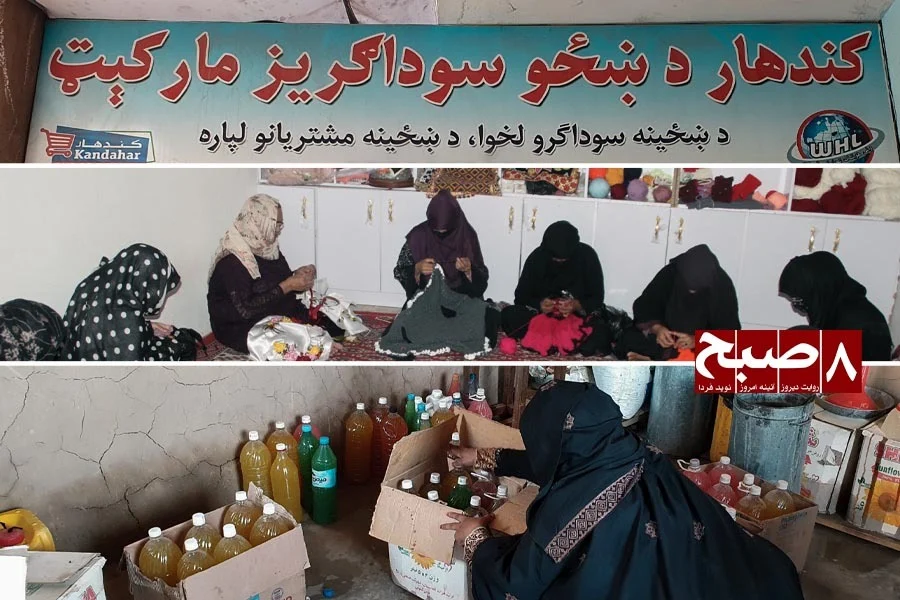
A number of women who worked in the women’s commercial market in Aino Mina, Kandahar, say the market had about 250 shops, where domestic products and women’s handicrafts were sold. However, about three years ago, it was closed by the Taliban’s Directorate for the Propagation of Virtue and Prevention of Vice. According to them, women were able to meet their basic living needs at that time through economic activity in this market, but they are now living in a difficult and uncertain situation.
Some of these women, who now work from home, say that continuing economic activity at home is difficult and that conditions for selling their products are not favorable. They stress that economic activity requires a market, and that the Taliban’s restrictions have confronted their businesses with widespread challenges.
A woman from Kandahar who asked for anonymity in the report says her husband was killed several years ago. She adds: “I live with my two daughters. I have no son. I used to work in the women’s market, but they closed that market. Now I sometimes work in one house and sometimes in another, and even that is hard to find. Our life is very hard.”
Zulaikha, who is the head of her family, says: “Our work used to be in the women’s market, but when they closed it, we started working at home. Women used to come to our house, but the Taliban banned that too. Still, I continued my work. Whatever I produced was sold in the market at half price, and no profit was left for me. Now all my work has stopped.” According to her, the movement of working women has also declined because of the restrictions, and for this reason, women who produce goods at home face serious problems selling their products.
A female entrepreneur in Kandahar also says that 30 to 40 women used to work with her, but now only six women are working with her.
She says: “Because of severe economic problems, no one works with me anymore. They are not to blame either, because I cannot pay high wages. Many women here learned tailoring and how to make soap and shampoo, but now not many women work with me, and our products do not have a specific market either.”
The loss of job opportunities for women in Kandahar has not only deepened economic hardship. Having lost their sources of income, some of them have been forced to ask others for help to meet their living needs.
A woman from Kandahar whose husband is disabled and who lives with her young son says the lack of work has forced her to reach out to others for assistance. She says: “I do not like taking charity and begging from people either. If there were work, I would work, but there is no work at all. My child cries, and I have no choice.”
A number of women in Kandahar who play an important role in their family economy say that, alongside losing job opportunities, they have also been deprived of another fundamental right. According to them, they have seen with their own eyes cases in which girls were married off without their consent, and as a result, all of their hopes for life have been destroyed. They say the Taliban’s severe restrictions against women and violations of human rights have had a profound impact on their lives.
Shazia, who previously worked at an organization, says her mental and physical condition has worsened after losing her job. She says: “I am the head of my family. They took my work from me. Wherever I went, there was no work. I have been ill for a long time, and I have headaches. Because of too much thinking and worry, I am mentally shattered. Doctors say not to think, otherwise your illness will get worse, but when the situation is like this, how can I not think? Now all roads are closed to me.”
Shazia adds that after losing her job, her ability to think and concentrate has also been affected. According to her, each time she tries to focus properly on something, economic problems, the restrictions imposed on women, and worries about the future subject her mind to constant pressure.
The World Bank also said in 2025 that the unemployment rate among young women in Afghanistan had risen and that, due to the lack of job opportunities, several women had left the labor market. According to the report, this situation has made women’s economic conditions even more vulnerable.
You can read the Persian version of this report here:
محدودیتهای طالبان؛ زنان قندهار از کار و استقلال اقتصادی محروم شدهاند