Afghanistan is recognized for its diverse social, linguistic, and religious structure. The country encompasses multiple Islamic sects, various ethnic groups, and diverse languages, each with its believers and advocates. The religious freedoms of the Afghan people were officially acknowledged in the constitution of the Islamic Republic of Afghanistan. Still, since the Taliban’s return to power, they have disregarded the country’s diverse values, emphasizing forced homogenization and the negation of others. Recently, the acting Minister of Higher Education for the Taliban has denied the existence of other religions in Afghanistan, stating, “All Afghans follow the Hanafi school of thought.” He claims that there are no other religions in Afghanistan. Political activists and religious affairs experts argue that the Taliban do not believe in diversity and plurality in the country, persisting in their mono-ethnic, mono-religious, and mono-linguistic behaviors. Previously, the US Commission on International Religious Freedom (USCIRF) reported that the Taliban had restricted religious freedoms. Additionally, the Asian Forum for Human Rights and Development (FORUM-ASIA) has expressed concern over the prohibition of religious freedom for Shiites by the Taliban.
The Taliban group, having gained control over Afghanistan in the past two years, has exhibited varied and contradictory behaviors and statements. Despite the group’s leadership political displays emphasizing respect for religions and collective beliefs, they consistently stress the negation of others and force homogenization in their speeches.
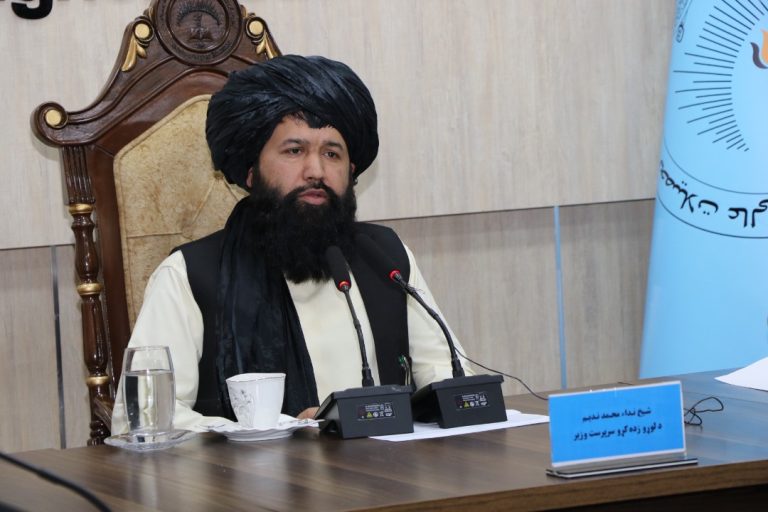
Nadeem, the acting head of the Taliban’s Ministry of Higher Education, has claimed that in Afghanistan, aside from the Hanafi school of thought, no other religious beliefs exist. He says, “All Afghans follow the Hanafi school of thought.”
Ziaullah Hashemi, the spokesperson for the Taliban-controlled Ministry of Higher Education, has shared portions of this Taliban official’s speech on social media, indicating a denial of other religions in Afghanistan.
Nadeem made these statements at the Sayed Jamaluddin Afghan University in Kunar province. He asserts Afghanistan’s mono-religious nature, despite a considerable portion of the country’s citizens adhering to the Shia sect of Islam.
While the Taliban, in control of Afghanistan for over two years, has displayed diverse and contradictory actions and statements, Governor Noor Mohammad Islamjar of Herat has described Shia Muslims as a “Takfiri sect” and “historical collaborators with infidels” in a book titled «مباحث فی العقیدة الماتریدیة المسمى معتمد ماترید من معتقد ماترید» which roughly translates to “Discussions on Maturidiyyah Doctrine Named Māturīdism Believers from Maturidisms.”
Alongside suppressing civil and political freedoms in Afghanistan, the Taliban have also negated religious freedom. In their initial actions, they removed the content of Jafari jurisprudence from Bamiyan University.
Despite repeatedly claiming respect for other religions in Afghanistan, according to some political opponents and experts in religious affairs, the Taliban are inclined towards exclusivity and hold specific interpretations of the Hanafi school of thought. In many instances, they exclude Shia Muslims from the “Islamic circle.”
Dawood Naji, a political activist, tells Hasht-e Subh Daily that the Taliban do not believe in diversity and plurality in Afghanistan. He adds, “The Taliban’s long-term plan is to gradually transform Afghanistan into a mono-religious, mono-linguistic, and mono-ethnic country. They [the Taliban] do not believe in diversity and plurality, and in practice, they have been implementing this policy step by step.”
Dr. Mohammad Saleh Moslih, a researcher in religious affairs, tells the Hasht-e Subh Daily that, according to the Taliban, the overwhelming majority of the Afghan population is considered “Sunni Hanafi” and they do not view Shia Muslims as their “rivals.” He states that the Taliban believe that officially recognizing the Shia sect in Afghanistan would open the door for the influence of the Islamic Republic of Iran. Therefore, they “are not interested in granting recognition to the Shia Islam and giving them a foothold.”
Mr. Moslih adds, “We have two issues: Hanafi and Deobandi. Although Deobandi follows the Hanafi school, in terms of beliefs and fundamental principles, it is more aligned and shares common ground with Salafism. From this perspective [Deobandi], Shia is accused of disbelief and deviation from Islam because, according to Shia, the first three caliphs deviated from the path of the Prophet of Islam, and their deviation extends to the point of leaving Islam. From the Sunni perspective, anyone who brings the three caliphs to the point of leaving Islam has, in turn, left Islam. That’s why the Taliban do not formalize recognition for the Shia Islam.”
This religious affairs researcher explicitly states that the Taliban’s major concern lies with Salafis, as the group perceives Salafism as a serious challenge to Deobandi’s thinking. In his view, although the Taliban share fundamental beliefs with Salafis, Salafis do not officially recognize anything called “denomination.” Alongside this, the Taliban government is characterized as an ethnocentric, authoritative hierarchy with a master-disciple dynamic, which Salafis reject. According to him, Nadeem’s disregard for denominations reflects the Taliban’s concern about Salafis present within the group, with many Taliban members sharing a “common type” of belief with Salafis.
Mr. Moslih emphasizes, “The reformist movement, which was active domestically under the name Jamiat Eslah, is present in the country but under another name. Nadeem, while trying to be able to ignore them and consider the suppression against Salafis resolved, conveyed to the people and his opponents that we no longer have adversaries, we are united, and we do whatever we want. Unity certainly does not imply rationality and commitment to the Hanafi denomination.”
This religious affairs researcher emphasizes, “The Taliban selectively resort to the Hanafi school of thought when it serves their interests, using it to support the suppression of their opponents. However, in cases where flexibility, righteousness, and human dignity are advocated, they are entirely Salafi, especially in their treatment of women. All of the Taliban’s actions contradict the Hanafi school of thought. The Hanafi school is one of the most dynamic and rational schools of thought globally, and the behavior of the Taliban cannot be representative of this denomination.”
Mr. Moslih states that the Taliban employ tactical maneuvers, utilizing Salafism whenever it benefits them. He asserts that the beliefs of this group have roots in ethnocentrism and tribalism.
These statements come as the US Commission on International Religious Freedom (USCIRF) previously stated in a report titled “Religious Freedom and Women’s Rights in Afghanistan” that with the Taliban in control, the religious freedom of Afghan citizens has been restricted.
The Asian Forum for Human Rights and Development (FORUM-ASIA) continues to assert that the Taliban have restricted the religious and doctrinal freedom of Shia Muslims. Additionally, Antonio Guterres, the Secretary-General of the United Nations, stated in his recent report to the Security Council that the Taliban have not allowed gatherings of Shia Muslims during the days of Ashura and have killed four individuals in the city of Ghazni during Ashura ceremonies.
Over the last two years, the Taliban systematically sought to convert Ismaili Shia followers to Sunni Islam. Within the current year, they enforced the Profession of Faith (shahada) for at least one individual who had converted to Sunni Islam influenced by the Taliban. This practice is specifically applied to those who have embraced Islam from other religions.