• 8AM.MEDIA
  • ویب‌سایت فارسی
  • پښتو ویب‌پاڼه
  • اۉزبېکچه ویب‌سایت
  • Podcast
Saturday, November 7, 2026
Hasht-e Subh
  • Home
  • News
    • Afghanistan News
    • World News
  • Opinion
    • Editorial
    • Analysis
  • Reports
    • Daily Reports
    • Investigative Reports
  • Society
    • The story of people
  • Women’s Word
  • Columns
    • Three Years After Afghanistan’s Fall: The Taliban’s Resurgence
    • Towards Equality
    • The Resurgence of the Taliban: Two Years Since Afghanistan’s Fall
    • Hebatullah Report Special Edition
    • Resistance for Education Special Edition
    • Special Column on Taliban’s Education Curriculum
    • Nawroz
  • Interviews
  • Contact Us
    • About Us
    • 8AM MEDIA Annual Awards
    • Submit an Article to Hasht-e-Subh
  • 8am.mediaBack
Subscribe
No Result
View All Result
  • Home
  • News
    • Afghanistan News
    • World News
  • Opinion
    • Editorial
    • Analysis
  • Reports
    • Daily Reports
    • Investigative Reports
  • Society
    • The story of people
  • Women’s Word
  • Columns
    • Three Years After Afghanistan’s Fall: The Taliban’s Resurgence
    • Towards Equality
    • The Resurgence of the Taliban: Two Years Since Afghanistan’s Fall
    • Hebatullah Report Special Edition
    • Resistance for Education Special Edition
    • Special Column on Taliban’s Education Curriculum
    • Nawroz
  • Interviews
  • Contact Us
    • About Us
    • 8AM MEDIA Annual Awards
    • Submit an Article to Hasht-e-Subh
  • 8am.mediaBack
No Result
View All Result
Hasht-e Subh
No Result
View All Result

Wagah Border Closure: Afghanistan Experiences 60% Decline in Exports to India

Hasht-E Subh Hasht-E Subh
31 August 2025 - Solar Hijri Date: 1404/06/09 [t_time:1756625537]
A security guard stands near a line of commercial trucks at a border crossing, highlighting the impact of trade route disruptions on Afghanistan's export industry. (Photo Credit: APnews)

APnews

The closure of the Attari-Wagah border, one of Afghanistan’s key export routes to India, has created serious concerns for exporters for the past six months. They say this situation has caused a 60 percent reduction in Afghanistan’s exports to India. Exporters emphasize that the closure of this border has not only led to the loss of some of their business contracts, but has also forced them to use alternative and costly routes. They are asking the Taliban to enter into negotiations with the embassies of Pakistan and India to reopen this trade route.

Some of these exporters, in conversation with the Hasht-e Subh Daily, have called for reducing the costs of Chabahar, Milk, and Dogharoun ports for dried fruit exporters and emphasized that using air corridors is not cost-effective for many exporters due to their high costs.

Gholam Yahya Meshkwani, one of the dried fruit exporters, says that the closure of the Attari-Wagah border has caused serious losses to them. He adds that currently, air corridors and Chabahar port are being used to transport dried fruits, but these routes come with heavy costs and long time periods. He considers the non-issuance of visas and the lack of access to European markets as major problems for merchants.

He adds: “The closure of Wagah port has caused more than a 60 percent reduction in exports to India. This severe reduction has caused extensive losses to merchants and has created major challenges for traders. Air corridors are very costly, but in urgent situations, we are forced to use them.”

Gada Muhammad Kohdamani, another exporter, emphasizes the immediate reopening of Wagah port for Afghanistan’s exports. He says that while Pakistan’s export items are easily exported to various countries, Afghanistan’s export items to Pakistan face numerous challenges.

Mr. Kohdamani asks the Taliban to reach an understanding with India and Pakistan as soon as possible to increase the country’s exports. He adds, “We ask officials to solve our problem and reach an understanding with Pakistan as soon as possible. When Pakistan’s commercial goods go through Afghanistan to Uzbekistan, Russia, and Tajikistan, our agricultural products should also be exported. Now all gates are closed to u, the US, and only Torkham is open, but we have many problems along the route. In 24 hours, not even 4 hours are given to fruits and vegetables. Coal fuel is exported daily by more than 200 trucks, but some trucks return empty, and our traders remain stranded at the border for two to three days.”

Masoud Safi, head of the dried fruit export administration, says that the closure of Wagah port results in losses for Afghanistan’s farmers and fruit exporters, and delays in reopening this route will bring further damage. He asks the Taliban to take action as soon as possible through diplomatic negotiations to reopen this port.

Mr. Safi adds, “If the closure of Wagah port continues, its damage will affect our farmers and exporters. Although most of our exports are conducted through the Torkham route and visas have been issued for about 100 freight trucks so far, Wagah port is vital for faster access to the Indian market and must be reopened as soon as possible.”

Meanwhile, the Union of Dried Fruit Exporters says they have repeatedly negotiated with the embassies of India and Pakistan about reopening Wagah port, but both sides make excuses, and permits for Afghanistan’s exports are not issued.

This union adds that although the country’s exports continue through Abbas and Chabahar ports, this route is also not without challenges.

Khaled Rahmani, spokesperson of the union chamber, says: “With the closure of the Attari-Wagah border, it has been six months since Afghanistan’s trade in the fresh and dried fruit sectors has faced enormous losses. When we approach the Pakistani embassy, they tell us we must first get permission from the Indian embassy. This is while Pakistan has no problem with Afghanistan’s exports, and neither does India.”

This union considers the failure to export more than 20 to 25 tons of fruit through Chabahar and Abbas ports as one of the major challenges for exporters. This organization asks all regional countries to keep trade separate from politics and help facilitate trade.

Meanwhile, several economic experts say that the closure of Wagah port was completely predictable and Afghanistan should have prepared alternative routes beforehand. They say that Afghanistan’s trade, due to being traditional and market similarity with Pakistan, is dependent on this country.

Qais Mohammadi, an economic expert, says: “Afghanistan must activate air corridors with countries it trades with. Also, new markets for Afghanistan’s dried fruits should be identified, especially neighboring countries that can be good markets for this product.”

Abdul Nasir Rashtia, an expert on economic issues, adds: “For us to emerge from isolation and reduce dependence on one route, we must first take fundamental measures within the country. Afghanistan’s most important export items are agricultural, and to compete in global markets, we need standard cold storage facilities, proper packaging, and standardization of our goods. Also, we must strengthen our strategic economic relations with the outside world and connect to new markets through connections to countries’ railway networks.”

The Attari-Wagah border was blocked after tensions escalated between India and Pakistan due to the killing of tourists in the Kashmir region under Indian control; however, this issue continues to cast a shadow over Afghanistan’s regional trade.

Afghanistan annually conducts exports worth nearly $1.5 billion to India and Pakistan, but due to political challenges created between these two countries, Afghanistan is on the verge of losing the most prosperous markets for selling its products. According to statistics, Afghanistan had commercial exchanges worth $3.246 billion with these two countries in the past year alone.

Previously, India’s Ministry of Commerce and Industry had announced that the volume of trade with Afghanistan had reached $1.078 billion during this period. Afghanistan mostly exported dried fruits, carpets, saffron, and medicinal plants to India and, in return, imported medicines, medical equipment, and construction materials.

Recently, local sources have told the Hasht-e Subh Daily that the Torkham border has also been blocked to all traffic due to heavy rainfall and flooding.

You can read the Persian version of this report here:

بسته‌ماندن بندر واگه؛ صادرات افغانستان به هند کاهش ۶۰ درصدی را تجربه می‌کند 

ShareTweetSendSendShare

Related Posts

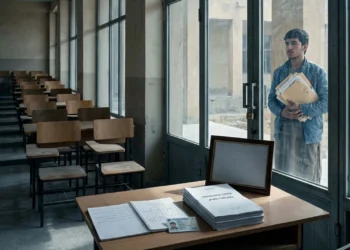
A student holding folders of documents looks through a locked glass door into an empty university classroom, where a blank frame, notebook and ID card sit on a desk. (Photo credit: AI)
Daily Reports

Students in Limbo, Unable to Obtain Records After Taliban Close Universities

7 November 2026 [t_time:1794051929]
Bruno Lemarquis - the UN Deputy Special Representative for Afghanistan (Photo: UN)
Afghanistan News

UN: More Than 700 Health Facilities Closed in Afghanistan

7 November 2026 [t_time:1794051652]
Alfalah bank entrance (Photo: investify)
Afghanistan News

Bank Alfalah Ends Two-Decade Presence in Afghanistan

7 November 2026 [t_time:1794049461]

Latest

Loading latest news...

Popular stories

  • Iran’s flag is seen with a ship in the background amid reports of a US attack on Larak Island in the Strait of Hormuz. (Photo credit: Fox News)

    Iran Cuts Strait of Hormuz Reopening Plan Timeline to Two Days

    Share
    Share Tweet
  • Would a Democratic Victory Rein In Trump’s “Freedom of Action” on Iran?

    Share
    Share Tweet
  • Obama After Democratic Gains: Americans Want an End to Division

    Share
    Share Tweet
  • UN Report Reveals Shifts in Family Attitudes and Rise in Domestic Violence in Afghanistan

    Share
    Share Tweet
  • Taliban and Pakistan Confrontation: Real or Staged?

    Share
    Share Tweet

Podcast

Insights
Insights

Join Lynne O’Donnell for 8AM’s podcast series, Insights.
Lynne talks with generals, diplomats, soldiers, journalists, politicians, activists, people who have front row seats for conflicts around the world, and citizens with a story to tell, happy or sad. For this first series, Afghanistan is the focus. Lynne and her guests talk about the collapse of the republic in August, 2021, and the impact since — for the people of Afghanistan, for the security of the region, for the safety of the world. It’s important, interesting and insightful.

Insights/22: Controlling the Narrative with Mina Sharif
byinsights8am

Controlling the Narrative

Lynne O’Donnell talks with Mina Sharif, author, activist, women’s rights campaigner, educator and mentor. They discuss who controls the narrative and who speaks for Afghanistan’s people when the Taliban appear to have seized control not only of the country but of the message, too.

Have a listen

Insights/22: Controlling the Narrative with Mina Sharif
Episode play icon
Insights/22: Controlling the Narrative with Mina Sharif
Episode Description
Episode play icon
Insights/21: Media Meltdown with Zahra Joya
Episode Description
Episode play icon
Insights/20: Terror Inc with Scott Richards
Episode Description
Episode play icon
Insights/19: Busting Stereotypes with Bushra Gohar
Episode Description
Episode play icon
Insights/18: Media Matters with Waliullah Rahmani
Episode Description
Episode play icon
Insights/17: What Goes Around Comes Around with Sima Samar
Episode Description
Search Results placeholder
Hasht-e Subh

8AM Media, also known as Hasht-e-Subh Daily, stands as Afghanistan's premier independent and non-profit newspaper, resonating as a beacon of journalistic integrity since its establishment in June 2007 by esteemed Afghan journalists and human rights advocates. With a steadfast commitment to citizen journalism and civic education, Hasht-e-Subh Daily has earned its place as the most esteemed publication in the nation.

Publisher: Sanjar Sohail
Email: [email protected]
Executive Director: Parwiz Kawa
Email: [email protected]

Read More

Part Three: The University Reopens

Democrats’ Midterm Win Sounds Alarm for Trump, Opens New Chance to Contain Middle East War

COP31: A Closer Look at the 31st UN Climate Change Conference

Students in Limbo, Unable to Obtain Records After Taliban Close Universities

UN: More Than 700 Health Facilities Closed in Afghanistan

Editor’s Choice

Every Saturday morning, 8AM MEDIA English Services Department will guide you through the week’s biggest stories from Afghanistan and the international community.

Subscribe

© 2026 - ©Hasht-e Subh Daily

No Result
View All Result
8am.Media
پښتو ویب‌پاڼه
ویب‌سایت فارسی
اۉزبېکچه ویب‌سایت
  • Home
  • News
    • Afghanistan News
    • World News
  • Opinion
    • Editorial
    • Analysis
  • Reports
    • Daily Reports
    • Investigative Reports
  • Society
    • The story of people
  • Women’s Word
  • Columns
    • Three Years After Afghanistan’s Fall: The Taliban’s Resurgence
    • Towards Equality
    • The Resurgence of the Taliban: Two Years Since Afghanistan’s Fall
    • Hebatullah Report Special Edition
    • Resistance for Education Special Edition
    • Special Column on Taliban’s Education Curriculum
    • Nawroz
  • Interviews
  • Contact Us
    • About Us
    • 8AM MEDIA Annual Awards
    • Submit an Article to Hasht-e-Subh
  • 8am.media

© 2026 - ©Hasht-e Subh Daily