• 8AM.MEDIA
  • ویب‌سایت فارسی
  • پښتو ویب‌پاڼه
  • اۉزبېکچه ویب‌سایت
  • Podcast
Thursday, October 22, 2026
Hasht-e Subh
  • Home
  • News
    • Afghanistan News
    • World News
  • Opinion
    • Editorial
    • Analysis
  • Reports
    • Daily Reports
    • Investigative Reports
  • Society
    • The story of people
  • Women’s Word
  • Columns
    • Three Years After Afghanistan’s Fall: The Taliban’s Resurgence
    • Towards Equality
    • The Resurgence of the Taliban: Two Years Since Afghanistan’s Fall
    • Hebatullah Report Special Edition
    • Resistance for Education Special Edition
    • Special Column on Taliban’s Education Curriculum
    • Nawroz
  • Interviews
  • Contact Us
    • About Us
    • 8AM MEDIA Annual Awards
    • Submit an Article to Hasht-e-Subh
  • 8am.mediaBack
Subscribe
No Result
View All Result
  • Home
  • News
    • Afghanistan News
    • World News
  • Opinion
    • Editorial
    • Analysis
  • Reports
    • Daily Reports
    • Investigative Reports
  • Society
    • The story of people
  • Women’s Word
  • Columns
    • Three Years After Afghanistan’s Fall: The Taliban’s Resurgence
    • Towards Equality
    • The Resurgence of the Taliban: Two Years Since Afghanistan’s Fall
    • Hebatullah Report Special Edition
    • Resistance for Education Special Edition
    • Special Column on Taliban’s Education Curriculum
    • Nawroz
  • Interviews
  • Contact Us
    • About Us
    • 8AM MEDIA Annual Awards
    • Submit an Article to Hasht-e-Subh
  • 8am.mediaBack
No Result
View All Result
Hasht-e Subh
No Result
View All Result

Why Was Lakhanwal Labeled a “Refugee” Rather Than an “American-Trained Veteran”?

Ahangar Ahangar
1 December 2025 - Solar Hijri Date: 1404/09/11 [t_time:1764652607]
Rahmanullah Lakhanwal, the attacker in the recent White House shooting incident, was a former CIA-trained operative who worked with Afghanistan's Zero Units in counterterrorism operations before being evacuated to the United States after the fall of Kabul in 2021. (Photo Credit: Social Media)

Social Media

The recent shooting near the White House, in which two members of the U.S. National Guard were targeted, has once again pushed debates around immigration, security, and media narratives to the forefront. Rahmanullah Lakhanwal, the attacker, was initially described by many U.S. outlets as “an Afghan refugee,” a label that may seem simple but is deeply misleading. It is a narrative that diverts attention from the central questions, shifting responsibility away from America’s political and security institutions and placing it instead on “immigration,” even though the real story lies elsewhere.

Violence, at any level, by any individual or group, is unjustifiable and must be unequivocally condemned. Violence takes lives, erodes security, and damages public trust. Preventing such incidents requires informed, deliberate, and preventive strategies that ensure no one,  whether in Washington or anywhere else in the world,  falls victim to violence.

What the media concealed, and continues to obscure, is that Lakhanwal was not an ordinary refugee. He was trained within the U.S. security apparatus. According to Sarah Adams, a former CIA officer, Lakhanwal entered the counterterrorism base known as Eagle in 2007, where he underwent intensive training before joining the “Zero Units” of Afghanistan’s National Directorate of Security, units that nominally operated under the Afghan government but were fully commanded and directed by the CIA. For years, Lakhanwal played an active role in tracking and suppressing terrorist networks and participated in operations in Kandahar against the Taliban, al-Qaeda, and ISIS.

After the fall of Kabul in August 2021, members of the Zero Units, along with operatives from the Khost and Kandahar strike forces, became direct targets for retaliation by the Haibatullah network, ISIS-K, and al-Qaeda. Many entered the evacuation process under false identities, but Lakhanwal’s was one of the few identities fully verified by the United States. This background makes one thing clear: Lakhanwal was a product of the U.S. security structure, a system that trains fighters but, once the war ends, releases them without any plan for rehabilitation, psychological evaluation, or structural support. This gap is both dangerous and long overlooked.

Lakhanwal’s familial connection to Muawiya Khorasani, a slain ISIS-K member, adds complexity to the narrative, but it does not explain the act of violence, just as having a criminal relative does not alter the responsibility of any individual. The real issue lies in psychological strain, post-war trauma, and the ongoing threats that combat personnel face long after their missions end.

Another important layer in this incident is the role of Western media in constructing and reproducing narratives. Mainstream outlets, knowingly or unknowingly, amplified exactly the storyline sought by the Trump campaign and right-wing factions: the reductionist framing of “an Afghan refugee,” implying that “immigration” is America’s core problem. This mirrors the post–September 11 narrative playbook, one that ties individual acts of violence to the collective identity of Muslims and immigrants. Within this framework, the perpetrator is a “migrant,” not a trauma-affected former operative, not a product of an American-run security structure, and not the outcome of failed integration policies. Yet the legal and ethical principles remain clear: responsibility for a crime is individual, not ethnic, not religious, and not cultural.

The double standard in this narrative construction becomes even clearer when compared with the attack on Charlie Kirk. In that incident, the assailant was a white American, yet none of the major news outlets dwelled on his “whiteness,” nor did any political figure link the attack to a supposed “white crisis.” Even today, the event has almost vanished from the media’s collective memory. The contrast is telling: when the perpetrator is white, the violence is framed as an “individual act,” but when the attacker is an immigrant or a Muslim, it is suddenly treated as a “collective threat.”

These narratives carry heavy human consequences. Tens of thousands of Afghans in the United States live in uncertain legal conditions, fearful that immigration police or ICE might detain and deport them to Afghanistan, where the Taliban and affiliated terrorist networks pose an immediate threat to their lives. Thousands more have been stranded for more than three years in the UAE, Pakistan, Albania, and other countries. Every incident that is politically framed as the work of an “Afghan refugee” drastically reduces their chances of relocation and fair processing.

In this context, one ethical principle must be emphasized: no injury and no political anger can justify violence. Individual, structural, state, or ideological violence must all be condemned. Every drop of blood shed in Washington, Kabul, or anywhere else signals the collapse of reason, ethics, and politics. Condemnation of violence must be unconditional.

Preventing the recurrence of such incidents requires confronting the root causes: postwar psychological pressures, the absence of support systems for combat personnel, weak social integration, and the distortions created by misleading narratives. Only by addressing these underlying factors can we find ways to ensure that no human being, soldier, refugee, or ordinary citizen, becomes a victim of violence.

The Washington incident is the consequence of war, not of migration; the product of twenty years of tension, night raids, psychological strain, flawed evaluations, and postwar abandonment. Presenting Lakanwal as an “Afghan refugee” distorts reality and shifts attention away from the primary sources of responsibility. If the institutions that train such forces and then abandon them are not held accountable, the recurrence of such events will not be an exception but part of a continuing cycle of violence and structural failure.


You can read the Persian version of this analysis here:
چرا لکنوال را «پناهنده» نامیدند نه «کهنه‌سرباز امریکایی»؟

ShareTweetSendSendShare

Related Posts

Former President George W. Bush speaks at a podium during an outdoor event, gesturing while addressing migration and refugee policies that have impacted Afghan allies and other immigrants. (Photo Credit: GETTY IMAGES VIA AFP)
Afghanistan News

George W. Bush Institute Condemns Trump Administration’s Migration Policy

21 December 2025 [t_time:1766310680]
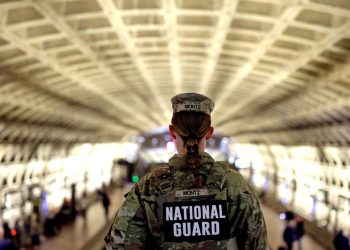
A U.S. National Guard member stands watch at a transit station, following increased security measures after the tragic shooting incident involving Afghan national Rahmanullah Lakanwal. (Photo Credit: GETTY IMAGES VIA AFP)
Afghanistan News

Shawn VanDiver: Shooting of U.S. National Guard Members Is a Tragedy and Must Not Be Politicized

11 December 2025 [t_time:1765452541]
Department of Homeland Security seal displayed at an immigration facility, as Afghan asylum cases face increased scrutiny under new administration policies. (Photo Credit: Bloomberg)
Afghanistan News

Afghan Asylum Seeker in the U.S. Faces Deportation after New Trump Administration Order

9 December 2025 [t_time:1765285072]

Latest

Loading latest news...

Popular stories

  • Donald Trump – U.S. President with Benjamin Netanyahu – Israeli Prime Minister in a gathering of people (Photo: Getty Images) Donald Trump – U.S. President with Benjamin Netanyahu – Israeli Prime Minister in a gathering of people (Photo: Getty Images)

    US Senator Criticizes Netanyahu’s Remarks Justifying War Against Iran

    Share
    Share Tweet
  • UN Report Reveals Shifts in Family Attitudes and Rise in Domestic Violence in Afghanistan

    Share
    Share Tweet
  • US Defense Secretary Warns Iran of “Destruction”

    Share
    Share Tweet
  • Trump Calls Iran’s Hope of War Lasting Beyond US Midterm Elections a “Dream”

    Share
    Share Tweet
  • Trump Again Says War with Iran Will End “Very Soon”

    Share
    Share Tweet

Podcast

Insights
Insights

Join Lynne O’Donnell for 8AM’s podcast series, Insights.
Lynne talks with generals, diplomats, soldiers, journalists, politicians, activists, people who have front row seats for conflicts around the world, and citizens with a story to tell, happy or sad. For this first series, Afghanistan is the focus. Lynne and her guests talk about the collapse of the republic in August, 2021, and the impact since — for the people of Afghanistan, for the security of the region, for the safety of the world. It’s important, interesting and insightful.

Insights/22: Controlling the Narrative with Mina Sharif
byinsights8am

Controlling the Narrative

Lynne O’Donnell talks with Mina Sharif, author, activist, women’s rights campaigner, educator and mentor. They discuss who controls the narrative and who speaks for Afghanistan’s people when the Taliban appear to have seized control not only of the country but of the message, too.

Have a listen

Insights/22: Controlling the Narrative with Mina Sharif
Episode play icon
Insights/22: Controlling the Narrative with Mina Sharif
Episode Description
Episode play icon
Insights/21: Media Meltdown with Zahra Joya
Episode Description
Episode play icon
Insights/20: Terror Inc with Scott Richards
Episode Description
Episode play icon
Insights/19: Busting Stereotypes with Bushra Gohar
Episode Description
Episode play icon
Insights/18: Media Matters with Waliullah Rahmani
Episode Description
Episode play icon
Insights/17: What Goes Around Comes Around with Sima Samar
Episode Description
Search Results placeholder
Hasht-e Subh

8AM Media, also known as Hasht-e-Subh Daily, stands as Afghanistan's premier independent and non-profit newspaper, resonating as a beacon of journalistic integrity since its establishment in June 2007 by esteemed Afghan journalists and human rights advocates. With a steadfast commitment to citizen journalism and civic education, Hasht-e-Subh Daily has earned its place as the most esteemed publication in the nation.

Publisher: Sanjar Sohail
Email: [email protected]
Executive Director: Parwiz Kawa
Email: [email protected]

Read More

Has the World Grown Accustomed to the Crisis in Afghanistan?

International Criminal Court Wins Sakharov Prize for Freedom of Thought

Guterres Calls for an End to Conflicts Worldwide

UNICEF: Millions of Children in Afghanistan Face Climate Risks

From the Shadows to Finding My Voice: A Story of Struggle and Resilience

Editor’s Choice

Every Saturday morning, 8AM MEDIA English Services Department will guide you through the week’s biggest stories from Afghanistan and the international community.

Subscribe

© 2026 - ©Hasht-e Subh Daily

No Result
View All Result
8am.Media
پښتو ویب‌پاڼه
ویب‌سایت فارسی
اۉزبېکچه ویب‌سایت
  • Home
  • News
    • Afghanistan News
    • World News
  • Opinion
    • Editorial
    • Analysis
  • Reports
    • Daily Reports
    • Investigative Reports
  • Society
    • The story of people
  • Women’s Word
  • Columns
    • Three Years After Afghanistan’s Fall: The Taliban’s Resurgence
    • Towards Equality
    • The Resurgence of the Taliban: Two Years Since Afghanistan’s Fall
    • Hebatullah Report Special Edition
    • Resistance for Education Special Edition
    • Special Column on Taliban’s Education Curriculum
    • Nawroz
  • Interviews
  • Contact Us
    • About Us
    • 8AM MEDIA Annual Awards
    • Submit an Article to Hasht-e-Subh
  • 8am.media

© 2026 - ©Hasht-e Subh Daily