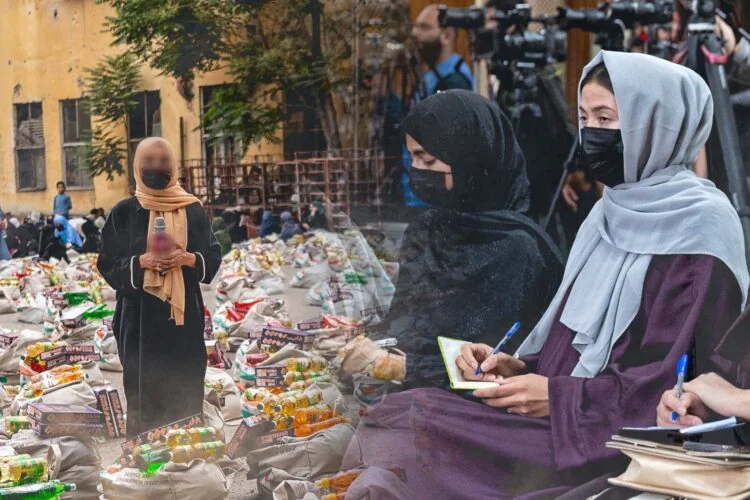
As women journalists in Afghanistan, we have to work several times harder to reach a position that may be more easily accessible to our male colleagues. We face gender-based restrictions and discrimination within our families and society, as well as the dismissal of our abilities, constant judgment and obstacles that stand in the way of our professional work every day. Journalism is not merely a job for us. It is a responsibility to report the truth and give a voice to those who cannot make themselves heard. To uphold this responsibility, we must repeatedly stand against discriminatory attitudes and countless challenges. Behind every successful woman journalist is a story of extraordinary effort, resilience and a heavy price that few people ever see.
Before facing the professional challenges of journalism, women journalists in Afghanistan must first deal with restrictions rooted in social and cultural structures and gender-based attitudes. In many families and communities, a woman’s work in the media is still not fully accepted, particularly when it requires attending press conferences, speaking with men or travelling frequently. Sometimes, to carry out even the simplest professional duty, a woman journalist must first convince her family, then endure society’s judgment, and finally work several times harder than a male colleague to prove her abilities in the workplace.
These challenges are not limited to families and society. Access to information is one of the most basic requirements for any journalist. However, for women journalists in Afghanistan, even obtaining information or conducting a simple interview can become a serious challenge. At times, contacting a male source, interviewing an official or entering a workplace comes with sensitivities that have nothing to do with the quality of a journalist’s professional work. In some cases, women journalists must take social and family considerations into account when interviewing men. These considerations can make the reporting process more difficult and time-consuming.
Workplace discrimination is another reality experienced by some women journalists. Despite carrying heavy responsibilities and undertaking extensive professional work, some receive very low salaries. At times, the workload assigned to a woman journalist is far greater than the resources and benefits available to her. Under such circumstances, she must struggle simultaneously to keep her job, meet her financial needs and continue her professional activities.
One of my personal experiences as a journalist took place in 2023, when I went to cover a press conference at the Kabul Intercontinental Hotel. A Taliban member prevented me from entering the event, questioning my presence with the words: “Women do not belong in places like this.” Afterwards, I was shown a seat in a corner at the far end of the hall, as if to make clear where a woman journalist was expected to sit. However, I did not give in. I tried to make my way to the second row, alongside other journalists and media cameras. For me, that day was not simply a personal encounter. It was an experience of fighting to have a woman’s right to be present in a place recognized, a position I had worked for years to reach.
Experiences like this show that a woman journalist’s challenge is sometimes not simply to prepare a report and convey information, but to prove her right to be in the very environment she needs to carry out her professional duties. When women’s presence in certain settings is restricted or met with hostility, it is unrealistic to expect them to continue their work without paying a psychological, social and professional price.
The concerns of women journalists in Afghanistan are not limited to public spaces and press conferences. Some women journalists who attend programmes and meetings where views critical of Taliban policies and actions are expressed face summonses, questioning and pressure from local officials of the Taliban’s Department of Information and Culture. Under such circumstances, the fear of threats, interrogation, violence or even arrest can affect their ability to continue their professional work.
One of the least visible aspects of this situation, however, is the silence of women journalists. Many prefer not to share their experiences with others, not because nothing has happened to them, but because they fear possible consequences, damage to their social reputation, concerns from their families and the loss of job opportunities. Sometimes, after experiencing pressure and threats, a woman journalist quietly withdraws from her workplace without filing a complaint or reporting the incident to any organization. In doing so, she may give up some of her professional goals.
This silence should not be interpreted as an absence of problems or acceptance of the situation. In many cases, it is simply the way a woman chooses to protect herself and her family from possible consequences. As a result, much of the pressure placed on women journalists never appears in official reports, media statistics or public accounts.
Meanwhile, women journalists who have left Afghanistan and continue their media work abroad face different challenges. Some support organizations require specific documents and evidence of threats and violence when reviewing applications for assistance and protection. However, many women journalists in Afghanistan have been unable to file formal complaints, keep records or obtain official confirmation from relevant authorities because they fear the security consequences. Sometimes, the absence of an official document becomes an obstacle to proving an experience whose consequences a journalist has lived with for years.
This raises an important question: Can a journalist’s documented account and personal testimony, together with her professional record, published reports, colleagues’ testimonies and available evidence, not serve as part of the criteria for assessing risk and the need for protection? Should alternative ways of documenting and reviewing the experiences of women who have lived under difficult conditions without access to formal mechanisms not be considered?
Alongside all these challenges, another important question arises: What are organizations supporting journalists doing to protect women journalists, and to what extent do these efforts address their actual needs?
Support for women journalists should not be limited to issuing statements of solidarity or adding their names to lists of vulnerable individuals. Providing safe access to legal advice, psychological support, emergency assistance, employment opportunities, professional training and confidential complaint mechanisms are among the measures that can help reduce their vulnerability. Media organizations and groups supporting journalists should also create conditions in which women can share their experiences and receive the support they need without fear of having their identities exposed or facing social consequences.
Another important issue is the need to pay attention to women who have been forced to leave media work because of threats and restrictions or have had to flee their country. For these women, support does not simply mean escaping an emergency situation. It also means creating opportunities to return to professional life, access education and training, achieve economic independence and continue working in the media in a safe environment.
Being a woman in Afghan society, particularly for someone who has chosen journalism as her profession and responsibility, sometimes means overcoming obstacles that her male colleagues do not face in the same way. Nevertheless, women journalists continue to work to represent those who have no opportunity to express their pain and demands. They are not fighting merely to keep a job. They are fighting to preserve their right to be present, to ask questions, to know and to tell stories.
Perhaps the most painful part of this reality is that sometimes, after years of hard work, a woman journalist leaves the profession not because she lacks the ability or interest, but because of pressure and neglect. No one asks why she left or recognizes the price she paid to stay.
Therefore, the fundamental question is not only how women journalists stand against restrictions, but also how much responsibility the media community, relevant institutions and organizations supporting journalists are willing to take to ensure that these women do not have to face this struggle alone. Forgetting a woman journalist does not simply mean losing a media professional. It means silencing a voice that took years of effort to make heard.
Women journalists in Afghanistan pay a price far greater than that of an ordinary job to be seen, heard and remain in their profession. But no woman should have to choose between her safety and her right to work in order to fulfil her journalistic responsibility. The silence of women journalists is not merely the silencing of one voice. It is the silencing of a part of society’s truth.