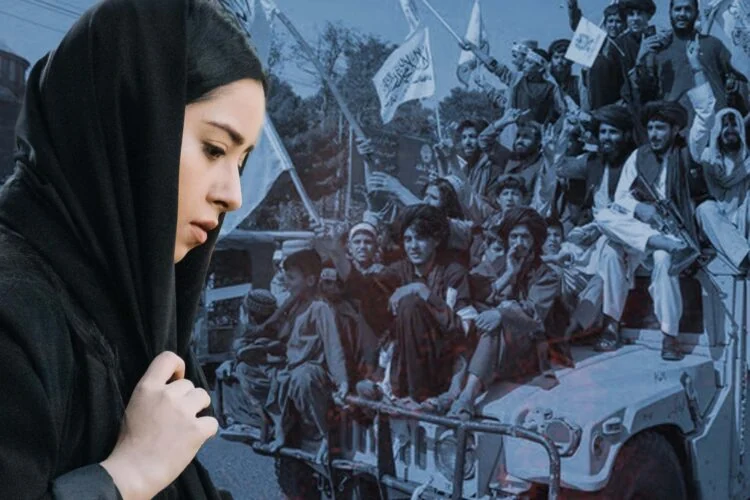
I am deeply worried: worried about the Taliban’s advance on Kabul and the fate of women and girls as a whole. My nights pass sleeplessly, consumed by a distress that drains all my strength, while during the day, my eyes and ears remain fixed on the news, which brings constant reports of the Taliban’s advances. August 15. The danger has reached people’s doorsteps. No one speaks of resistance or saving Afghanistan anymore. Fear and anxiety have taken hold of every part of people’s lives, and everyone is trying to escape the grip of a group whose first period of rule left bitter memories in their minds.
In the final moments before the Taliban take control of Kabul, shocking news spreads across the media: “Please pay attention to this breaking news: Two sources have told TOLOnews that President Ghani has left the country.” My legs give way. I lean against the wall and sink to the floor. I think of the flagpole that has flown the three-colored national flag above the Presidential Palace for years, a flag that will be lowered within moments.
Before I can even process the devastating news, my phone starts ringing nonstop. I receive several calls from my father, brother, sister, and friends who think I am at university. The last call is from Hamasa. I answer hurriedly and ask, “Where are you? Have you left the dormitory?” She speaks in broken sentences, struggling to catch her breath. “I’m trying to escape. I can’t find a car, and I have my suitcase with me. What should I do?” Then I hear nothing more. The call drops.
This time, Shima calls. She is also worried about Hamasa. I tell her, “I just spoke to her. She is fine, has left the dormitory, and is coming home.” I try calling Hamasa again, but sometimes her phone is switched off and at other times she is unreachable. I am terrified, wondering where she is and what might have happened to her.
On the day Kabul fell, we had no classes according to our schedule, and most of my classmates were at home. Hamasa and a few others, however, had gone to university for one last visit because of the uncertain situation in those days. In those dreadful and dark moments, we all shared the same feelings: shock, anxiety, and hatred towards a government that had sold out the country.
I call Hamasa again, but her phone is still switched off. Finally, after four hours, she answers. Hearing her voice makes me happy, and my anxiety eases a little. With a painful laugh, she says, “You won’t believe it. I finally made it home after going through so much trouble.” Her tone makes it clear that she is still in shock. Although I do not feel like continuing the conversation and tell her we can talk whenever she feels calmer, she lets out a cold sigh and continues:
“I was at the dormitory when I heard that the Taliban had reached the gates of Kabul. Students were running from their faculties towards the dormitory to gather their belongings and escape. I still couldn’t believe we were witnessing something like this. No one listened to anyone. Everyone was just shouting, ‘Hurry up! The Taliban have reached the gates of Kabul.’ I was frightened, so I quickly packed my books and belongings into my suitcase and tried to leave the university grounds. It was such a heartbreaking moment. Everyone was fleeing.”
I say nothing, and a heavy silence fills the conversation. She takes another deep breath and continues:
“Some of the girls came from different provinces and had no relatives in Kabul. They were confused, worried, and frightened, desperately looking for somewhere to take shelter. They were standing in the middle of the street with their large suitcases and distressed faces. There were no cars available. Some drivers refused to take us to our destinations, even when offered several times the usual fare. Carrying our large suitcases, we had no choice but to walk towards Kote Sangi. Meanwhile, reports of the Taliban’s arrival kept coming, making us increasingly anxious. But what hurt the most were the comments made by some people. They said, ‘It’s a good thing the Taliban have arrived. Now they will clear all of you off the streets, and the short-dressed girls will disappear.’ Their words felt like arrows piercing my heart. But it was no time to argue. We had to find a car as quickly as possible and get home. It was an extraordinary scene. Everyone was fleeing. Whenever a car appeared, people rushed towards it, desperately trying to save themselves.”
I remain silent, unable to find the words to describe those moments or comfort her. I can only listen through the phone. She asks, “Are you there?” I raise my voice to let her know I am listening, and she continues: “Did you ever think we would reach a day like this, something we could never even have imagined?” After those final words, neither of us knows what will happen next, and we say goodbye.
After that day, and the bitter repetition of history, nothing was ever the same again. With each passing day, our fear and anxiety grew. Hour by hour, Kabul lost more and more of its residents, becoming increasingly deserted. I called my friends and classmates. Some did not answer, while others were unreachable. It seemed as though everyone had packed up and left, while I remained alone and anxious amid the chaos.
Days passed one after another, and the news was filled with stories of people fleeing from under the Taliban’s flag. Whenever I asked someone, they told me they were preparing to leave. Some were leaving out of desperation, while others feared living under Taliban rule. Half of our classmates, each of whom represented a great asset to society, had already left or were preparing to do so. I heard that some had gone to Pakistan and others to Iran, while a few had reached their destination countries within those first days.
Amid the chaos of leaving and staying, the only reassuring news was that some of our professors had remained at the faculty and were sending us messages saying, “Everything is fine. Don’t worry. We will see each other again in our university classrooms.”
But the fall dealt a heavy blow to the university community, scattering, wounding, and displacing countless talented young people and stripping the country of much of its potential.