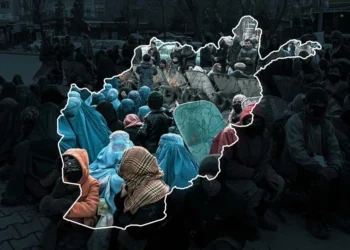
The Taliban, as both a political force and a tribal movement, holds a deeply dehumanizing view of women. Since its inception, the group has never revised its stance on any major issue, including its perception of women. Although the Taliban claim that their views are rooted in religious texts, neither the scriptures nor Islamic scholarship supports such interpretations. To impose their worldview on society, they insist that they are implementing sharia law, while in reality, their customs, family structures, interactions, and social codes are entirely tribal, shaped by a specific geography and culture. In essence, the Taliban have affixed the label of religion to tribal decrees and presented them as divine mandates. Their view of women is an inseparable part of this same construct. The following points illustrate how the Taliban perceive women:
1) The Taliban regard women as possessions of men. Under this belief, a woman’s individuality and autonomy are denied; she cannot make decisions about her personal or social life, and her fate lies in the hands of male family members. To tighten their control, the Taliban emphasize the compulsory veil and burqa, not as expressions of faith, but as instruments of domination over women’s bodies. Men, in turn, treat women according to their needs and convenience, while an “ideal woman,” in the Taliban’s eyes, is silent, submissive, and unresisting.
2) In the Taliban’s worldview, a woman’s place is strictly within the four walls of her home. Leaving the house is seen as a sign of a man’s dishonor, implying that he cannot protect his family’s honor. The Taliban’s rigid cultural framework does not allow girls to attend schools or universities, nor women to engage in economic, political, or educational activities. They cannot tolerate women’s presence in public spaces, and as a result, women are systematically erased from public life.
3) In Taliban culture, women have only two primary functions: reproduction and service to their husbands. A “good woman” is defined as one who bears children and dutifully serves her husband and family. Her human and social roles are stripped away. The relationship between men and women is not that of two equal human beings, but of owner and owned. In such households, affection and emotional connection are absent; interactions are entirely one-sided and governed by authority, not empathy.
4) To impose their views on women, the Taliban exploit discriminatory interpretations of religion. They present selective readings of the Quran and other religious texts that confine women’s rights and use these distortions to silence any form of dissent. Because these interpretations align with tribal norms and customs, they are often accepted by uneducated or uninformed communities. Through this manipulation and instrumental use of religion, the Taliban have effectively paralyzed half of Afghanistan’s population.
5) According to this ideology, girls must marry as early as possible, a belief deeply rooted in tribal culture. Under the Taliban regime, many girls who should be attending school or university are instead forced into early marriage. Once married, they are expected to bear children immediately, replacing the pursuit of education with motherhood and domestic duties. This practice is a deliberate tribal strategy designed to block girls’ social progress and intellectual growth.
6) To instill fear and prevent women from defying tribal laws, the Taliban employs horrific methods of control. Those accused of disobedience are subjected to inhumane and brutal punishments, ranging from public humiliation and verbal abuse to flogging and stoning. Women who have been systematically oppressed and conditioned to see themselves as men’s property lose the ability to resist or speak out. Through these violent measures, the Taliban crushes women’s spirits and enforces submission through terror. After all, the Taliban are a regressive and obscurantist group whose worldview is entirely tribal. They perceive religion, society, and women through the narrow lens of tribal patriarchy. In their belief system, women are neither independent nor autonomous; they are the property of men and have no rightful place in public, political, or economic life. In the twenty-first century, when women in most countries, including many in the Arab world, enjoy the right to education and employment, Afghan women under Taliban rule are denied even the most basic human rights.
You can read the Persian version of this analysis here: