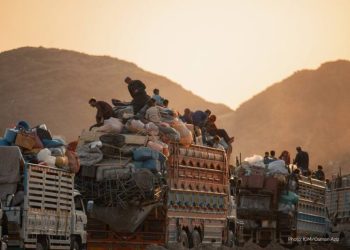
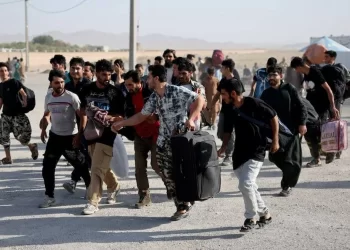
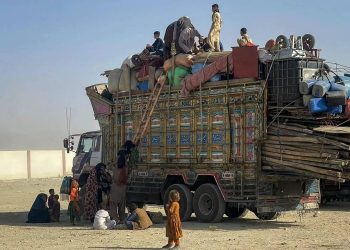
With the Taliban’s takeover and growing retaliation against Afghan citizens, along with prolonged unemployment, thousands have fled to Iran. There, they face increasing anti-immigrant sentiment and pressure. Recently, reports have highlighted heightened xenophobia and the expulsion of Afghan refugees. Senior Iranian judicial and government officials have issued repeated warnings, and in some areas, a judicial order has banned the sale of bread to Afghan refugees. This move has sparked reactions from some Iranian officials, who consider it contrary to good neighborly relations and emphasize shared cultural and historical ties. However, former Afghan military personnel and human rights activists, who sought refuge in Iran, argue that these shared ties are meaningless, as Iran has institutionalized xenophobia and escalated forced deportations.
In recent months, anti-immigrant sentiment has surged on Iranian social media and in mainstream media. Numerous social media campaigns have called for the expulsion of Afghan migrants. False and misleading news has blamed Afghan refugees for crimes, using these claims to shape public opinion against them.
Some Afghan refugees report that being denied services in Iran is part of a systematic effort to force them to leave. They stress that they sought refuge there out of sheer necessity, and no one willingly endures humiliation and insult or chooses such a life.
Hakima Mahdawi, a women’s rights activist, told the Hasht-e Subh Daily about the widespread pressure and institutionalized discrimination against migrants in Iran. After being detained and tortured by the Taliban, she fled to Iran for safety but still faces discrimination there. Mahdawi calls on Iranian authorities to consider the plight of vulnerable individuals, including former military personnel, women’s rights activists, and others who fled to escape Taliban retaliation. According to her, children are deprived of education, adults are ridiculed in every aspect of life, and no organization, including the United Nations, is addressing their dire situation.
A former military officer, who requested anonymity, said the living conditions for former security forces in Iran are worsening, with the threat of forced deportation growing. He noted that many former forces were detained, tortured, and even killed by the Taliban at the border after being expelled. He urged Iran to reconsider its actions and avoid sending thousands of people to their deaths at the hands of the Taliban, urging the country to fulfill its humanitarian duty as a neighbor and fellow speaker of the same language.
Previously, anti-immigrant sentiment was informal and unofficial, often denied by government bodies. However, a recent judicial order banned the sale of bread to Afghan citizens, sparking widespread reactions from Iranian officials. Rasoul Mousavi, an assistant to the Iranian Ministry of Foreign Affairs, recently shared a post on X (formerly Twitter) with a photo of a bakery in Bardesir, Kerman, displaying a sign that read, “By order of the prosecutor’s office, selling bread to foreigners is prohibited.”
On Tuesday, September 10, Ahmad-Reza Radan, the chief commander of Iran’s Law Enforcement Command, announced that police, in coordination with other agencies, including the Ministry of Interior, aim to deport a “significant number” of people residing illegally in Iran by the end of the year. In an interview with the Young Journalists Club, Radan said the number of illegal foreign nationals in Iran has been identified, but the final announcement will be made by the Ministry of Interior’s Bureau of Foreign Nationals. Hours earlier, Iranian Interior Minister Eskandar Momeni said in a television interview that there are no exact figures for illegal foreign nationals in the country, and a survey will be conducted to gather accurate statistics. He called for speeding up efforts to seal the Iran-Afghanistan border to prevent illegal crossings.
As pressure on Afghan refugees mounts, education for refugees has also been banned. On September 12, Behrang Ghorbani, Director-General of Foreign Nationals and Immigrants Affairs in Fars Province, announced that “any residence, employment, and education of children of undocumented migrants in this province is prohibited and considered a violation.” He added that the Directorate-General for Foreign Nationals and Immigrants Affairs would prosecute business owners, landlords, and school administrators who provide employment, housing, or education services to undocumented migrants.
In line with judicial orders to deport and ban the hiring of Afghan workers, Behnam Jafarizadeh, the prosecutor of Bam city in Kerman, stated that Iranian employers exploit Afghan workers. He warned that coercive measures would be taken against Iranian citizens who continue to hire Afghan workers.
Earlier, the governors of Tehran and Isfahan also announced that undocumented foreign nationals would be deprived of municipal and non-municipal services. On August 26, Reza Mortazavi, Governor of Isfahan, said at a gathering that the presence of 60,000 foreign students in Isfahan Province alongside local students has caused concerns for families. He noted that efforts were made to address this by reducing the registration quota for foreign nationals, but the issue requires attention at the national level.
However, Ali Farhadi, spokesperson for Iran’s Ministry of Education, emphasized that all countries respect those displaced by war and hardship, and Iran must do the same. “We will register all foreign students based on religious, cultural, human, and neighborly principles, as well as international commitments,” he added.
Previously, in 2015, Iran’s Supreme Leader Ali Khamenei ordered that “no Afghan child, even those illegally in Iran, should be deprived of education, and all must be enrolled in Iranian schools.”
A video that circulated earlier showed Iranian police officers pinning down a young Afghan refugee, with one officer placing his foot on the refugee’s neck. The video drew widespread condemnation and was compared to the image of George Floyd in the United States.
Meanwhile, the International Organization for Migration reported that between August 25 and 31, 96,522 people fled Taliban-controlled Afghanistan for Iran and Pakistan. During the same period, more than 63,000 people returned to Afghanistan from Iran and Pakistan.
You can read the Persian version of this daily report here: