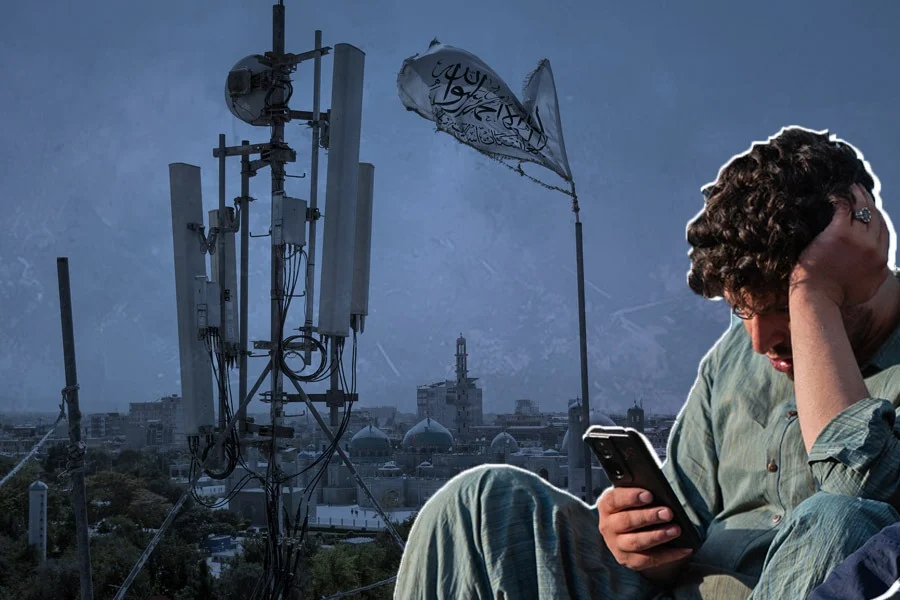
Some residents of Kabul city are complaining about the poor quality of internet services in the city. They say they use Afghan Telecom’s internet services, but for the past week, the internet speed has dropped significantly, and it disconnects and reconnects more than ten times within an hour. According to them, this situation has reduced the speed and quality of their online work, and the pressure and stress resulting from it have made their lives more difficult.
Some women and girls who are active online in education, journalism, and sales are concerned about the drop in internet speed. They say that in the past week, they have faced significant problems accessing Wi-Fi internet services. According to them, they use Afghan Telecom’s Wi-Fi services, but the company has not yet provided a clear response regarding the reduced speed and poor quality of its internet services.
Sarina (pseudonym), one of Afghan Telecom’s customers, says that for nearly a week, the quality of the company’s internet services has become severely weak, disconnecting and reconnecting more than ten times within an hour. According to her, this situation has reduced the speed and quality of her work and, at the same time, has created significant stress and pressure for her, since she cannot complete her tasks within the designated time frame, and the fear of losing her job has also worried her.
This woman adds: “Since I am a journalist, in many cases I am forced to forgo publishing and covering certain news items, because due to the lack of timely coverage, I may lose my audience, and the news may end up being published when it no longer holds the necessary news value.”
Sarina says: “Today was one of those days as well. Due to the repeated disconnection and reconnection of the Wi-Fi, I was forced to drop some story topics and could not cover them in time. Every time I call the company, they say the problem is not just ours and that everyone is facing it. Well, if the problem is nationwide, is there ever going to be a way to solve it? How can we continue our work with this kind of quality?”
Mehrbano (pseudonym), who works in online sales, says that for the past two weeks, the internet speed has dropped drastically and the service is not functioning properly. According to her, at times their Wi-Fi cuts off completely, and it takes about an hour for it to become active again. She emphasizes that this situation causes her work to fall behind and prevents her from responding to her customers’ requests within the designated time.
This vendor says: “When I call the company, they say, ‘ Yes, that’s right, we will look into it, but so far there has been no result. Much of my work has fallen behind. The internet speed is very weak, and it does not even work with a VPN. For this reason, we have had to activate the internet on our SIM card.”
Nastaran, one of the students who studies online, also complains about the poor internet services in Afghanistan and says that despite the low quality, the price of internet in Afghanistan is several times higher compared to neighboring and regional countries. According to her, in recent weeks, the drop in internet speed has meant that she cannot regularly attend her online classes and download her educational videos.
This student says: “The internet speed has dropped very low in the past week. When I join class, the internet cuts off and reconnects so often that I am forced to leave the class group and cannot reconnect, because I truly cannot hear the audio or answer a question I am asked. In the past few days, I have not been able to download educational materials that include video, and I had to activate the internet on my SIM card in order to download it. The Wi-Fi service has become very weak.”
These Kabul residents, who work online, have expressed concern about the continuation of the current situation and say that there is no specific authority to address their complaints, and despite repeated contact with the company, they have not received any satisfactory response. They add that they rely solely on online work to cover their living expenses and those of their families, and with the reduced speed and repeated internet outages, there is also a possibility of losing their jobs.
This comes as, according to a study on the quality of mobile network services in Afghanistan conducted with the participation of one thousand five hundred and fifteen users of five telecommunications operators, the quality of internet and telecommunications services faces challenges from users’ perspective. The researchers of this study have proposed increasing regular network performance testing, proper placement of telecommunications towers, expanding network capacity, and using small cells to improve service quality.
Last year, the Taliban, on the orders of Hibatullah Akhundzada, the group’s Taliban Supreme Leader, cut off fiber-optic internet, claiming that this measure was taken “to prevent moral corruption.” Under this order, all telecommunications services in Afghanistan were completely cut off for 48 hours.
You can read the Persian version of this report here:
کاهش سرعت انترنت؛ کاربران از قطعووصل و اختلال در خدمات وایفای شکایت دارند