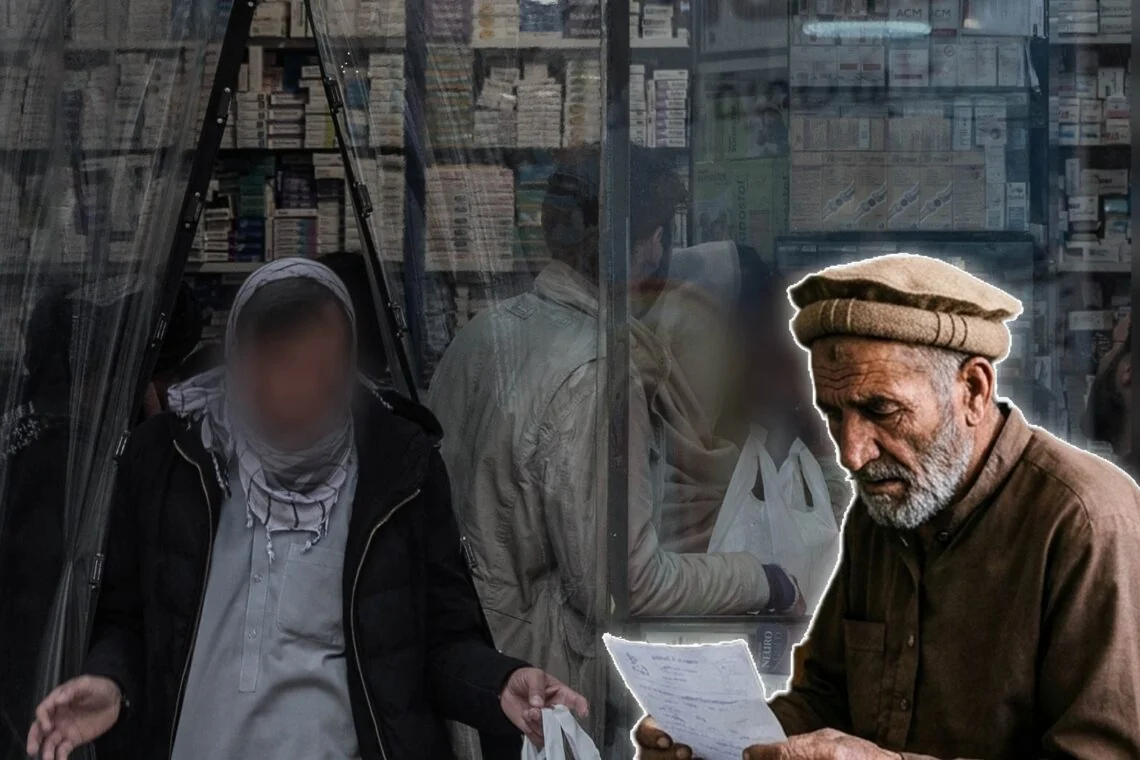
A number of citizens of Afghanistan are complaining about rising medicine prices and the shortage of some medicines in the country’s markets. They say that in the nearly one year since the import of medicines from Pakistan was halted, the prices of some medicines have risen to unprecedented levels and obtaining them has become harder for patients. According to them, a number of essential medicines have also become scarce in the market during this period, and others are hard to find.
These citizens add that replacing Pakistani medicines with Indian and Turkish products or domestically produced ones is not possible for all patients, and that the quality of some of the substitute medicines is not satisfactory. They stress that higher medicine prices and the shortage of essential drugs have increased the cost of treatment and put patients’ families under greater hardship.
Zarmina, a resident of Ghazni, says she has stopped her son’s treatment because of rising medicine prices. She adds that over the past year the prices of the medicines he needs, particularly those for heart disease and diabetes, have gone up and she can no longer afford them.
The woman says: “Medicine prices have risen a great deal. For this reason, I was first forced to reduce my son’s dosage, and then I stopped his treatment completely, because I cannot afford the medicine. A medicine that used to cost 20 afghanis has now reached 180 afghanis. What are we, the poor, supposed to do in such circumstances? Doctors recommend using the medicine of a specific Pakistani company, and Indian and Turkish medicines cannot replace it.”
Samir, another resident of Ghazni, says that rising medicine prices and the low quality of some of the medicines available in the market have made the treatment of patients difficult.
This Ghazni resident says: “The medicines that are now in the market often do not have the required effect. We go to the doctor and he prescribes a large amount of medicine, but the patient does not recover, because the quality of the medicines is not what it used to be, and some of them have little effect on the course of treatment.”
Hassan, a resident of Kabul, says that restrictions on the import and supply of Pakistani medicines have made it difficult for patients to access some of the medicines they need. According to him, even though domestically produced, Indian and Turkish medicines are available in the market, some patients cannot easily switch to substitutes because they previously used specific Pakistani medicines.
This man says: “They have completely blocked Pakistani medicines, and now they even collect medicines from pharmacies and monitor the pharmacies as well. Domestically produced, Indian and Turkish medicines are also available in the market, and their quality is not bad, but people had become accustomed to some Pakistani medicines and now cannot find them easily. My mother’s medicines had run out too, and however much I searched, I could not find them in the area where we live. I even went to Hotel Parwan, but it was not there either, and I finally found it in Bagh-e Bala. This kind of wandering from place to place has become common. On the other hand, the price of medicines has also risen sharply. The blood pressure medicine that I used to buy for 150 afghanis, I now buy for 300 afghanis. The diabetes medicine that was 150 afghanis has now reached 400 afghanis, and another medicine that I used to buy for 180 afghanis, I now buy for 280 afghanis.”
Sakina (pseudonym), another resident of Kabul, says that rising medicine prices and the disappearance of some essential medicines have made it difficult for patients to access the medicines they need. According to her, the prices of some medicines that were previously available at low cost have risen several times over, and obtaining them has become difficult too.
She adds that some Pakistani medicines that were previously easy to find in pharmacies are now available only in a few parts of the city and with difficulty. According to Sakina, the supply of Kandahar-made products has also failed to provide a suitable replacement for some of these medicines, because the prices of these products have risen as well.
Sakina says: “The price of medicine has become very high, and everyone who goes to a pharmacy to buy medicine complains about the increase in prices. Just this morning my father was also complaining about the cost of medicine. The Pakistani medicine that used to be 50 afghanis has now reached 180 afghanis, and even then it is not found everywhere. Even if it is at Hotel Parwan, it is hard to find. Now they have substituted some Kandahar-made medicines, whose prices are also between 180 and 190 afghanis, whereas previously the price of some of these medicines was 30 to 50 afghanis. Most medicines are not easy to find.”
Esmat, a resident of Laghman, also says that rising medicine prices and illegal imports have caused price fluctuations and made it harder for citizens to access the medicines they need. According to him, the price of one type of medicine differs from one pharmacy to another, and citizens cannot buy it at a set, fixed price.
This young man says: “Medicine prices have risen a great deal, and smuggling of medicines has also increased. A few days ago, the Taliban stopped 22 vehicles carrying medicine. If each vehicle was loaded with one ton of medicine, the total of these shipments would come to 22 tons. For example, the price of one type of tablet that I use to treat jaundice reaches 900 to 1,000 afghanis on one occasion and is sold for 600 to 700 afghanis on another, whereas previously its price was 650 afghanis. When medicine enters the market through smuggling, its price is not stable either. Most of the available medicines enter the country from India via the Chabahar route, but because of the high prices, these medicines are not imported in sufficient quantities. On the other hand, Pakistani medicines do not have easy replacements, and medicines imported from other countries and domestic products cannot meet the entire needs of the market.
Afghanistan previously imported a large share of its required medicines from Pakistan. According to available information, more than 70 percent of the country’s medicines were supplied from Pakistan, but with the halt of imports from that country, the supply of a number of medicines has run into difficulty.
In recent months, citizens have complained about rising medicine prices and the scarcity of some essential items in the market. Panadol, Brufen, Augmentin, amoxicillin, insulin, blood pressure medicines, serums, children’s antibiotic syrups, asthma sprays and heart disease medicines are among the items that, according to citizens, have become harder to obtain.
These concerns are being raised at a time when, according to the Taliban, about 95 percent of the medicines consumed in Afghanistan are imported from abroad, and despite the activity of several pharmaceutical companies inside the country, domestic production still meets only a small part of the market’s needs.
Meanwhile, concerns about the quality of the medicines available in the market have also been raised. Abdul Bari Omar, acting head of the Taliban’s National Medicines and Food Authority, said previously that the authority has on its agenda the creation of a digital system and the drafting of a new procedure to control the sale of substandard medicines.
You can read the Persian version of this report here:
افزایش بهای دوا و کمیابی داروهای ضروری در افغانستان؛ بیماران با دشواری درمان روبهرو هستند