In a country like Afghanistan, nurses are far more than medical assistants. They hold up the entire health system, and in many parts of the country, they are the only people delivering medical care. Honoring them is not just a polite gesture or a salute to their profession. It is a way of recognizing the sacrifice and courage of those who, under crushing pressure and impossible conditions, choose the health of strangers over their own peace of mind. International Nurses Day gives us a moment to look at their working lives, hear what they are asking for, and confront the urgent need to invest in their profession. May 12 marks the birthday of Florence Nightingale, the British nurse who founded modern nursing and reshaped the way patients are cared for. In Afghanistan, the day carries a heavier weight. Half the population cannot even enter the profession, and those who remain in it carry the burden alone, weighed down by hardship and quiet despair.
Every year, the International Council of Nurses (ICN) chooses a theme that captures the most pressing health challenges and priorities of the profession. The theme for 2026 is, “Our Nurses, Our Future: Caring for Nurses Strengthens Economies.” The slogan is a global call to action. It reminds the world how vital nurses are and urges leaders to reform the conditions in which they work. Its purpose is not simply to patch up what exists today but to push for deep change: putting nurses at the heart of health institutions, sharpening their skills, and rewriting the policies that shape their careers. Yet a question hangs over all of this in Afghanistan. Who here actually marks this day? What are our nurses living through? Is anyone listening to them? What do they want?
Afghanistan’s education system has collapsed since the Taliban returned to power. Today, half the population cannot study anything, anywhere, neither in medicine nor in any other field. When universities shut their doors, medical institutes that trained nurses and midwives became the last refuge for girls who dreamed of working in healthcare. Then in 2023, that door slammed shut as well. Afghanistan now faces a severe shortage of medical workers, and not a single woman is being trained anywhere in the sector. The cruelty of this runs deeper still. Most Afghan families prefer that women be treated by female doctors, and the Taliban’s own gender policies forbid women and men from working side by side in hospitals.
Rahil has worked at a government hospital for more than eight years. She has three children, and her youngest is only three days old. When she spoke with 8am Daily, the worry in her voice was hard to miss. In a few weeks, her 42-day maternity leave will end, and she will have to find some way to care for a newborn while still working as a nurse. “Maternity leave used to be three months,” she said. “By the time it ended, the baby had grown enough that I could leave him with someone. Now it’s only 45 days.” The hospital offers no childcare, so she has no choice but to leave her children with her mother or mother-in-law.
International standards call for four nurses for every doctor. Afghan hospitals fall far below that, and the few nurses who remain carry the load of those who are missing. “There are too few nurses, and the shifts are brutal,” Rahil said. “The shortage is even worse in the women’s ward. We have very few female nurses, while the number of men is higher.” The shortage drags down the quality of care, delays treatment, and feeds public anger and mistrust. Foroozan, another nurse, described the daily reality. “The crowding of patients is overwhelming. It’s hard to attend to them all, but we try. Another problem is the low level of public awareness.”
Gender discrimination reaches even into the shift schedule. Male nurses work a night shift once every three nights. Women must report for duty every other night. “Because there are so few female nurses, we’re forced to take night shifts every other day,” Rahil said. “Two nurses have to cover the operating room, the inpatient ward, the children’s section, the emergency room, and the malnutrition unit all at the same time.” The workload pushes past anything a human body can sustain, and it falls hardest on the women.
For all of this responsibility, nurses are paid almost nothing. Rahil spends 3,000 afghanis a month just on transportation, and she admits that if she did not need the job and love the work, she would have walked away long ago. Every day she travels an hour and a half each way to the hospital, and the commute earns her no extra compensation. Nurses bring their own breakfast and lunch. Only on nights when they are on duty does the hospital provide a meal, and according to Rahil and Foroozan, that meal is neither enough nor decent. “If the hospital can’t always provide meals,” Foroozan said, “at least the food it does provide should be of good quality.”
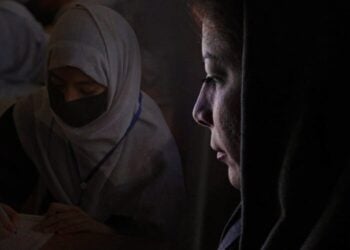
On top of poor conditions, low pay, and impossible workloads, Taliban restrictions have become one of the heaviest burdens on female nurses. The Ministry for the Promotion of Virtue and Prevention of Vice has ordered them not to be seen by men at all, whether doctors or fellow nurses. “We’ve been told to observe hijab strictly,” Foroozan said. Rahil added, “We’re not allowed to be without a mask. Our clothes must be long, we must not speak to men unless absolutely necessary, and there are other orders…” These rules do not stay on paper. Taliban officials walk into hospitals without warning, hunting for any sign that someone has crossed a line. Their presence has turned the workplace into a space of fear and constant surveillance.
The Taliban’s restrictions strip nurses of personal freedom and corrode the quality of healthcare itself. When female nurses cannot speak openly with their male colleagues, treatment slows and team coordination falls apart. In a system already starving for women medical workers, these rules pile fresh pressure on female nurses and trap them between the humanitarian work they are sworn to do and the politicized, gender-driven orders of the Taliban.
Rahil and Foroozan both want the same things: more female staff in hospitals, better pay, decent food, a steady supply of medicine, and real attention to the health sector. These are not personal complaints. They reflect the structural needs of Afghanistan’s health system. Until someone addresses them, nurses will keep breaking under the weight, and patients will keep losing access to the kind of care that actually heals.
These demands rise up at a moment when no women anywhere in Afghanistan are being trained for the health sector. In this reality, this year’s global slogan, “Empowered nurses save lives,” lands with a hollow echo. Nurses here are denied even their most basic rights, and their mental health is under serious threat. Crushing workloads, the absence of institutional support, long hours, shortages of equipment, and even violence from patients’ families leave them exposed to harm on every front, especially psychological harm. And yet no institution exists to protect their wellbeing. A huge part of the medical community, the very pillar holding up healthcare delivery, has been stripped of even the most basic protections. That neglect has worn nurses down to the bone and left the entire health system more fragile in the face of whatever crisis comes next.
You can read the Persian version of this story here:
روز جهانی پرستار؛ پرستاران افغانستان زیر سایه بحران، فشار و فراموشی