• 8AM.MEDIA
  • ویب‌سایت فارسی
  • پښتو ویب‌پاڼه
  • اۉزبېکچه ویب‌سایت
  • Podcast
Sunday, October 25, 2026
Hasht-e Subh
  • Home
  • News
    • Afghanistan News
    • World News
  • Opinion
    • Editorial
    • Analysis
  • Reports
    • Daily Reports
    • Investigative Reports
  • Society
    • The story of people
  • Women’s Word
  • Columns
    • Three Years After Afghanistan’s Fall: The Taliban’s Resurgence
    • Towards Equality
    • The Resurgence of the Taliban: Two Years Since Afghanistan’s Fall
    • Hebatullah Report Special Edition
    • Resistance for Education Special Edition
    • Special Column on Taliban’s Education Curriculum
    • Nawroz
  • Interviews
  • Contact Us
    • About Us
    • 8AM MEDIA Annual Awards
    • Submit an Article to Hasht-e-Subh
  • 8am.mediaBack
Subscribe
No Result
View All Result
  • Home
  • News
    • Afghanistan News
    • World News
  • Opinion
    • Editorial
    • Analysis
  • Reports
    • Daily Reports
    • Investigative Reports
  • Society
    • The story of people
  • Women’s Word
  • Columns
    • Three Years After Afghanistan’s Fall: The Taliban’s Resurgence
    • Towards Equality
    • The Resurgence of the Taliban: Two Years Since Afghanistan’s Fall
    • Hebatullah Report Special Edition
    • Resistance for Education Special Edition
    • Special Column on Taliban’s Education Curriculum
    • Nawroz
  • Interviews
  • Contact Us
    • About Us
    • 8AM MEDIA Annual Awards
    • Submit an Article to Hasht-e-Subh
  • 8am.mediaBack
No Result
View All Result
Hasht-e Subh
No Result
View All Result

From Student Despair to Expert Warnings: Why Are Young Men in Afghanistan Turning Away from University?

Translated by Farhad Farhaad | Originally reported in Persian by Adrina Behzad

Mohammad Farhaad Mohammad Farhaad
25 October 2026 - Solar Hijri Date: 1405/08/03 [t_time:1792944669]
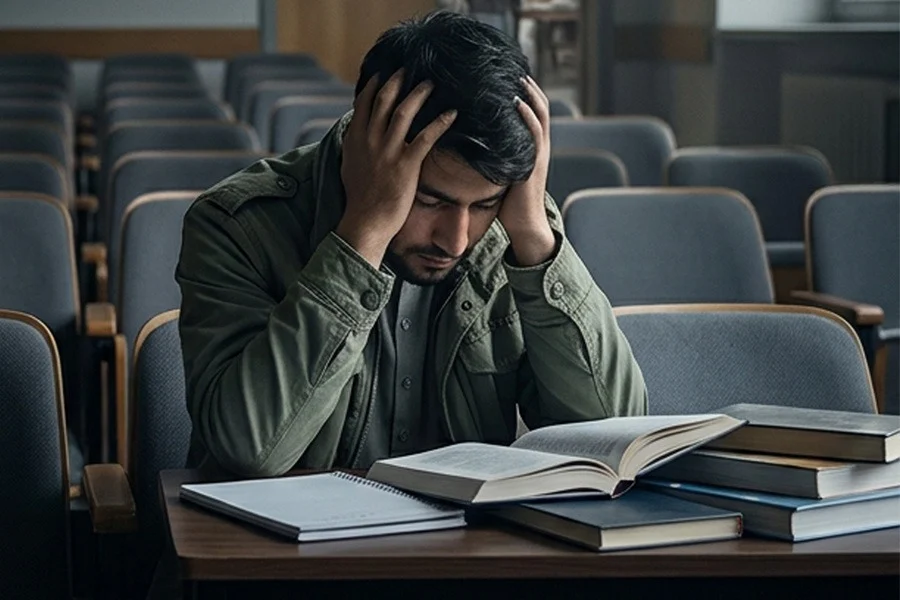
A young male student sits with his head in his hands among open books in an empty lecture hall amid declining university enrollment in Afghanistan. (Photo credit: AI)

AI

Some experts say that economic hardship, social pressure, and political and educational restrictions have led to a decline in male enrollment at universities. In their view, the imposition of particular preferences in university environments, compulsory dress requirements, the imposition of specific viewpoints and ideologies, and the absence of an open academic atmosphere have reduced young people’s motivation to continue higher education. Meanwhile, a number of students are calling for access to quality education, suitable job opportunities, reasonable academic freedoms, and a healthy, dynamic environment in which to nurture their talents and achieve their goals.

Miagul Wasiq, an education expert, says that educational restrictions, the imposition of particular preferences at universities, compulsory dress requirements, and the imposition of a specific mindset and ideology are among the factors that make students lose interest. According to him, the lack of job opportunities and the uncertain academic and professional future of young people are other factors that discourage them from continuing their studies.

Mr. Wasiq says: “The absence of academic staff, who were forced to leave the country or were dismissed by the Taliban, has also negatively affected students’ ability to continue their studies. In addition, economic problems and the responsibility of providing for their families force young people to choose between education and meeting their families’ needs.”

The expert adds: “Seeing educated people removed from government offices and institutions, uncertainty about career prospects, the presence of intermediaries and bribery in the hiring process, and the exclusion of girls, who make up half of society, from education are other factors that can also make boys lose interest in continuing their studies. Under current conditions, the exclusion of girls from education and the loss of interest among boys in continuing their studies will produce an illiterate society and hold Afghanistan back from progress for years.”

Asif Nang, a deputy minister of education in the former government, says that the state of higher education in Afghanistan is stagnating and that this trend may continue in the future. According to him, the decline in student enrollment at universities may have economic, social, and political causes.

Mr. Nang says: “At public universities, the fields of study that students are interested in are not sufficiently available, and studying at private universities is also very expensive. Under current conditions, many young people are forced to choose between work and education. In addition, the shortage of educational facilities and services, particularly in the provinces, is also evident. On the other hand, students have little hope for the future. Many of them hoped to be hired for their desired positions after graduation, but now, seeing the lack of free competition and the diminished role of expertise and talent in the hiring process, they prefer to look for work and earn a living instead of continuing their education.”

Ahmad (pseudonym), a student at Kabul University, says that the restrictions imposed by the Taliban, including limits on students’ dress, the elimination of some faculties, reduced admission capacity in several faculties, and the removal of some academic subjects, are among the factors that have negatively affected young people’s interest in and motivation for continuing their education.

According to him, the lack of job opportunities, the absence of a clear outlook for the future, the lack of a reliable authority to support students, the disregard for students’ rights, and the neglect of educated people are other problems that have caused widespread concern among young people over the past five years.

The student says: “Young people naturally want freedom and independence in various areas of life, whether in education or in choosing what to wear.”

Ahmad adds: “All of these factors together have reduced young people’s interest and motivation to continue university education, to the point that many of them are willing to endure the hardships of life but give up on continuing their studies at universities. This situation shows that to increase young people’s motivation for education, serious attention must be paid to the reasonable freedoms of students, improving the quality of education, providing job opportunities, and creating a clear outlook for their future.”

Shaker (pseudonym), another student, says that the decline in student enrollment at universities is not merely an educational issue, but a reflection of deep economic and social problems and of the restrictions present in educational environments.

According to him, economic problems, unemployment among graduates, educational restrictions, and a lack of sufficient motivation are among the factors that reduce young people’s interest in continuing their education.

The student says: “In my view, a university is not just a place to obtain a degree, but an environment for intellectual growth, character development, strengthening analytical ability, and preparing to serve society. When a student feels that, after years of study, there is no suitable ground for using their knowledge and abilities, it is natural for them to doubt their academic future.”

He adds: “To increase student enrollment, the ground must be prepared for quality education, job opportunities, reasonable academic freedoms, and an environment suited to the development of young people’s talents, because investing in universities is investing in the future of a nation, and weakening higher education in effect means weakening the scientific and professional capacity of society.”

This comes as two United Nations bodies, the United Nations Educational, Scientific and Cultural Organization (UNESCO) and the United Nations Children’s Fund (UNICEF), reported in a document titled “The State of Education in Afghanistan in 2026” that the participation and inclusion of male students in Afghanistan’s universities in 2026 has declined by about 30 percent compared with 2019.

According to the report, about 208,000 male students enrolled in higher education institutions this year, while their number in 2019 was estimated at 306,000.


You can read the Persian version of this report here:

از ناامیدی دانشجویان تا هشدار کارشناسان؛ چرا پسران از تحصیلات دانشگاهی فاصله می‌گیرند؟

ShareTweetSendSendShare

Related Posts

A mother holds her infant in a hospital ward in Afghanistan as doctors warn that postpartum depression often goes unnoticed. (Photo credit: AFP)
Daily Reports

Postpartum Depression: The Disorder Afghanistan Overlooks

25 October 2026 [t_time:1792942957]
Leaked letters and meeting minutes shown over the Kabul Bank headquarters sign reveal the Taliban-ordered merger with Bank-e-Millie Afghan. (Photo credit: 8am.media+AFP)
Investigative Reports

Bitter End to a Banking Tragedy: Taliban to Merge Kabul Bank with Bank Millie Afghan

25 October 2026 [t_time:1792938686]
A man rolls a liquefied gas cylinder as residents gather around rows of LPG cylinders in the cold amid rising fuel prices. (Photo credit: AFP)
Daily Reports

Taliban’s Billion-Dollar Gas Deals: Why Are LPG Prices Still Rising?

25 October 2026 [t_time:1792932325]

Latest

Loading latest news...

Popular stories

  • Donald Trump – U.S. President with Benjamin Netanyahu – Israeli Prime Minister in a gathering of people (Photo: Getty Images) Donald Trump – U.S. President with Benjamin Netanyahu – Israeli Prime Minister in a gathering of people (Photo: Getty Images)

    US Senator Criticizes Netanyahu’s Remarks Justifying War Against Iran

    Share
    Share Tweet
  • Iran’s Revolutionary Guards Say They Are Preparing to Unveil “Father of All Bombs”

    Share
    Share Tweet
  • UN Report Reveals Shifts in Family Attitudes and Rise in Domestic Violence in Afghanistan

    Share
    Share Tweet
  • Trump Calls Iran’s Hope of War Lasting Beyond US Midterm Elections a “Dream”

    Share
    Share Tweet
  • Beyond Victimhood: How the Women of Afghanistan Became Actors of Civil Resistance Against Gender Apartheid

    Share
    Share Tweet

Podcast

Insights
Insights

Join Lynne O’Donnell for 8AM’s podcast series, Insights.
Lynne talks with generals, diplomats, soldiers, journalists, politicians, activists, people who have front row seats for conflicts around the world, and citizens with a story to tell, happy or sad. For this first series, Afghanistan is the focus. Lynne and her guests talk about the collapse of the republic in August, 2021, and the impact since — for the people of Afghanistan, for the security of the region, for the safety of the world. It’s important, interesting and insightful.

Insights/22: Controlling the Narrative with Mina Sharif
byinsights8am

Controlling the Narrative

Lynne O’Donnell talks with Mina Sharif, author, activist, women’s rights campaigner, educator and mentor. They discuss who controls the narrative and who speaks for Afghanistan’s people when the Taliban appear to have seized control not only of the country but of the message, too.

Have a listen

Insights/22: Controlling the Narrative with Mina Sharif
Episode play icon
Insights/22: Controlling the Narrative with Mina Sharif
Episode Description
Episode play icon
Insights/21: Media Meltdown with Zahra Joya
Episode Description
Episode play icon
Insights/20: Terror Inc with Scott Richards
Episode Description
Episode play icon
Insights/19: Busting Stereotypes with Bushra Gohar
Episode Description
Episode play icon
Insights/18: Media Matters with Waliullah Rahmani
Episode Description
Episode play icon
Insights/17: What Goes Around Comes Around with Sima Samar
Episode Description
Search Results placeholder
Hasht-e Subh

8AM Media, also known as Hasht-e-Subh Daily, stands as Afghanistan's premier independent and non-profit newspaper, resonating as a beacon of journalistic integrity since its establishment in June 2007 by esteemed Afghan journalists and human rights advocates. With a steadfast commitment to citizen journalism and civic education, Hasht-e-Subh Daily has earned its place as the most esteemed publication in the nation.

Publisher: Sanjar Sohail
Email: [email protected]
Executive Director: Parwiz Kawa
Email: [email protected]

Read More

From Student Despair to Expert Warnings: Why Are Young Men in Afghanistan Turning Away from University?

Postpartum Depression: The Disorder Afghanistan Overlooks

Bitter End to a Banking Tragedy: Taliban to Merge Kabul Bank with Bank Millie Afghan

Taliban’s Billion-Dollar Gas Deals: Why Are LPG Prices Still Rising?

Taliban Raid Home of Former Military Official in Uruzgan

Editor’s Choice

Every Saturday morning, 8AM MEDIA English Services Department will guide you through the week’s biggest stories from Afghanistan and the international community.

Subscribe

© 2026 - ©Hasht-e Subh Daily

No Result
View All Result
8am.Media
پښتو ویب‌پاڼه
ویب‌سایت فارسی
اۉزبېکچه ویب‌سایت
  • Home
  • News
    • Afghanistan News
    • World News
  • Opinion
    • Editorial
    • Analysis
  • Reports
    • Daily Reports
    • Investigative Reports
  • Society
    • The story of people
  • Women’s Word
  • Columns
    • Three Years After Afghanistan’s Fall: The Taliban’s Resurgence
    • Towards Equality
    • The Resurgence of the Taliban: Two Years Since Afghanistan’s Fall
    • Hebatullah Report Special Edition
    • Resistance for Education Special Edition
    • Special Column on Taliban’s Education Curriculum
    • Nawroz
  • Interviews
  • Contact Us
    • About Us
    • 8AM MEDIA Annual Awards
    • Submit an Article to Hasht-e-Subh
  • 8am.media

© 2026 - ©Hasht-e Subh Daily