
This article attempts to re-examine the legacy of Ahmad Shah Durrani beyond his military conquests. The central question is what consequences his repeated campaigns into India, the defeat of local powers, and the transfer of plunder, in the absence of durable state-building, had for the region, and how part of the political vacuum in the subcontinent ultimately benefited Britain, a power that later marched from that same India into Afghanistan.
The irony of history is heavy here. In 1761, Ahmad Shah went from Afghanistan to India to shift the balance of power in that land. Nearly 80 years later, in 1839, an army drawing its power and resources from India entered Afghanistan to decide who would rule in Kabul. Less than 80 years had passed, yet the direction of power had almost completely reversed.
Among the inheritance that passed from Nader Shah to Ahmad Shah was the famous Koh-i-Noor diamond, a jewel whose fate takes on symbolic meaning at the end of this story.
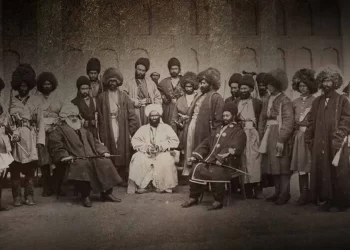
In the official narrative of Afghan history, Ahmad Shah Durrani usually appears as a conqueror, a ruler who rose to power after the death of Nader Shah Afshar, built a great empire, captured Delhi, and defeated the Maratha Confederacy at Panipat. There is no doubt about his military capability, but a ruler’s history cannot be measured solely by the wars he won or the extent of his territory.
The more important question is this: how did Britain, which was not yet the dominant power in India at the time of Ahmad Shah’s conquests, manage in a relatively short span to bring a large part of the subcontinent under its control and extend its influence to the threshold of Afghanistan? And did the wars and political vacuums of that period, including Ahmad Shah’s campaigns, play a role in smoothing this path?
If a ruler expends enormous force to defeat an army hundreds or thousands of kilometers away, capture a capital, collect tribute and plunder, and then return, but fails to convert that victory into a stable political and administrative order, the historical assessment should not stop at the moment of conquest. One must ask what power that war weakened, what vacuum it created, and who later filled it.
The story began before Ahmad Shah. Nader Shah Afshar invaded India in 1739, defeated the Mughal army, and captured Delhi. The Mughal Empire was already in decline before that, but this invasion dealt it another blow. Eight years later, following Nader Shah’s assassination in 1747, Ahmad Khan Abdali rose to power. He took advantage of the weakness of the Afsharids in the west and the Mughals in the east, and rapidly expanded his territory.
India was, for the fledgling Durrani state, both a source of wealth and a field for the expansion of power. Over roughly two decades, Ahmad Shah repeatedly led military campaigns into the subcontinent. This very repetition of campaigns raises a fundamental question: if influence over that land had been firmly established, why would it need to be secured again and again through repeated military expeditions?
Ahmad Shah was not without a mechanism of governance; he appointed governors and collected tribute from local rulers. It would therefore be inaccurate to view him merely as a commander who came, plundered, and left. But there remains a great difference between military dominance and durable state-building.
Conquest requires an army; maintaining it requires an institution. A state requires administration, finance, security, legitimacy, and a structure that can function without the ruler’s personal presence, and this quality was absent from Ahmad Shah’s structure.
A significant part of the Durrani state’s political economy depended on tribute, revenue from subject regions, and war spoils. This model was fragile in distant territories, and this fragility later became evident in the loss of parts of the realm, including Lahore in 1765.
Panipat was the peak of this contradiction. On 14 January 1761, Ahmad Shah’s army defeated the Marathas in the Third Battle of Panipat. The Marathas were one of the most serious contenders to fill the Mughal power vacuum, and their defeat severely damaged their manpower, command structure, resources, and political standing.
But Ahmad Shah did not remain in India for long. He was victorious, yet he did not turn his victory into a unified and stable political order in northern India. The Mughals were weak, the Marathas had been struck a heavy blow, and the victor of Panipat did not stay behind to build a new state in India.
A power vacuum had been created, and a power vacuum usually does not remain empty. In those same years, another power was advancing in the eastern part of the subcontinent: the British East India Company. In 1757, Ahmad Shah captured Delhi, and in that same year the British were victorious at Plassey. But the crucial difference was not on the day of the battle; it was on the day after the battle.
The East India Company converted military victory into revenue and administration. Following Plassey and later Buxar, in 1765 it obtained the right to collect revenue from Bengal, Bihar, and Orissa. Revenue from the captured territory funded the army; the army seized new territory, and the new territory generated even more revenue.
Ahmad Shah also collected tribute, but the difference lay in the extent to which these resources were converted into a lasting structure. He returned to India repeatedly to preserve his influence, while the Company sought to remain after conquest and convert military power into permanent administration and revenue.
This is where the outcome of Panipat becomes more significant than the battle itself. The Encyclopaedia Iranica states that Ahmad Shah’s victory over the Marathas allowed Britain to consolidate the foothold it had gained in Bengal after Plassey.
This does not mean that Ahmad Shah “caused the colonization of India.” But the reality is that Ahmad Shah severely weakened one of the most important powers capable of filling the Mughal vacuum in northern India, without himself replacing it with a lasting political order. This was one of the most significant unintended consequences of his victory. In fact, Ahmad Shah won Panipat, but Britain won time.
Decades later, the outcome of this difference became clear. The Durrani Empire became caught up in succession crises and the loss of territory, while the East India Company advanced from Bengal toward central and northern India, reaching Delhi at the start of the nineteenth century.
From this point, the direction of history changed. In Ahmad Shah’s time, power moved from Afghanistan into India. Decades later, the power established in India was making decisions about Afghanistan. In 1809, Britain entered into political relations with Shah Shuja Durrani, and with the intensification of Russian-British rivalry, Afghanistan became part of the question of British India’s security. In 1839, the army of British India entered Afghanistan and marched to restore Shah Shuja to Kabul.
These two events do not have a simple, direct relationship of cause and effect. The immediate cause of the First Anglo-Afghan War was Britain’s concern over Russia, Iran, and the security of India. But the historical reversal is clear: the power that was still establishing its foothold in Bengal at the time of Ahmad Shah’s conquests marched, decades later, from that same India into Afghanistan.
For this reason, the question about Ahmad Shah’s legacy is not simply how many wars he won or how far his territory extended; the more important question is what he built from all that power, and how long what he built endured. It is worth noting that weakness in institution-building and the excessive dependence of the state on the person of the ruler recurred in many Afghan governments after Ahmad Shah as well. It seems that one of the most enduring political legacies of that period was not merely borders and conquests, but this very difficulty in converting personal and military power into lasting institutions.
Strategy is not merely the art of defeating an enemy; it is the art of building a situation that remains to one’s advantage after the war has ended. Ahmad Shah proved his ability on the battlefield, but many of his distant achievements did not endure. Rival powers in India were weakened, but no lasting order was built to replace them. In that same fragmented environment, a power grew that converted conquest into taxation, administration, and a permanent army.
In the end, the fate of the very Koh-i-Noor diamond takes on symbolic meaning. The Koh-i-Noor, once held by Ahmad Shah and then the Durrani dynasty, eventually passed through the hands of Shah Shuja and the Sikh state of Punjab before falling to the East India Company and going to Britain. The irony of history is that the Koh-i-Noor was not the only thing whose path ultimately ended up in British hands.
The influence that Ahmad Shah had extended by the sword into India was also lost by his successors, and the power that was still fighting to secure Bengal in his time eventually reached the gates of Afghanistan from that same India.
Perhaps this is one of the most important lessons for modern Afghan state-builders and those who today claim to be building a state: conquest can build the glory of a generation, but a conquest that is not converted into institutions, state-building, and lasting power may leave behind a cost that later generations must pay.
You can read the Persian version of this analysis article here: