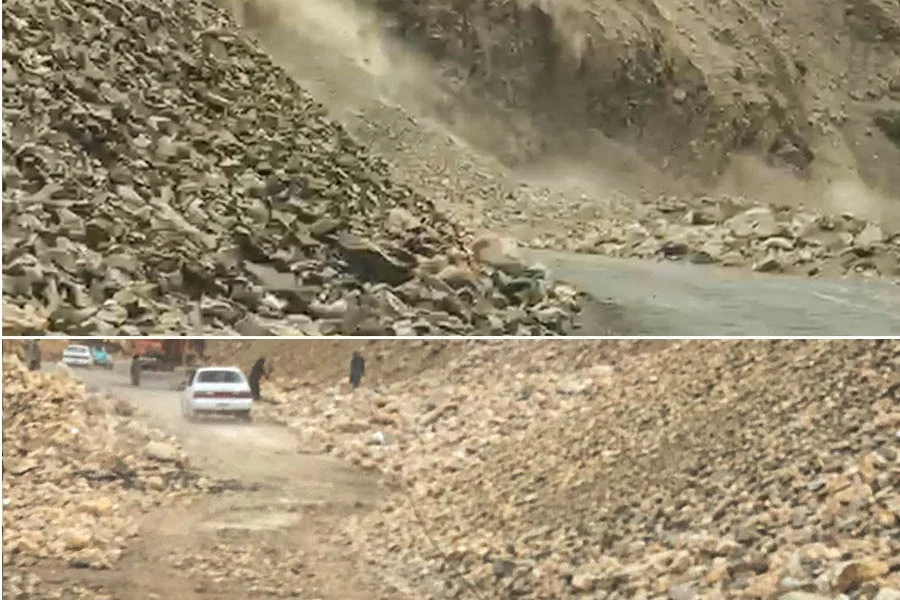
Several residents of Panjshir say work on the CASA-1000 power transmission project has turned the province’s main road into a dangerous route for travelers. They add that, as work on the project proceeds, large rocks tumble from the mountain onto the road and, in some cases, block traffic. According to them, project officials promised before work began to install protective wire nets in vulnerable sections to prevent rockfall, but that promise has not been fulfilled so far.
Speaking to the Hasht-e Subh Daily, the residents say that although the Taliban have built an alternative route, its unpaved surface and poor condition make it difficult for people to use. They say the continuation of this situation is disrupting the daily movement of passengers and drivers, and they are calling for protective nets to be installed in vulnerable sections.
Ahmad Soroush (pseudonym), a Panjshir resident, says the province’s main road was damaged during implementation of the CASA-1000 project, and that rockfall in parts of the route has made travel difficult. He adds that rocks falling from the mountain sometimes block the road for hours, and travelers are forced to wait until the route is cleared.
Soroush says: “The main road in Panjshir is sometimes closed for hours because of landslides and rocks that fall from the mountain during the project’s work. About 15 years ago, this road was rebuilt and asphalted from the end of Hesa-ye Awal district to the end of Paryan district, but now large parts of it have been destroyed by landslides.”
A driver who did not want his name mentioned in the report says rockfall from the mountain has put drivers and passengers traveling this route at risk. According to him, vehicles striking rocks along the roadside sometimes cause tire punctures, and the absence of tire repair facilities along the route has added to drivers’ difficulties.
The driver says: “We pass through this route with fear and caution, and we never take our eyes off the mountain so we can stay safe from falling rocks. Sometimes a vehicle hits big rocks beside the road, and tires also get punctured from hitting small rocks. On this route, there are no tire repair facilities until you reach the center of Hesa-ye Awal district.” He adds that a few days ago, a rock also fell from the mountain and struck the hand of one of the drivers, breaking it.
Shafiq (pseudonym), another Panjshir resident, says officials of the CASA-1000 project had promised before work began that they would install protective wire nets in vulnerable sections to prevent rockfall and protect the road, but this has not been done so far. He adds that an alternative route has also been created for people’s travel, but its unpaved surface makes it difficult for people to use.
This Panjshir resident says: “Before work began, project officials had said that they would install protective nets along the routes where masses of rock fall from the mountain, so that the rocks would be stopped before reaching the road. But this has not been done so far. If these nets are not installed, the risk of rockfall and harm to people and the road will continue.”
Samim (pseudonym), another Panjshir resident, says that during work on the CASA-1000 project, vehicles remain stopped for hours in some sections of the route, and passage through these areas has become difficult. He adds that during the day, project officials open the route for about 20 minutes so that passengers and drivers can get through.
Samim says: “About four days ago, I had gone to Panjshir. A body was being transferred from Paryan district. When we reached the site, the road was completely closed, and vehicles were passing with difficulty along an unpaved route near the river. Another section of the road was also closed at the entrance to Paryan district, and we waited about an hour for the road to open.”
He adds that during the project’s work, soil, rocks, and mountain debris have been dumped near the road, and falling large rocks have also damaged parts of the road. According to him, in some sections the asphalt has been destroyed by rockfall and landslides.
Samim says: “The project’s work site is about 300 to 400 meters from the road, but large rocks that fall from the mountain hit the road and have destroyed it, to the point that in some sections no trace of asphalt remains. Officials open the road for only about 20 minutes so that passengers and drivers can pass through.”
The Central Asia-South Asia Electricity Transmission and Trade Project, known as CASA-1000, is designed to transmit electricity from Kyrgyzstan and Tajikistan to Pakistan through Afghanistan. The project includes about 750 kilometers of power transmission lines and has a transmission capacity of 1,300 megawatts of electricity. Parts of this project are being implemented in Panjshir province.
Residents of Panjshir say that alongside the continuation of the project’s work, steps must also be taken to prevent rockfall and ensure the safety of travelers and drivers. They are calling for protective nets to be installed in vulnerable sections and for the damaged parts of the road to be rebuilt.
You can read the Persian version of this report here:
پروژه کاسا-۱۰۰۰؛ ریزش سنگ، جاده پنجشیر را برای مسافران پرخطر کرده است