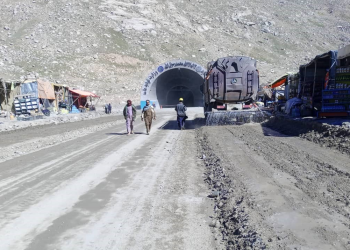
Simultaneously with the reopening of the Salang Pass after reconstruction, some drivers allege that the Taliban are imposing a “substantial” toll on them. According to these drivers, the Taliban collect money based on the “number of tires per vehicle.” They claim that the Taliban charge small vehicle drivers between 80 to 100 Afghanis and demand 1,200 to 3,000 Afghanis from passenger and cargo vehicles, depending on their size. Some drivers condemn the Taliban’s actions as “oppressive,” stating that, given the country’s dire economic conditions, they cannot afford these payments. They argue that people lack even bread to eat, but the Taliban, under various pretexts, continue to collect money from them. Meanwhile, some informed individuals advocate for exploring “legal ways” to obtain tolls.
After approximately four months of closure, the Salang Pass reopened on December 20, 2023, for small passenger vehicles, and on December 28, 2023, for all types of vehicles.
During the inauguration ceremony of the Salang Pass, Mullah Abdul Ghani, the acting Deputy Prime Minister for Economic Affairs of the Taliban, stated that the reconstruction of this highway has provided significant facilitations for traders. According to him, after the Salang Pass reconstruction, the grounds for the transfer of commercial goods will also increase. However, this pass has created a “new headache” for the drivers and traders.
A source within the union of cargo truck drivers in Kabul confirmed to the Hasht-e Subh Daily that the Taliban have imposed a “hefty” toll for their movement through the Salang Pass. According to the source, the Taliban charge small passenger vehicles between 80 to 100 Afghanis and larger passenger and cargo vehicles a fee of 1,000 Afghanis for the “Toll charges.” However, drivers claim that the Taliban charge them based on the “number of tires per vehicle.”
Shah Mahmood has been a truck driver, specifically handling “trailer” cargo, on the Kabul-North route for approximately 15 years. He tells the Hasht-e Subh Daily that the Taliban charges small vehicles between 80 to 100 Afghanis and larger passenger and cargo vehicles from 1,200 to 3,000 Afghanis for the toll charges.
He adds, “It’s a lie that the Taliban take a fixed amount from drivers for toll charges. We pay based on the number of tires on the truck. For example, they charge 200 Afghanis for each tire of larger vehicles. If your truck has ten tires, the Taliban take 2,000 Afghanis.”
Shah Mahmood states, “They only collect this amount from one side. On the return journey, we are also obligated to pay this amount at the Salang Pass. Even small vehicles are charged 20 Afghanis for each of their tires. For instance, Sriracha vehicles are charged 80 Afghanis, and due to the slightly higher fare of Corolla Model 2000 are charged 100 Afghanis.”
Nevertheless, some drivers denounce the Taliban’s actions as “oppressive” and say that, given the country’s dire economic conditions, they cannot afford to pay this money.
Sadiq is another cargo truck driver on the Kabul-North highway. He states that people don’t even have bread to eat, yet the Taliban collect money from them under various pretexts.
He adds, “The Taliban have turned into highway robbers, collecting money from drivers through various pretexts at their offices and on the road. Recently, they’ve extended their actions to include peddlers and street vendors. Armed with guns, they approach, demanding money by any means possible. This does not reflect a form of governance.”
However, some citizens of the country criticize the Taliban’s actions, stating that considering the country’s poor economic situation, this group should not extort hefty sums from drivers.
Hussain Ahmadi, a resident of Mazar-i-Sharif, tells the Hasht-e Subh Daily, “If the Taliban are imposing tolls, that’s acceptable, but the economic situation of the people should also be taken into account. When substantial amounts are collected, drivers naturally increase their fares, and under the current conditions, no one can afford it.”
Hussain continues to advocate for transparency in the process of collecting money from the country’s major gateways. He asserts, “A transparent solution must be established to prevent the misallocation of this money. Every day, millions of Afghanis are collected from the country’s highways and markets under various pretexts, yet there have been no improvements in people’s lives. Our pockets are gradually emptying.”
Earlier, sources had confirmed to the Hasht-e Subh Daily that the Taliban are working on a plan under which tolls will be collected from the drivers on the Salang Pass route. A source in the Salang Pass Maintenance Authority had told the Hasht-e Subh Daily on August 2023 that tolls for the reconstruction of an 80-kilometer Salang road would be collected through a program called “Tool Plaza”; however, at that time, the Taliban had denied these claims.
Meanwhile, some experts are calling for the consideration of “legal avenues” to obtain toll charges.
Mujib Osmani, a university professor and an economic affairs expert, states, “It must be clarified whether this money is collected only for the reconstruction of the Salang Pass or permanently. If their goal is a specific amount, revenues and expenditures should be taken into account. Once expenditures have been incurred, and they seek to generate revenue, it must be specified over what period they intend to obtain this revenue. Then, it should be estimated how many vehicles pass through, and subsequently, determine how much toll charges each vehicle should pay.”
The Salang Pass, a congested and challenging highway, is considered a strategic route connecting the north to the south of Afghanistan.
The Taliban claim to have reconstructed parts of this highway, including the inside of the tunnel. However, videos released after the reconstruction of this pass indicate that the Salang Pass has not been fully reconstructed yet.