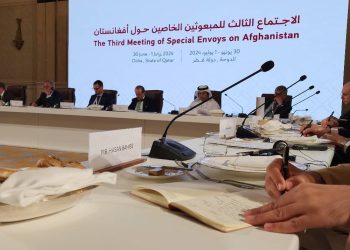
The third Doha meeting, hosted by the United Nations, concluded without the presence of women despite widespread protests from women, civil society organizations, human rights groups, and political activists opposed to the Taliban. Special representatives from 25 countries and five international organizations discussed private sector, banking, and counter-narcotics issues with Taliban representatives. The Deputy Secretary-General of the United Nations, who led this two-day meeting, described it as “positive” and stated that the participants raised the lifting of the ban on girls’ education as a top priority with the Taliban. The Taliban delegation described the meeting as “good and constructive” and showcased their promotional programs on countering narcotics to the participants. Meanwhile, women civil society, and human rights activists condemned the exclusion of women from the meeting and the UN’s approach as contradictory to the Universal Declaration of Human Rights, leading to widespread protests. Some women described the UN’s behavior as “Talibanic” and accused the organization of “silencing” women’s voices.
The two-day Doha meeting, hosted by the Deputy Secretary-General of the United Nations in Qatar, concluded yesterday. Participants discussed economic issues, counter-narcotics, the financial and banking system in Afghanistan, and support for the private sector with a focus on supporting women entrepreneurs.
In her closing speech at the third Doha meeting, Rosemary DiCarlo, Deputy Secretary-General of the United Nations, emphasized continued engagement with the Taliban. She expressed hope that the outcomes of this meeting would help create an open society in Afghanistan.
On Monday evening, July 1, DiCarlo told reporters that she hopes the presence of special representatives from various countries in the meeting and their engagement with the Taliban will lead to a more open and inclusive society in terms of governance and civil society participation in Afghanistan.
DiCarlo addressed the concerns of women and civil society in Afghanistan, stating that the United Nations would not reduce its role regarding women, civil society, and minorities in Afghanistan. She highlighted that the participating countries’ representatives raised the lifting of the ban on girls’ education as a top priority with the Taliban. She also described the ban on women’s education, employment, and studies as delaying Afghanistan’s development.
The Deputy Secretary-General of the United Nations claimed that the Doha meeting does not signify the normalization of relations or recognition of the Taliban. She emphasized that UN policy is to center decisions around the people, and women are part of the people of Afghanistan. She also mentioned that the meeting agreed on forming two working groups in the private sector and eradicating poppy cultivation.
Ms. DiCarlo said that the meeting also discussed the necessity of inclusive governance and respect for minority rights. She claimed that girls’ education is the world’s top priority and that the UN’s engagement with the Taliban will be step-by-step.
Meanwhile, the Afghanistan Freedom Front (AFF), in reaction to the third Doha meeting, called the meeting’s agenda selective and aimed at appeasing the Taliban. This front called for the implementation of UN Security Council Resolution 2721, including appointing a special representative for Afghanistan.
The Afghanistan Freedom Front stated in a press release that the humanitarian crisis, women’s rights, terrorism, and the appointment of a special representative for Afghanistan mentioned in the UN Security Council Resolution 2721 were absent from the third Doha meeting’s agenda. The front described the UN’s approach as contrary to its charter, stating that it questions the UN’s impartiality in Afghan affairs.
Zabihullah Mujahid, Taliban spokesperson and head of the group’s delegation at the third Doha meeting, expressed gratitude for the positions of representatives from Russia, China, Iran, Pakistan, Kazakhstan, Uzbekistan, Kyrgyzstan, Turkmenistan, and the United States, describing the meeting as “good.” He called on participants to focus on lifting all sanctions, removing restrictions on the private sector, and returning the frozen assets of Afghanistan’s central bank.
The Taliban spokesperson showcased promotional videos and claimed, “We have banned the cultivation, processing, and trafficking of poppy, which affected the world.” He called for assistance in providing alternative crops for farmers.
Mujahid claimed that “the main pillar of our foreign policy is economic orientation” in the region. He added that the Taliban has established relations with regional countries, demonstrating their “capacity and commitment” to establishing and maintaining these relationships.
Meanwhile, Canada’s Ministry of Foreign Affairs described the exclusion of women’s rights advocates, civil activists, and representatives of ethnic and religious groups as disappointing. The ministry stated that it had consulted with civil society groups and human rights advocates before the Doha meeting to reflect their concerns.
David Sproule, Canada’s special representative for Afghanistan, who attended the meeting, stated in a press release that he had conveyed this issue privately and publicly to the representatives of the countries. Canada urged the United Nations to promptly appoint a special envoy for Afghanistan with expertise in human rights and gender discrimination based on UN Security Council Resolution 2721.
The meeting concluded while women protesters, civil activists, and women’s rights advocates held widespread protests in various cities worldwide for the past month, urging countries to boycott the meeting.
Citizens protested in Canada, Germany, France, the Netherlands, Pakistan, Iran, and several other cities around the world, criticizing the UN’s current approach to the Taliban as normalizing relations and whitewashing the group.
However, some protesting women, who wished to remain anonymous in the report, described the UN’s approach at the Doha meeting as “Talibanic” in an interview with the Hasht-e Subh Daily. They stated that despite a month of protests by women and human rights organizations, the UN did not heed their voices, contradicting the Universal Declaration of Human Rights. According to them, the UN’s failure to respond to the civil and human rights demands of Afghan women and political forces has “silenced” their voices.
These protesting women argue that if the UN does not consider itself accountable to human rights values and advances based on the Taliban’s misogynistic policies, its actions will also be Talibanic.
You can read the Persian version of this daily report here:
پایان نشست سوم دوحه با برنامه تبلیغاتی طالبان؛ سازمان ملل صدای زنان را «خفه» کرد