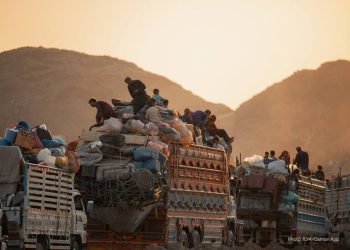
Residents of Kabul report that following the mass deportation of Afghan migrants from neighboring countries, particularly Iran, property owners have significantly increased housing rents. They note that the collective return of migrants has led to a surge in demand for housing, prompting many landlords to multiply rents, placing additional pressure on tenants. According to them, this situation, amid the current economic crisis, has made life even more challenging for low-income and vulnerable groups.
In interviews with the Hasht-e Subh Daily, these residents emphasize that they can no longer afford the current rent levels and have been forced to cut back on basic living expenses to cover them. They state that some families are even forgoing essential needs, such as proper nutrition for their children, to pay monthly rent. They urge the Taliban to impose strict oversight on the housing market, establish clear regulations, and prevent arbitrary rent increases to address this chaotic situation. The residents warn that without intervention, this crisis could lead to widespread and irreversible social consequences.
Raihana, a 32-year-old woman living with her three young children in a narrow alley in Kabul’s first district, complains about the exorbitant rise in house rents. She says her husband, a day laborer, has no stable income and often finds no work at all.
Raihana and her family have lived in a small mud house for over five years, previously paying 3,000 Afghanis monthly in rent. Now, the landlord, without any prior notice, has raised the rent to 7,000 Afghanis, stating, “Pay the rent or vacate the house.” She expresses her concern, saying, “Some days, my husband earns only 100 Afghanis. How can I pay 7,000? I have three children. If we’re evicted, where will we go? They should have some conscience and fear God.”
She calls on the Taliban’s Kabul municipality to closely monitor property owners to prevent low-income individuals from being harmed.
Zahra Hussaini, a resident of Kabul’s Pul-e Surkh area, says that after the large-scale return of migrants to the country, house rents have risen dramatically. She believes this trend has left many families unable to afford housing. She adds, “Rents have skyrocketed because of the returning migrants. People are coming from all directions, increasing demand for housing to the point that many can no longer afford it.”
Qurban Ali, a resident of Kabul’s fourth district, says finding a house in Kabul has become a serious challenge, with rents rising at an alarming rate. He adds, “People are facing severe problems in this regard. Houses are hard to find, and when they are available, the rent is beyond most people’s means.”
Criticizing the Taliban’s Ministry of Justice, Qurban Ali says, “Previously, the Ministry of Justice [under the Taliban] announced that people could file complaints about excessive rent increases, but in practice, no action has been taken, and no attention has been paid to the rising cost of housing.”
He notes that currently, the rent for a three-room house in Kabul exceeds 15,000 Afghanis, and two-room houses are rarely found for less than 10,000 Afghanis. According to him, this situation began with the deportation of Afghan migrants from Pakistan and intensified with the return of migrants from Iran, leaving many families struggling with housing shortages.
Many families who previously rented small houses for 3,000 to 7,000 Afghanis are now forced to pay over 10,000 to 15,000 Afghanis for the same properties. This staggering increase has pushed thousands of laborers, retirees, and low-income families to the brink of economic and humanitarian collapse.
Abdul Rauf, who returned to Kabul a few weeks ago with his wife and three children after seven years of working as a laborer in Mashhad, Iran, was detained and deported by Iranian police during the recent wave of migrant expulsions.
This returnee says he is temporarily living with relatives in a house in western Kabul’s outskirts. Complaining about the current situation, he says, “I’ve searched extensively for a house. Everywhere I went, they said the rent is 15,000 to 20,000 Afghanis. I have no job, no money. The rent is beyond my means.”
Abdul Rauf says that in Iran, despite the hardships, he could provide food for his family, but now in his own country, he feels helpless: “We returned to our homeland, but we have nowhere to stand. I search for work every day, and at night, I can’t sleep thinking about rent and food.” He is one of thousands of migrants who, after being forcibly returned to Afghanistan, are grappling with housing crises, unemployment, and an uncertain future.
Masuma, another Kabul resident, says her sister is set to return from Iran to Kabul next week. She adds that in recent days, she has made significant efforts to find suitable housing for her sister but has been unsuccessful. According to Masuma, houses that were previously rentable for 2,000 to 3,000 Afghanis now cost 5,000 to 6,000 Afghanis. She expresses concern about this situation, stating, “With this trend, securing shelter for returning families is becoming increasingly difficult.”
Several real estate agents in Kabul say that over the past three to four months, house rents in the city have risen significantly.
Fazlur Rahman, a real estate agent in Kabul, says, “Three- or four-room apartments that were previously rented for 6,000 to 10,000 Afghanis are now being rented for 15,000 to 20,000 Afghanis.”
He adds, “In areas like Qala-e Fatullah, Taimani, Khairkhana, Sheikh Zahed Township, Mimaar-e Shahr, and Khwaja Rawash (Qasaba), the rent for small houses has also increased. Houses that were previously rented for 3,000 to 4,000 Afghanis are now rented for 7,000 to 10,000 Afghanis.”
Fazlur Rahman says their clients include both migrants and local families, but most inquiries come from migrant families. He emphasizes that finding two- or three-room houses in these areas has become very difficult.
These complaints have surged while the Taliban’s Ministry of Justice has asked citizens to file complaints against landlords for excessive rent increases.
The ministry had announced that landlords who raise rents compared to the previous year would be held accountable. It also warned via a post on X that real estate agencies charging commissions above the set limit would be referred to judicial authorities.
You can read the Persian version of this report here:
اخراج اجباری مهاجران و بیکفایتی طالبان؛ افزایش کرایه خانهها و بحران مسکن در کابل